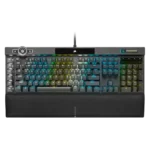
Corsair K100 RGB Feature Scores
Explore all 47 feature scores for Corsair K100 RGB, organized into pros and cons.
Scores by Feature
Summary
47 reviewed features-
Very positive 4.5-5.020 (43%)
-
Positive 3.5-4.417 (36%)
-
Neutral 2.5-3.46 (13%)
-
Negative 1.5-2.43 (6%)
-
Very negative below 1.51 (2%)
Pros
Sort
-
The wrist rest is broadly praised as comfortable, cushioned, magnetic, and much improved over earlier Corsair rests, with only minor firmness or branding complaints.
-
RGB lighting quality is one of the most consistently praised areas, with reviewers calling it vibrant, bright, clear, excellent, and visually premium.
-
Gaming performance is widely praised as fast, smooth, and confidence-inspiring, with some reviewers reporting better responsiveness or a noticeable improvement in games.
-
Reviewers consistently describe the OPX or Speed linear switches as fast, smooth, and satisfying, though a few note the sensitivity takes adjustment and the feel is not for everyone.
-
Design aesthetics are widely praised as premium, sleek, gorgeous, luxurious, or visually impressive, with the RGB-heavy look occasionally framed as busy.
-
Macro customization is a major strength, with reviewers praising G keys, Stream Deck integration, on-the-fly macro recording, and broad remapping possibilities.
-
Materials quality is praised for aluminum, premium feel, strong construction, and top-quality components.
-
The double-shot PBT keycaps are praised for feel, texture, clean looks, durability, and bright/crisp legends, though one review criticizes the included replacement caps as less durable.
-
Build quality is usually described as premium, sturdy, solid, or excellent, but one Tom's Hardware sample left concerns because of magnet and key issues.
-
The volume wheel is a highlight, repeatedly praised for smoothness, premium feel, strong resistance, and better feel than some competitors.
-
The keyboard is repeatedly praised for very fast, sensitive, and responsive inputs, with several reviewers describing immediate or lightning-fast key response.
-
Frame rigidity receives excellent marks from reviewers who report no frame flex or only minimal flex.
-
Typing feel is generally strong once acclimated, with praise for fewer typos and satisfying keys, though PCMag initially found the keys uncomfortable.
-
Onboard memory is praised as unusually large or impressive, especially the ability to store many profiles and lighting layers on the keyboard.
-
Key stability receives strong praise from reviewers who note almost no tilt, no rattle, and no flex or wobble in the keys.
-
Customization options are extremely broad across lighting, keys, macros, and wheel functions, but reviewers often warn that configuring them takes effort.
-
Latency impressions are mostly positive in real use, including reports of no lag or instant action, but some reviewers question whether the sub-millisecond gains are perceptible.
-
Legends are praised as sharp, clean, bright, and well illuminated, with reviewers appreciating the less gamer-heavy font and full legend visibility.
-
RGB customization is considered extensive, with praise for per-key control, many lighting zones, and deep reworking options, though software complexity can slow the process.
-
Layout options improve because reviewers appreciate the standard bottom row and easier compatibility with aftermarket keycap sets.
-
Durability evidence focuses mainly on PBT keycaps and materials that reviewers say resist wear or hold up better over time.
-
Media controls are mostly praised for dedicated keys, a metal scroll wheel, and usable feedback, although some buttons feel odd or less satisfying.
-
Acoustics are mixed: several reviewers like the smoother or more satisfying sound, while ProSettings complains about hollow, resonating, loud keys.
-
Ergonomics are generally good due to comfort and wrist support, though some reviewers want a better wrist angle or note the large full-size layout.
-
Per-key lighting control is positively noted in reviews that appreciate the individual key lighting and access to the keyboard's 44 lighting zones.
-
Passthrough features are generally appreciated as a useful luxury or handy extra, though cable routing is not universally ideal.
-
Stabilizer quality is viewed as improved, with praise for better sound and less rattle, though one reviewer still found some wobble and rattling.
-
Extra gaming features are polarizing: reviewers praise the G keys and control wheel potential, but several call the wheel limited, janky, or not very useful in games.
-
The 4,000Hz polling rate is seen as technically impressive and future-facing, yet many reviewers say the practical difference from 1,000Hz is subtle or hard to notice.
-
Actuation consistency is supported by IGN's report that there were no response or press issues during fast gaming use.
-
Backlight brightness is strongly praised where mentioned, especially by reviewers who call the lighting impressively bright.
-
Sound dampening is praised most strongly by KitGuru, which finds the K100 noticeably more muted and less resonant than its predecessor.
-
Reliability is mixed: optical switches are praised for avoiding chatter and missed inputs, but one reviewer experienced keyboard freezing and shutoff.
-
Profile management is capable but can be overwhelming; reviewers praise large onboard profile capacity while noting the profile system can become complex.
-
Compatibility receives positive evidence from iCue recognizing another Corsair device, suggesting useful ecosystem integration.
-
Key spacing is mixed, with praise for standard bottom-row spacing but complaints that the left G keys can cause reaches or accidental presses.
-
Connectivity gets positive marks for USB passthrough as a handy extra, though the wired-only setup and thick cable remain contextual limitations.
Cons
Sort
-
Portability is poor because reviewers emphasize the K100's size, weight, full-size layout, and non-detachable cable as desk-bound traits.
-
Hot-swappable switches score poorly because the one opinionated mention treats the lack of hot-swap support as a drawback.
-
Size and form factor are a limitation for reviewers who describe the K100 as large, full-size, and demanding of desk space.
-
Desk space efficiency is weak because multiple reviewers mention a massive footprint or the need to sacrifice room for the keyboard and wrist rest.
-
Switch choice is viewed as limited because reviewers mention OPX and Cherry MX Speed variants, while one reviewer explicitly disliked the lack of a tactile option.
-
Cable quality is mixed: reviewers call the cable sturdy, thick, and braided, but fixed and non-detachable design hurts convenience.
-
Noise level is divided: some reviewers call the board loud or drastically louder than quieter keyboards, while others find the sound pleasant or less distracting.
-
Software quality is the most divisive area, combining deep iCue functionality with repeated complaints about clunkiness, confusing workflows, and tedious setup.
-
Typing comfort is mixed: some find the K100 comfortable after adjustment, while others call the sensitive switches unforgiving or not for all typists.
-
Value for money is highly conditional: reviewers like the premium feature set but repeatedly warn that the high price only makes sense if the extras are used.