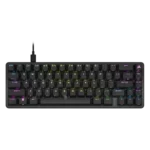
Corsair K65 PRO Mini Feature Scores
Explore all 49 feature scores for Corsair K65 PRO Mini, organized into pros and cons.
Scores by Feature
Summary
49 reviewed features-
Very positive 4.5-5.020 (41%)
-
Positive 3.5-4.418 (37%)
-
Neutral 2.5-3.49 (18%)
-
Negative 1.5-2.42 (4%)
Pros
Sort
-
Responsiveness was one of the strongest themes, with reviewers repeatedly describing the keyboard as direct, fast, snappy, and highly responsive in use.
-
Build quality was a major strength across reviews, with repeated praise for the sturdy, premium-feeling construction.
-
Reviewers consistently liked the OPX switches for their fast, smooth, light feel, though one noted they are still restricted to Corsair’s switch ecosystem.
-
Acoustics were one of the strongest wins, with reviewers repeatedly saying the board sounded pleasant, rich, or unusually good for a gaming keyboard.
-
The 65% layout earned strong praise for keeping arrow/navigation keys and useful functions while avoiding much of the adjustment pain of smaller boards.
-
Typing feel was mostly praised as satisfying, smooth, and pleasant, with only lighter caveats around sensitivity and one first-impressions review calling it merely acceptable.
-
Gaming performance was strongly positive, especially for fast FPS play and compact desk setups, thanks to optical switches and the 65% layout.
-
Sound dampening was generally praised for reducing ping and harshness, though one reviewer felt the internal foam did not do much.
-
Reviewers liked the desk-space savings, especially for gaming, while still retaining enough functionality.
-
The PBT keycaps were repeatedly praised for texture, grip, durability, and a premium feel compared with lower-grade caps.
-
RGB customization was a strength, with reviewers praising iCUE presets, effects, and the breadth of lighting options.
-
The frame was praised for sturdiness, minimal flex, and a solid aluminum-topped feel.
-
RGB lighting was broadly liked for its crisp, vibrant, stylish look, although a few reviewers found it dimmer or weaker than predecessor models.
-
Media controls were praised as easy to access through the Fn layer and useful despite the compact layout.
-
Extra functions such as lit Fn layers, mouse controls, and onboard shortcuts were valued as practical gaming/utility aids.
-
Customization was broadly positive, covering shortcuts, key remapping, RGB, macros, and hardware-level control.
-
Macro customization was a strength, with reviews praising extensive assignments and easy macro setup.
-
Per-key lighting control was viewed positively, with reviewers highlighting thorough per-key behavior and smooth movement across the keys.
-
Key spacing was praised for avoiding a cramped feel and helping fingers move accurately across the compact deck.
-
Latency was praised where discussed, especially in reviews that emphasized the wired connection and very low-latency behavior.
-
The compact form factor was praised as easy to adjust to and effective as a small-board offering.
-
Actuation was fast and often accurate, but the very sensitive switches created a split: some saw rare or no accidental presses, while others reported mistakes.
-
The detachable braided USB-C cable was received positively for portability and convenience.
-
Value was mixed: reviewers liked the quality and performance, but many questioned the $130 price given missing wireless, wrist rest, or broader features.
-
Design was generally liked for its clean, compact look and RGB accents, though some wanted more style or colorway variety.
-
Legends and secondary labels were usually easy to see, though one review noted a few blurry spots in the lighting/legend presentation.
-
Noise was viewed as controlled and pleasant rather than silent, with multiple reviews saying it was quieter or smoother than expected.
-
Durability evidence centered on the stronger aluminum frame and PBT keycaps designed to resist long-term wear.
-
Materials were received well, especially the aluminum plate and higher-quality PBT plastic.
-
Onboard memory was valued because it lets users save settings locally and avoid keeping software running.
-
Profile handling was praised for onboard profile storage and the ability to configure many setups.
-
Portability was helped by the light compact body and detachable cable, though wireless absence limited the upside.
-
Software reactions were mixed, ranging from clean and easy iCUE setup to clunky behavior, crashes, complexity, and frequent-update complaints.
-
Volume control was praised for placement that made it easy to manipulate with one hand.
-
Backlighting was bright enough for low-light use and described as vibrant, with only minor caveats about presentation.
-
Switch/stabilizer access was considered possible and useful for manual tuning, though not fully tool-free or broadly compatible.
-
Key stability was generally good, helped by stabilizers, though one reviewer noted bounce or looseness in the small layout.
-
Typing comfort was positive for one reviewer using the OPX switches but another found typing less satisfying than gaming.
Cons
Sort
-
Reviewers repeatedly wished a wrist rest were included, especially given the height and price.
-
Wireless received a low score because reviewers framed the absence of wireless connectivity as a missed opportunity.
-
Hot-swap support was a weakness overall: reviewers mostly pointed to missing or limited switch customization, despite one review noting some PCB flexibility.
-
Passthrough was a limitation because one reviewer said USB passthrough would have improved portability.
-
Switch choice was a limitation: reviewers liked the OPX feel but noted the narrow proprietary switch path for buyers who want broader switch variety.
-
Compatibility is broad on paper, but one reviewer found wired console use awkward enough to hurt the experience.
-
Stabilizers were mixed: some reviewers found them acceptable or smooth, while others called out spacebar rattle and the need for tuning.
-
Connectivity was mixed: reviewers liked standard USB-C plug-and-play behavior, but repeatedly criticized the lack of wireless and one noted 8,000Hz connection issues.
-
Reliability was mixed: one reviewer had no drops or response issues, while others experienced accidental commands or inputs.
-
The 8,000Hz polling rate impressed on paper, but reviewers often found it hard to notice and one had to reduce it after connectivity problems.
-
Ergonomics were mixed: some liked the feet and angle, while others wanted more adjustment or found the tall compact body uncomfortable.