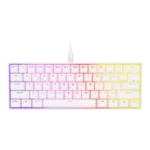
Corsair K65 RGB MINI Feature Scores
Explore all 45 feature scores for Corsair K65 RGB MINI, organized into pros and cons.
Scores by Feature
Summary
45 reviewed features-
Very positive 4.5-5.010 (22%)
-
Positive 3.5-4.418 (40%)
-
Neutral 2.5-3.412 (27%)
-
Negative 1.5-2.45 (11%)
Pros
Sort
-
Desk space efficiency was one of the clearest strengths, especially for mouse movement and compact setups.
-
RGB lighting quality was one of the strongest areas, repeatedly praised as bright, vibrant, attractive, and well supported by the white plate.
-
The compact 60% form factor was broadly praised for small size, portability, and fitting tight spaces.
-
Software quality was a strong point overall, with reviewers praising iCUE's customization depth, clearer interface, and hardware/software profile support.
-
Keycap quality was a consistent strength, with praise for textured doubleshot PBT, durability, and clean shine-through in many reviews.
-
Responsiveness was consistently strong, with reviewers describing fast actuation, precise input, and satisfying keypresses for gaming.
-
RGB customization was strongly praised for onboard effects, iCUE layers, per-key control, and flexible lighting profiles.
-
Customization options were repeatedly praised as broad and deep, covering lighting, assignments, profiles, and onboard controls.
-
Gaming performance was generally positive, especially for FPS use and mouse space, though some reviewers found it ordinary or less suitable for shortcut-heavy games.
-
Onboard memory was a clear strength, letting reviewers store profiles, macros, lighting, and assignments for use across computers.
-
Per-key lighting control was well received, with reviewers praising granular illumination and layered customization.
-
Build quality was mixed: several reviewers found it sturdy or well constructed, while others felt the plastic case hurt perceived value.
-
Frame rigidity was praised where tested, with reviewers noting a solid frame and little or no flex.
-
Backlight brightness earned positive marks, with reviewers praising vivid output and good white/light performance despite minor color caveats.
-
Durability feedback centered on the PBT keycaps, which reviewers expected to resist shine, wear, and abuse.
-
Macro customization was praised for onboard recording, iCUE assignment, and the ability to save functions without always using software.
-
Portability was a strong fit for the board's small footprint, detachable cable, and travel-friendly profile storage.
-
Stabilizers improved over past Corsair boards and were often described as decent or good, though not always premium.
-
Extra gaming features were viewed as solid, including mouse controls, firmware layers, NKRO-style gaming functions, and 8,000Hz marketing features.
-
Profile management was powerful but not always simple, with praise for travel-ready profiles and criticism of complicated hardware-profile handling.
-
Typing feel ranged from excellent to compromised, depending on switch variant and tolerance for bottoming out or compact-layout adjustment.
-
Reviewers split on the linear Cherry switches: many praised smoothness and satisfaction, while several disliked scratchiness, Speed switch harshness, or the absence of Corsair's optical option.
-
Key spacing was praised because the compact layout did not feel compressed and maintained comfortable distances.
-
Connectivity was praised around detachable USB-C convenience and easier travel use.
-
Media controls were considered useful and reachable despite being secondary-layer functions.
-
One review found no key chatter in testing, supporting good actuation consistency on the working sample.
-
Volume control was praised as easy to reach through the secondary media controls.
-
Compatibility was mostly positive for Corsair ecosystem users and supported platforms, though console use lacked iCUE support.
Cons
Sort
-
Acoustics were a recurring weakness, with pinging, hollow resonance, reverberation, and metallic tones appearing across many reviews.
-
Sound dampening was weak or absent, with reviewers noting hollow space, no internal dampening, and case resonance.
-
Noise level was a common complaint: some found the board less intrusive than expected, but most cited loudness, scratchiness, or hollow sound.
-
Hot-swappable switches were a weakness because reviewers wanted the feature and noted the switches were soldered.
-
Materials quality was the main physical compromise, with repeated criticism of plastic construction, sharp edges, scratch risk, and entry-level feel.
-
Latency benefits were mostly judged theoretical: a few noted fast signaling, but most found the polling-rate advantage hard or impossible to feel.
-
Ergonomics were mixed-to-negative because of fixed height, no angle adjustment, awkward shortcut reaches, and no incline options.
-
Switch replacement ease was poor, with soldered switches making aftermarket modifications difficult.
-
The 8,000Hz polling rate drew attention but mixed-to-negative usefulness judgments, with reviewers often calling it imperceptible or a paper spec.
-
Layout options were highly context-dependent: reviewers liked the rich function layers but criticized the learning curve, awkward arrows, and strange secondary placement.
-
Value was one of the most debated areas, with reviewers praising competitive pricing versus some rivals but criticizing price against cheaper or more feature-rich alternatives.
-
Switch options were viewed as serviceable but limited, with reviewers noting linear Cherry choices while questioning the lack of OPX/optical or broader options.
-
Legend visibility was divisive: one review criticized clarity, while another praised the sharply defined legends.
-
Reliability evidence was mixed: one review expected reliable inputs, while another received an initial defective sample before replacements worked.
-
Typing comfort varied widely, from comfortable bottoming-out for some to mispresses, heavy-typing fatigue, and typo-prone adjustment for others.
-
Cable quality was mixed: detachable and convenient for travel, but some reviewers disliked stiffness, braiding, or kinking.
-
Design aesthetics were mixed: reviewers liked the compact look, spacebar, and lighting, but some found it plain, cluttered, bland, or hurt by odd physical decisions.