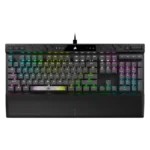
Corsair K70 MAX Feature Scores
Explore all 48 feature scores for Corsair K70 MAX, organized into pros and cons.
Scores by Feature
Summary
48 reviewed features-
Very positive 4.5-5.015 (31%)
-
Positive 3.5-4.420 (42%)
-
Neutral 2.5-3.410 (21%)
-
Negative 1.5-2.43 (6%)
Pros
Sort
-
Customization was one of the strongest themes, with reviewers praising granular actuation, RGB, profiles, and per-key tuning depth, despite some software caveats.
-
Key responsiveness was a major strength, often described as instant, flawless, precise, or extremely rapid.
-
Build quality was widely praised as solid, premium, rock solid, or excellent, though one reviewer felt it was merely okay for the price.
-
Wrist rest quality was one of the strongest consensus positives, widely praised as plush, comfortable, magnetic, soft, or a major improvement.
-
Gaming performance was usually excellent, especially for responsiveness and configurability, though a few reviewers said it did not transform their play.
-
RGB customization was consistently strong, with reviewers praising layered effects, per-key color control, and broad iCUE lighting options.
-
Switch feel was generally praised as smooth, friction-free, and satisfying, though a few reviewers found it merely fine or rattlier than normal.
-
Latency performance was mostly praised, especially with fast polling and instant-feeling registration, though some reviewers framed the highest settings as niche.
-
Keycap quality was mostly praised for thick, durable PBT construction, but texture and RGB masking drew a few complaints.
-
Extra gaming features were praised for dual actuation, tournament mode, and magnetic-switch tricks, but several reviewers found some features niche or hard to use in games.
-
Typing comfort was often good thanks to the wrist rest and smooth keys, but fatigue and loudness made it less ideal for some long typing sessions.
-
Frame rigidity was usually a strength, with reviewers reporting a solid aluminum frame or no flex, aside from one more moderate build assessment.
-
Durability received strong marks from reviewers who praised the tough frame, robust keycaps, and drop survival.
-
Media controls were usually appreciated, especially dedicated keys, though one reviewer found some buttons stiff or spongy.
-
RGB lighting quality was mixed but leaned positive, with bright, crisp, or superb shine-through offset by one reviewer’s disappointing uniformity complaint.
-
Design aesthetics ranged from gorgeous, refined, and sleek to dated or too plastic-looking depending on the reviewer.
-
Ergonomics were generally helped by the desk stability, soft palm rest, and incline, though the evidence focused on comfort rather than compactness.
-
Software quality was polarizing: several reviewers found iCUE powerful, clear, or easy enough, while others called it messy or harder than it should be.
-
Polling rate evidence was positive for responsiveness in some reviews, but others said 8,000Hz was unnoticeable or not worth the resource tradeoff.
-
Actuation consistency drew praise when reviewers described the switches as consistent and tunable, though evidence was limited to a few reviewers.
-
Per-key lighting control was praised where reviewers highlighted individually coloring keys, buttons, and icons.
-
Sound dampening was improved over some Corsair boards and praised by several reviewers, but others said it was insufficient for the price.
-
Backlighting was generally bright enough, with reviewers calling out bright RGB and visible lighting through the keycaps.
-
Macro customization was supported by onboard recording and flexible assignments, though evidence was not as extensive as general customization.
-
Typing feel was highly divided: some reviewers loved the smooth, comfortable feel, while others found it aggressive, clunky, or not best-in-class.
-
Materials quality was usually positive because of aluminum and premium finishes, but some reviewers felt the finish looked plastic or should have used more metal.
-
Volume control was generally praised for the dedicated wheel or premium roller feel, though one reviewer disliked the separate mute-button layout.
-
Cable-related comments were mixed: reviewers liked the removable or braided cable and routing, but one criticized wobble at the port.
-
Reliability evidence was limited but very positive where Hall-effect sensing was described as highly reliable.
-
Connectivity evidence was narrow but positive where the wired connection was described as reliable.
-
Ease of switch replacement had limited but positive evidence from one reviewer who valued being able to swap switches if they fail.
-
Hot-swappability had limited positive evidence from one reviewer who called it a major bonus for serviceability.
-
Rapid Trigger support was treated as useful but not decisive; reviewers saw promise, but some noted timing, uniqueness, or practical-use caveats.
-
Compatibility evidence centered on iCUE being one of the few peripheral apps noted as macOS compatible.
-
Onboard memory had limited positive evidence, with one reviewer finding the number of onboard profiles more than most users need.
Cons
Sort
-
Desk-space efficiency was consistently weak because the full-size-plus body and wrist rest take a large amount of desk room.
-
Noise level was the most common concern: many reviewers called the keyboard loud, clacky, rattly, or not quiet despite some exceptions.
-
Portability was weak because reviewers found the heavy full-size board unsuitable for carrying around.
-
Size and form factor were a drawback for many reviewers because the keyboard is chunky, full-size, and large-footprint.
-
Stabilizer quality was a frequent weak point, especially around spacebar rattle or dry stabilizers, with only mild praise in one review.
-
Key stability was a recurring weakness in negative reviews, with rattliness, wobble, or moving keycaps mentioned.
-
Wireless performance scored poorly because one reviewer treated the lack of wireless capability as a major downside for casual users.
-
Analog-style capability was treated as limited; one reviewer noted the K70 Max lacks more advanced analog movement found elsewhere.
-
Switch options were weak because one reviewer specifically disliked the lack of tactile or clicky alternatives.
-
Profile management was mixed: one reviewer liked setting up profiles, while another criticized iCUE for not saving changes properly.
-
Legend visibility was mixed: some reviewers praised vibrant shine-through, while others found certain legends dim or hard to read.
-
Acoustic impressions split sharply: some reviewers liked the snappy or satisfying sound, while others called the board poor, unpleasant, or terrible sounding.
-
Value for money was the most divided category, with some reviewers calling it worth the premium and others saying cheaper competitors make it hard to justify.