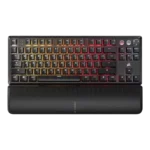
Corsair K70 PRO Feature Scores
Explore all 51 feature scores for Corsair K70 PRO, organized into pros and cons.
Scores by Feature
Summary
51 reviewed features-
Very positive 4.5-5.014 (27%)
-
Positive 3.5-4.425 (49%)
-
Neutral 2.5-3.49 (18%)
-
Negative 1.5-2.43 (6%)
Pros
Sort
-
Key responsiveness scored strongly across gaming-focused reviews, with repeated praise for fast, precise inputs and reliable command registration.
-
Gaming performance was one of the strongest areas, with many reviewers calling the keyboard fast, accurate, responsive, and excellent in real gameplay.
-
RGB customization was a major strength, with reviewers praising iCUE control, layers, profiles, individual color control, and broad lighting flexibility.
-
Volume control was a standout positive, with reviewers repeatedly praising smooth, grippy, accurate, tactile, or notchy rollers and knobs.
-
Onboard memory was repeatedly praised for storing profiles, lighting layers, macros, and settings directly on the keyboard.
-
Profile management was a strength, with repeated praise for onboard profiles, game/typing setups, and saved settings without running software.
-
Keycap quality was usually praised for PBT material, durability, texture, and legends, though one TKL review criticized ABS caps as cheap.
-
Build quality was mostly praised for solidity and premium feel, though some reviews flagged simplicity, ping-related build concerns, or cost-cut corners.
-
Design aesthetics were generally praised for clean, simple, sleek styling, though a few reviewers found brushed aluminum or generic gaming looks less exciting.
-
Cable quality was a clear positive, with reviewers liking detachable USB-C, premium braided feel, useful length, and easier transport.
-
RGB lighting quality was praised for vivid lighting, accurate whites, strong reflections, and daytime visibility, with one Mini Wireless review finding LEDs dim.
-
Reliability was strong in full-size reviews, with praise for no dropped keystrokes or lag, though one TKL review noted early system-specific issues.
-
Switch selection was a consistent strength, with reviewers praising the range of Cherry MX options, though one review noted that some versions offered fewer variants.
-
Software quality was generally positive, with iCUE praised for depth and control, though some reviewers found it confusing, heavy, or occasionally frustrating.
-
Media controls were mostly praised for convenience, dedicated buttons, and immediate usefulness, though one TKL review found the buttons unresponsive.
-
Reviewers generally liked the Cherry MX and Hall-effect switch feel, praising smoothness and responsiveness, though some called Speed switches too sensitive, mixed switches distracting, or certain switches rough.
-
Rapid trigger support was treated as a real competitive feature, especially for Hall-effect TKL models, though reviewers also noted the risk of accidental inputs.
-
Macro customization was praised for easy recording, remapping, and programmable keys, though one reviewer wished for dedicated macro keys.
-
Extra gaming features were useful to many reviewers, especially Tournament/Game Mode, though some called Tournament Mode niche or unnecessary.
-
Durability evidence centered on PBT keycaps and legends, which reviewers expected to resist wear, shine, and fading.
-
Wrist rest quality varied widely, from very comfortable and secure to gross-feeling, loose, or intrusive depending on reviewer and model.
-
Typing comfort was mostly positive when reviewers discussed comfortable keycaps, wrist support, and long typing sessions.
-
Frame rigidity was usually strong, with many reviewers noting little or no flex, though one review found more flex than expected.
-
Value for money was heavily mixed: many reviewers justified the premium price, while others called it high, only reasonable, or poor against alternatives.
-
Latency impressions were positive in several gaming reviews, but some reviewers said the measurable gains were too small for humans to feel.
-
Typing feel ranged from excellent and breezy to merely adequate or underwhelming, with sound and switch choice strongly shaping the experience.
-
Legend visibility was mostly positive thanks to crisp fonts and durable legends, but a few reviews disliked indicator visibility or reduced RGB shine-through.
-
Materials quality was praised where reviewed, especially for brushed aluminum, solid plastic, and a premium-feeling chassis.
-
Compatibility was mostly positive for PC, Mac, Linux, Xbox, and multi-device use, though PS5 support was criticized elsewhere in the source.
-
Portability evidence was positive when detachable cables, onboard profiles, or lighter TKL construction made travel or moving easier.
-
Actuation consistency was praised in mechanical-switch testing, but mixed Hall-effect and mechanical switch coverage created a more uneven feel in one TKL review.
-
Layout options evidence was positive but limited, covering useful full-size gaming benefits and alternative layout support through software.
-
Per-key lighting control had limited but positive evidence, with one review emphasizing individual key color programming as part of the keyboard’s main appeal.
-
Backlight brightness evidence was limited but positive, with reviewers finding it visible without becoming distracting.
-
Customization options were strong overall, especially on Hall-effect TKL models and iCUE, but some reviews saw limits from mixed switch coverage or brand software.
-
Size and form factor evidence was mixed: some liked the standard full-size layout, while others preferred smaller boards.
-
Connectivity was praised for easy wired plug-and-play and USB-C, but several reviewers disliked the lack of wireless choice.
-
Key spacing had limited evidence, with one review saying the keys were well spaced despite some wobble.
-
Key stability had limited evidence; the one scored review found some wobble but said it was not distracting in normal use.
Cons
Sort
-
Ease of switch replacement was criticized where switches were not hot-swappable, requiring soldering or whole-keyboard replacement for failures.
-
Hot-swappable switch support was a major split: some models finally offered it, while many Pro/RGB Pro reviews criticized the lack of hot-swap repairability.
-
Sound dampening drew criticism when silicone layers or internal design failed to control ping, though one TKL review said silicone helped.
-
Passthrough features were a weakness, with reviewers missing built-in USB passthrough from earlier or competing keyboards.
-
Acoustics were one of the most mixed areas, with praise for low ping in one review but repeated complaints about hollow sound, harsh clacking, or ping.
-
Battery life had limited evidence from the Mini Wireless review, where RGB-on runtime was criticized as poor.
-
The 8,000Hz polling rate divided reviewers: some noticed benefits in gaming, while many called it unnoticeable, unnecessary, or only marginally useful.
-
Wireless performance was mostly a limitation for wired models, though the Mini Wireless evidence reported no wireless signal issues.
-
Stabilizer quality was mixed: some reviews found little rattle or a strong spacebar, while others complained about ping, rattle, or inconsistent lube.
-
Noise level depended heavily on switch choice and board acoustics, with quiet Red-switch praise balanced by noisy, clicky, and ping-heavy complaints.
-
Desk space efficiency was context-dependent; stable rubber feet helped, but some reviewers noted sliding feet or full-size bulk.
-
Ergonomics were mixed, with comfortable angle options and wrist slopes offset by palm-rest interference in one review.