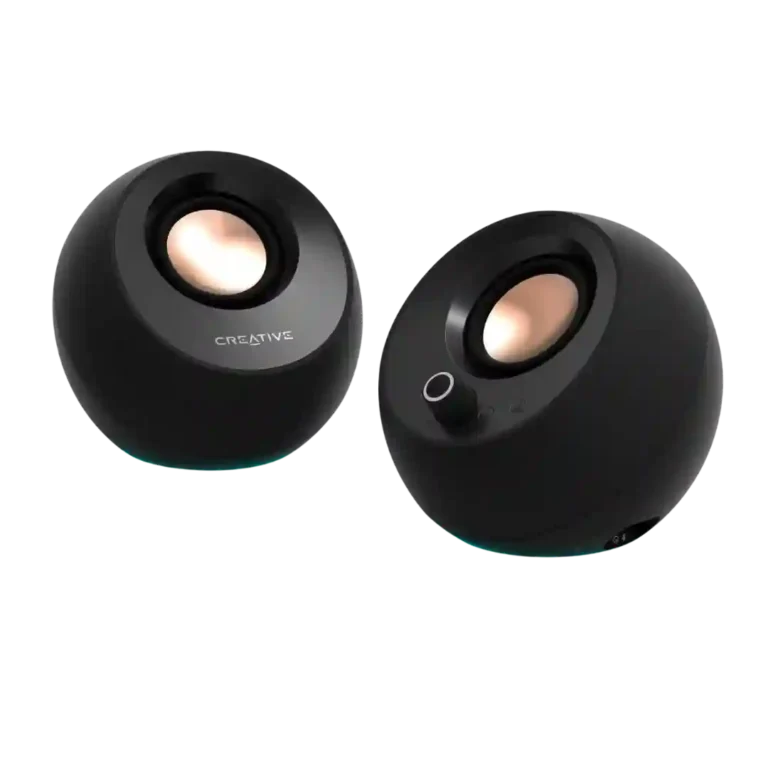
Choose these for clear, compact desktop sound, easy inputs, and standout value. Skip them if you need deep bass, room-filling volume, flawless USB/Bluetooth reliability, or a power adapter in the box.
Best for
Best for small desks, offices, dorm rooms, and compact gaming setups needing clear everyday music, dialogue, calls, and video without spending much.
Not for
Not ideal for bass-heavy listening, large-room playback, a completely cable-free desk, or buyers who need flawless USB and Bluetooth behavior across every computer.
Verdict
Creative Pebble Pro makes its strongest case as a compact, affordable upgrade over laptop and monitor speakers. Reviewers repeatedly praise its clear vocals, crisp detail, stereo separation, small footprint, flexible USB, aux, and Bluetooth inputs, and tasteful RGB lighting. With a 30W USB-C PD adapter, many hear a meaningful jump in loudness and bass punch. The tradeoff is consistency: deep bass remains limited, the app and EQ options are weak, the fixed inter-speaker cable complicates clean desks, and a minority report USB or Bluetooth dropouts, power quirks, static, or early failures. It is a capable near-field system for everyday music, video, calls, and gaming, but not a substitute for larger powered speakers or a subwoofer-backed setup.
One customer reports very long battery life, but no other source evaluates portable battery endurance. This isolated claim is not enough to establish a consistent pattern.
Clarity and fine detail are standout qualities, with voices, instruments, and small audio cues often sounding cleaner and sharper than expected. A few critical listeners still hear muddiness or limited resolution.
The compact footprint fits crowded desks, offices, dorm rooms, and small apartments especially well. It can fill a modest room for casual listening, but it is most consistent at close range.
Most buyers describe a quick plug-and-play installation with several connection choices. Tiny instructions, unclear indicators, and platform-specific connection issues make setup frustrating for a minority.
Bluetooth connectivity: 4.1, 14 reviews, low consensus
Bluetooth adds welcome flexibility for phones and computers, and switching is easy for many users. Some systems require extra troubleshooting, manual reconnection, or a separate Bluetooth adapter.
Most owners hear a clear, surprisingly full upgrade over laptop or monitor speakers, especially for the price. A smaller group finds the tuning merely average or disappointing.
Dialogue is one of the clearest strengths, with calls, movies, videos, and tutorials coming through cleanly. This makes the set especially useful for work desks and casual viewing.
Adequate USB-C PD power gives the speakers noticeably more punch, scale, and bass authority. Running only from a low-power computer port can leave them sounding restrained.
USB-C power and data are convenient, flexible, and easy to integrate with modern computers. The higher-power USB-C PD path is especially useful, although the required adapter is not included.
Price-to-performance is the product's clearest strength, with many buyers calling it hard to beat for compact desktop sound. Weak bass, power-adapter costs, or reliability problems reduce the value for some owners.
The overall presentation is usually smooth, balanced, and immersive enough for desktop use. It remains a compact near-field system rather than a full-range replacement for larger speakers.
Spoken voices usually sound crisp and intelligible, making the speakers well suited to calls, narration, tutorials, and podcasts. A few listeners still prefer headphones for very fine editing.
Design and aesthetics: 3.7, 86 reviews, low consensus
The compact spherical shape and RGB accents look modern to many buyers, but the dark green finish is highly polarizing. Some also find the plastic cheap-looking or the speakers bulkier than the minimalist branding suggests.
Frequency response balance: 3.7, 35 reviews, low consensus
Mids, vocals, and general balance are common strengths, while the treble can sound dull and the low end ranges from thin to boomy. Several listeners improve the tuning with software EQ.
These are near-field speakers that sound best aimed toward a listener at the desk. Room-filling performance varies, and both volume and tonal quality can drop with distance or poor positioning.
The RGB rings are generally praised as subtle, attractive, and easy to turn off. Controls are basic, and a few users report stuck LEDs, failed colors, nighttime glow, or colors that clash with the green shell.
Loudness / maximum volume: 3.6, 49 reviews, low consensus
Near a desk, many users find the volume more than adequate, particularly with a 30W USB-C PD adapter. Others say USB-only output is restrained and reaches normal listening levels only near the top of the volume range.
Bass is the biggest tradeoff: mid-bass can be surprisingly punchy with proper power and placement, but deep bass is limited and opinions vary widely. Listeners seeking real low-end weight will want a subwoofer or larger speakers.
Casual music listening is enjoyable, clear, and spacious for a small desktop set. Bass-heavy genres and critical listening expose the limits more readily than vocals, acoustic music, or background listening.
General satisfaction is positive, with many calling the set practical and effective for everyday desktop audio. A few buyers report outright defects or poor overall quality.
The lightweight cabinets are easy to place and move, but they can slide, wobble, or be knocked over. Some owners wish the bases had more mass and grip.
Bluetooth connection stability: 3.3, 32 reviews, low consensus
Many owners report quick, stable pairing, but a meaningful minority experiences random drops, reconnection loops, choppy audio, or failures after sleep. Platform and power configuration appear to influence results.
Proper spacing and toe-in can produce clear left-right separation and a convincing desktop soundstage. Positioning matters, and a few users find the effect less consistent away from the sweet spot.
Distortion at high volume: 3.2, 19 reviews, low consensus
At ordinary desk levels the speakers are often clean, but maximum volume can introduce harshness, rattling, breakup, or audible distortion. Several owners still report impressively clean output for the size.
Range reports are limited and mixed: some users connect reliably around a room, while others experience dropouts at only a few meters. It is safest as a close-range desktop connection.
Low-level listening is inconsistent: some users hear crisp, distinct notes even very quietly, while others find bass and depth fade away. The result depends heavily on power and tuning.
Latency with TV (lip sync): 3.0, 3 reviews, strong consensus
Direct USB can stay properly synchronized with video, while Bluetooth may introduce noticeable lag. The reports are too limited and setup-dependent for a universal conclusion.
There is no true spatial-audio or surround-processing support. One owner describes an immersive, crisp presentation, but it remains a conventional two-speaker stereo system.
The source, lighting, and volume controls are useful and accessible, but long-press functions and indicator logic take practice. Missing play/pause and tone controls also frustrate some owners.
Amplifier power requirements: 2.8, 40 reviews, low consensus
A separate 30W USB-C PD adapter unlocks noticeably more volume, bass, and fullness for many users. The speakers work from a computer port, but not including the adapter is one of the most repeated caveats.
USB and aux provide useful flexibility, and USB often produces the best sound. However, several Mac and USB users report failed recognition, dropouts, dead interfaces, or the need to reconnect cables.
There is little useful onboard or app-based tone control, so correcting dull, boomy, or bass-light tuning often requires third-party software. Several listeners get much better sound after manual EQ adjustments.
Cabinet construction / bracing: 2.4, 25 reviews, low consensus
Build impressions are split: many find the speakers solid and well made for the price, while others report cheap plastic, bent knobs, dead USB interfaces, or short service life. Quality control is not fully consistent.
There is no included subwoofer or dedicated sub-out, and many users want one for rock, movies, and bass-heavy games. The built-in low end is adequate for casual use but cannot deliver subwoofer impact.
Status indicators: 2.0, 10 reviews, strong consensus
Voice prompts and status LEDs are more intrusive than helpful for some users, especially when reconnecting or in a dark room. Others appreciate the visible mode feedback once they learn the color meanings.
Bluetooth codec support: 2.0, 2 reviews, limited evidence
Bluetooth codec support is basic, with SBC-only playback specifically criticized and no higher-quality aptX or AAC option confirmed. Buyers prioritizing wireless fidelity may find the format support limiting.
The set is designed for close desktop listening rather than a full home theater. It lacks the scale, deep bass, and surround capability needed for a convincing large-screen system.
Control button responsiveness: 1.8, 8 reviews, low consensus
The combined volume and power control is a recurring weak point, with complaints about uneven steps, bent or loose caps, awkward long presses, and inconsistent clicking. Keyboard volume control is often easier.
The speaker-mounted headphone path draws repeated complaints about hiss and awkward source switching. Users who frequently alternate between speakers and wired earphones should be cautious.
The Creative software is widely viewed as limited, offering little useful EQ or RGB control. Firmware and platform support can also be awkward, especially for Mac-only users.
A small but serious cluster reports static, popping, buzzing, or ringing, sometimes even while no audio is playing. Several of those cases ended in returns.
The permanently attached cable between the left and right speakers is a recurring cable-management complaint. It can prevent hidden routing through desks and makes the minimalist presentation harder to achieve.
Power reliability: 1.3, 4 reviews, strong consensus
A few units fail to wake properly after outages or power changes, forcing users to unplug, reconnect, or move the power source. These quirks can worsen over time.
High-resolution codecs, Dolby, and DTS formats are not supported, keeping the feature set basic. The speakers are built for straightforward computer audio rather than advanced home-theater formats.
There is no optical connection, so buyers must rely on USB, aux, or Bluetooth. That is acceptable for most computers but limits compatibility with some TVs and audio setups.
Products reviewers directly compared with this model, grouped into quick takeaways.
Pebble V3
Worse: bass performanceThe Pro delivers substantially more bass than the Pebble V3.
Older model: connectivity and cablingThe Pro is treated as a worthwhile upgrade from the pebble V3 for USB audio and cable flexibility.
Bose SoundLink Mini
Better: overall soundThe Bose SoundLink Mini is judged better overall.
Edifier MR4
Better: sound qualityThe Edifier MR4 is presented as a better-sounding upgrade at roughly twice the price.
FAQ
Does the Creative Pebble Pro have strong bass?
It can produce pleasing mid-bass, especially with 30W USB-C PD power and good placement, but deep sub-bass is limited. Bass-focused listeners will prefer larger speakers or a system with a subwoofer.
Do I need a 30W USB-C PD adapter?
The speakers work from a computer USB port, but many owners hear substantially more volume, bass, and fullness with a 30W PD adapter. The adapter is not included.
Are these speakers good for calls and dialogue?
Yes. Clear mids and intelligible voices are among the most consistent strengths for Zoom calls, tutorials, podcasts, movies, and everyday video.
Is the Bluetooth connection reliable?
Many users report quick, stable pairing, but a meaningful minority experiences drops, reconnection loops, or wake-from-sleep problems. Reliability can depend on the computer, operating system, and power setup.
Can the RGB lighting be turned off?
The decorative RGB rings can generally be disabled or adjusted from the speaker controls. Some users still report status LEDs, unexpected nighttime lighting, or limited customization.
Will they fill a large room?
They are most consistent as near-field desktop speakers in a small room. Some owners get room-filling sound, but distance, angle, limited deep bass, and maximum-volume constraints make them a weaker large-room choice.
Sample Expert Reviews We Analyzed
These are a few of the reviews included in our analysis.

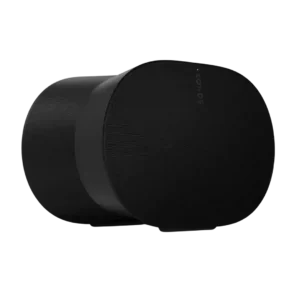
Choose the Sonos Era 300 for immersive spatial audio, loud room-filling sound, easy Sonos setup, and expandable home theater. Skip it if you rely on Google/Chromecast, need cheap stereo-only listening,...
Pros: Control button responsiveness, Smart features
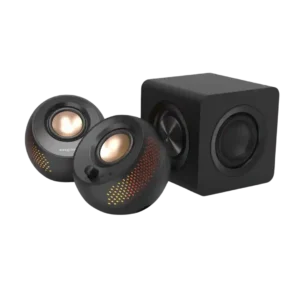
Choose the Creative Pebble X Plus if you want compact desktop speakers with RGB, strong volume, and subwoofer-backed bass. Skip it if you need deep sub-bass, clean cable management, advanced...
Pros: Bluetooth connection stability, Surround sound simulation
Cons: Bluetooth codec support, Audio format support