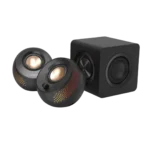
Creative Pebble X Plus Computer Speakers Feature Scores
Explore all 29 feature scores for Creative Pebble X Plus Computer Speakers, organized into pros and cons.
Scores by Feature
Summary
29 reviewed features-
Very positive 4.5-5.05 (17%)
-
Positive 3.5-4.417 (59%)
-
Neutral 2.5-3.44 (14%)
-
Negative 1.5-2.43 (10%)
Pros
Sort
-
Value was broadly positive for a compact 2.1 desktop system, but not unanimous because some reviewers preferred cheaper Pebble models or saw platform-dependent value.
-
Reviewers generally found the system loud for its compact size, with several saying it can get very loud, though a few noted limits near the top of the volume range.
-
Design and aesthetics were usually praised for the compact, cute, tasteful, or good-looking Pebble style, with only minor reservations about plastic finish.
-
The subwoofer was the most discussed upgrade: reviewers often praised punch, boom, and better bass, but some still found sub-bass depth, integration, or headroom limited.
-
Wired input support was a strength overall, with reviewers praising broad audio-source support and USB/AUX options, though one noted limited additional connection methods.
-
Voice and vocal clarity were a consistent strength, with reviewers praising clear vocals, good presence, and cleaner vocals through the Plus system.
-
Lighting was generally liked for customization and visual flair, though some reviewers found it dim, side-biased, or not personally useful.
-
Frequency balance was mixed: several reviewers praised clear, full, or powerful sound, while others heard a warm tilt, muted treble, or mids that were too high or thin.
-
Latency evidence was mostly positive, with two reviewers reporting no audio-video lag or latency issues and one noting a minor Bluetooth delay for video.
-
Build quality was generally solid, especially for the subwoofer, though some reviews still described plastic or less-premium satellite construction.
-
On-device controls were generally useful and tactile, but one reviewer found volume steps coarse and another wanted more sound-shaping control.
-
Physical control responsiveness was mixed-positive: several reviewers liked the tactile buttons and dial, while one criticized the cheap-feeling volume knob.
-
High-volume behavior was mostly positive: one review found no driver or amplifier distortion at maximum volume, while another noted quality loss above roughly 80 percent.
-
Microphone-related usefulness was positive, with reviewers praising the handy input and external peripheral flexibility.
-
Stereo presentation was considered better than a single speaker and immersive at a desk, but constrained by short speaker spacing and imperfect handling of complex mixes.
-
Bluetooth stability had limited but strong positive evidence, with one reviewer reporting stable, issue-free Bluetooth testing.
-
Detail retrieval was mixed: some reviewers praised treble/midrange detail and improved clarity, while others missed micro-details or upper-frequency sparkle.
-
The angled drivers created a surprising sense of scale in one detailed review, supporting a strong score for perceived height and scale.
-
Surround-style processing had limited but positive evidence, with one reviewer saying the app processing brought the sound to life.
-
One reviewer praised the compact size as easy to fit into a desktop setup.
-
Cohesion was mixed: one review praised better layering and separation, while another found the subwoofer did not fully disappear into the system.
-
Dynamic headroom depended heavily on power and volume level; some reviewers wanted more output, while others found the sound fuller with stronger power delivery.
Cons
Sort
-
Inter-speaker connectivity was a recurring complaint because fixed, short, hard-wired cables limited placement and raised durability concerns.
-
Bluetooth codec support was a clear weakness because reviewers repeatedly noted SBC-only support and the lack of AAC or AptX.
-
Power requirements were a repeated caveat because full performance often required a separate 30W or higher USB-C PD adapter that was not included.
-
Audio format support was criticized in one review for being locked to 16-bit/48 kHz with no higher-resolution option.
-
App feedback was split: the app could detect or personalize the system, but several reviewers criticized limited mobile/Mac support, missing EQ, or Windows app issues.
-
EQ customization was highly platform-dependent: some reviewers praised Windows equalizer controls, while others criticized no EQ or limited controls in mobile/Mac apps.
-
Setup ranged from easy to mildly frustrating: reviewers liked basic plug-in simplicity but repeatedly criticized cable clutter and cable management.