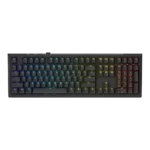
Ducky One X Wireless Feature Scores
Explore all 51 feature scores for Ducky One X Wireless, organized into pros and cons.
Scores by Feature
Summary
51 reviewed features-
Very positive 4.5-5.09 (18%)
-
Positive 3.5-4.418 (35%)
-
Neutral 2.5-3.417 (33%)
-
Negative 1.5-2.47 (14%)
Pros
Sort
-
Typing feel was one of the strongest areas, with reviewers repeatedly calling the experience smooth, satisfying, fantastic, or among the best in analog keyboards.
-
Acoustics were one of the clearest strengths, with reviewers praising the controlled, deep, soft, and fantastic sound profile.
-
Build quality was widely praised, with reviewers repeatedly describing the keyboard as solid, sturdy, tank-like, durable, and well built.
-
Reviewers generally liked the inductive switch feel, repeatedly calling it smooth, pleasant, and better for typing than many Hall-effect boards, though one noted it was only fine or somewhat heavy for gaming.
-
Stabilizer quality was a major strength, with reviewers praising lubed, solid, vastly improved stabilizers and reduced wobble or rattle.
-
Sound dampening was strongly praised for its layers of foam, dampening materials, and controlled sound, though modders disliked how hard it was to alter.
-
Connectivity was consistently useful, with reviewers appreciating wired, Bluetooth, 2.4 GHz, dongle storage, and stable connection options.
-
Hands-on reviewers praised responsiveness, saying response times felt great, keystrokes registered instantly, and actuation behaved as expected in tests.
-
Design aesthetics were widely liked, with reviewers praising the clean, minimalist, sleek, cozy, and premium-looking design.
-
Keycap quality was mostly praised for PBT feel, texture, and durability, though one reviewer complained about chemical smell and another noted lighting legibility issues on alternate caps.
-
Wireless performance was mostly responsive in positive reviews, but battery life and the usefulness of wireless for a latency-focused keyboard were questioned.
-
Frame rigidity earned strong marks where tested, with minimal flex and little meaningful twisting or bending reported.
-
Key stability drew strong praise where discussed, especially for reduced wobble, stable switches, and well-controlled larger keys.
-
Noise level was mostly favorable due to quieter, softer, low-rattle typing, but coil whine with RGB created a notable caveat.
-
Materials quality was mostly positive despite the plastic case, which reviewers often found premium-feeling or not cheap, though one wished for a more premium material.
-
RGB lighting quality ranged from bright and attractive to limited or not especially bright, with some concern about unclear shine-through on alternate caps.
-
Gaming performance split reviewers: several found it fast and excellent, while competitive-oriented reviewers said limited software and features keep it behind top rivals.
-
Value for money was sharply split, with positive reviewers calling it a great price or strong stock experience while critical reviewers said better-featured rivals make it hard to justify.
-
Latency impressions were mostly positive in wired and wireless use, but one reviewer questioned the latency tradeoff of going wireless for a performance keyboard.
-
Cable quality was praised where reviewed, especially the braided USB-C cable, though one reviewer wanted an additional USB-A adapter.
-
Typing comfort was generally strong, especially for long sessions, though one full-size reviewer felt strain during typing-heavy workdays.
-
Layout options received positive evidence from reviewers who appreciated the full-size and 60% choices and broader layout availability.
-
RGB customization was generally available and sometimes praised, but reviewers also flagged unfinished configurator behavior and setup patience.
-
Macro customization was praised in a few reviews for macro support and assigning keys, but one reviewer found multi-point or macro setup confusing.
-
The product’s size choices were useful, with reviewers noting both full-size and 60% versions, though full-size ergonomics and mouse-room tradeoffs remained.
-
Volume control was present and sometimes appreciated as part of the simple control layout, though some reviews treated it as one of few dedicated controls.
-
Desk space efficiency depended on layout: the Mini/compact version freed mouse room, while full-size reviewers noted less space for wide mouse sweeps.
Cons
Sort
-
Profile management was one of the biggest pain points in earlier reviews, with later updates improving the Mini through dual-profile support.
-
Extra gaming features lagged rivals in many reviews, especially due to sparse controls, missing SOCD/Snap Tap, and limited advanced analog options.
-
Battery life was repeatedly criticized, with reviewers reporting around 10 to 15 hours with RGB and saying it was not a buying reason.
-
Switch options were a recurring limitation: the board uses proprietary Ducky inductive switches, with few or no alternatives, although one reviewer described multiple switch options positively.
-
Wrist rest evidence was negative because reviewers complained the board did not include one, especially given the keyboard height or ergonomics.
-
Reliability confidence was mixed: stable wireless and bug fixes helped, but first-gen risk, no spare switches, and breakage concerns persisted.
-
Portability was weak for the full-size board because reviewers found it heavy and poorly suited to frequent travel.
-
Compatibility evidence centered on software and key-binding limitations, with Chromium-only support and missing special keys reducing flexibility.
-
Ergonomics were a concern on taller or full-size versions, with reviewers noting finger strain, missing wrist-rest support, or the need to supply their own rest.
-
Software quality was the most repeated weakness: web-based setup was appreciated by some, but many called it buggy, limited, slow, confusing, or unfinished.
-
Customization options were broad in concept but uneven in execution, with praised actuation/RGB controls offset by limited guidance, profiles, and advanced settings.
-
Backlight brightness was a modest weakness in the reviews that judged it, with reviewers calling it lower-end or not the brightest.
-
Onboard memory evidence was split: one reviewer praised saved macros/settings, while another criticized the absence of onboard profiles.
-
Durability evidence was mixed: PBT wear resistance impressed one reviewer, but fragile clips, teardown damage, and switch housing concerns lowered confidence elsewhere.
-
Legend visibility was mixed: standard legends were praised as sharp, while peach or orange alternate caps were criticized for poor shine-through or low-light readability.
-
Media controls were mixed: some liked Ducky’s simple media-key approach, while others missed playback controls or broader dedicated buttons.
-
Reviewers saw the consistency claim as plausible but not clearly transformative, with multiple reviewers saying they did not feel a practical advantage over Hall-effect alternatives.
-
Per-key lighting control was present, yet one review found it limited to a single mode while another treated per-key adjustment as useful.
-
Key spacing was only directly judged in one review, which found the wider full-size spacing noticeable and mildly straining.
-
Hot-swap support was useful in principle, but proprietary switch limits, switches popping out with keycaps, and no spares reduced confidence.
-
Switch replacement was mixed: one reviewer found replacement easy, while others disliked reliance on Ducky-only switches and scarce spares.
-
Analog-style functionality was a mixed strength: multi-point and adjustable actuation impressed some reviewers, while others said induction did not add enough beyond existing Hall-effect boards.
-
Rapid trigger was valued as useful and easy to toggle, but several reviewers criticized the limited high/medium/low sensitivity controls and lack of deeper tuning.
-
Most reviewers treated the 1,000 Hz polling rate as adequate for normal play, while competitive-focused reviewers noted it trails higher-polling rivals.