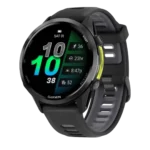
Garmin Forerunner 970 Feature Scores
Explore all 50 feature scores for Garmin Forerunner 970, organized into pros and cons.
Scores by Feature
Summary
50 reviewed features-
Very positive 4.5-5.016 (32%)
-
Positive 3.5-4.423 (46%)
-
Neutral 2.5-3.411 (22%)
Pros
Sort
-
GPS accuracy was one of the strongest consensus points, with reviewers repeatedly calling tracks excellent, impeccable, highly accurate, or industry-leading on land.
-
Reviewers repeatedly treated the LED flashlight as a major practical upgrade, useful for night runs, hotels, errands, and everyday visibility.
-
Heart-rate accuracy drew broad praise across reviews, with optical readings often matching straps closely; caveats focused on wrist-sensor limits in fast-changing or gym efforts.
-
Durability received broad praise, especially the sapphire screen’s scratch resistance after months of wear, gym use, and daily abuse.
-
Recovery insights were a major strength: reviewers found impact load, training readiness, running tolerance, and daily reports useful for pacing workload and avoiding overtraining.
-
Coaching features were praised for adaptive training, race guidance, running tolerance, and triathlon plans, though some advanced metrics were better suited to serious users.
-
Brightness was a standout improvement across reviews, making the display easy to read in tough conditions but contributing to battery tradeoffs.
-
Comfort was consistently positive because the watch is lighter and thinner than rugged alternatives, making it easier to wear all day.
-
Mapping and navigation were powerful and detailed, but reviewer sentiment was split by laggy map rendering and failed round-trip rerouting in some tests.
-
Display quality was widely praised for its bright, clear AMOLED panel, vibrant color, sapphire lens, and premium feel.
-
ECG was generally seen as a meaningful premium health addition, though reviewers stressed it is manual, sometimes a hassle to enable, and not continuous monitoring.
-
Style and design were generally praised as sleek, good-looking, sporty, and refined, though some found it less subtle than lifestyle watches.
-
Fitness tracking accuracy was praised in real workouts, including indoor gym sessions, long runs, routes, elevation, and wrist heart-rate behavior during structured training.
-
Smartwatch features were strong for a sports watch, with calls, voice, music, payments, reports, and notifications adding daily usefulness without matching cellular smartwatches.
-
Workout variety was considered very broad, with reviewers highlighting multisport plans, many sport modes, and enough detail for runners, cyclists, triathletes, and data-focused athletes.
-
Fit was mostly praised, including on slim wrists, though the single 47mm format constrained some users.
-
The user interface was generally considered easy or improved, but more complex reviewers still found parts of the layout overwhelming.
-
Button controls were useful and reliable, preserving full control when touch is unavailable, though one reviewer wanted a more tactile click.
-
Build quality was strong overall, with reviewers valuing the light polymer body, titanium bezel, sapphire lens, and durable feel.
-
Voice assistant quality was helpful for timers, commands, and reducing menu use, but reviewers noted delays, limited personal appeal, or mediocre speaker quality.
-
Wellness insights were useful when they translated daily data into practical advice, especially Evening Report, recovery prompts, and broader health context.
-
Contactless payments were valued, especially by reviewers who rely on Garmin Pay, though bank support was described as solid in the US and mixed elsewhere.
-
Touchscreen responsiveness was mostly positive, with one reviewer calling it snappy and responsive while another flagged sensitivity quirks.
-
Call handling was mixed: reviewers liked the convenience and improved speaker, but some found the volume or sound quality unimpressive.
-
Customization options were a clear strength, with settings, touchscreen behavior, sport profiles, data fields, and watch faces described as highly adjustable.
-
Outdoor visibility was excellent, with reviewers emphasizing readability at noon, in indirect sunlight, and on bright sunny days.
-
Stress tracking received strong praise from the one reviewer who directly evaluated it, especially for reflecting migraine-related strain and adjusting recovery guidance.
-
Third-party app support was useful for watch faces, data fields, and niche apps, though reviewers did not equate it with a full smartwatch app store.
-
Onboard music was positively received for offline storage and improved GPS-plus-music endurance, making music more practical on longer activities.
-
The operating system experience was praised as best-in-class among sports watches by one reviewer, reinforcing Garmin’s software depth.
-
Sleep tracking was viewed as useful but imperfect: reviewers praised sleep timing or overall sleep ratings while noting uncertain stages, missed wakeful moments, or bulky overnight wear.
-
The app ecosystem scored well where reviewers discussed Connect IQ, especially because Garmin’s marketplace is much larger than rival sports-watch ecosystems.
-
Band quality had limited but positive evidence, with the strap’s subtle stretch helping stability without cutting circulation.
-
Bluetooth evidence was narrow but positive, with one reviewer reporting AirPods pairing and use without dropouts on multiple runs.
-
Health tracking evidence was limited but positive, with one reviewer saying the watch accurately reflected stress, temperature, heart-rate changes, and period timing.
-
Materials quality was praised for the premium titanium bezel, sapphire crystal protection, and lightweight durable body.
-
Watch-face quality was praised through customization and the large Connect IQ selection, including many free third-party options.
-
Safety features were viewed positively where discussed, with emergency alerts, incident detection, LiveTrack, and the flashlight improving confidence.
-
PulseOx-related evidence centered on improved practicality, with one reviewer finding breathing-variation tracking no longer caused a notable overnight battery penalty.
Cons
Sort
-
Size options were a repeated weakness because the Forerunner 970 only comes in one 47mm case size.
-
Companion app quality was mixed: Garmin Connect offered comprehensive data, but layout, workouts, and pairing friction drew criticism.
-
Menu navigation was mixed, with voice helping reduce menu diving but daily use sometimes requiring too many clicks or feeling overwhelming.
-
Reliability concerns centered on crashes and buggy round-trip routing rather than the core tracking system.
-
Charging convenience was criticized by one reviewer who wanted wireless charging instead of Garmin’s proprietary cable.
-
Cross-platform compatibility was limited by iOS restrictions, especially the inability to reply to messages or view photos from the watch.
-
Pairing reliability had limited evidence, with one reviewer noting the Garmin Connect pairing process took several attempts.
-
Software smoothness was a common caveat: saving workouts, loading activities, widgets, and maps could lag, though some reviewers still found normal scrolling responsive.
-
Water resistance was adequate for swimming and wet use, but reviewers noted the 5ATM rating is not dive-ready like the Fenix line.
-
Battery life produced the most mixed feedback: GPS endurance was acceptable or strong, but always-on and general smartwatch use often disappointed reviewers.
-
Value for money was divisive: reviewers saw top-tier capability for serious runners but repeatedly questioned the high price versus the 965 or Fenix alternatives.