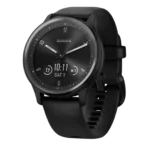
Garmin Vivomove Sport Feature Scores
Explore all 51 feature scores for Garmin Vivomove Sport, organized into pros and cons.
Scores by Feature
Summary
51 reviewed features-
Very positive 4.5-5.012 (24%)
-
Positive 3.5-4.421 (41%)
-
Neutral 2.5-3.415 (29%)
-
Negative 1.5-2.43 (6%)
Pros
Sort
-
Comfort was one of the most consistent strengths, with reviewers repeatedly saying it was light, unobtrusive, and comfortable day and night.
-
Style and design were the clearest wins: reviewers repeatedly praised the analog look, hidden display, fun colors, and everyday wearability.
-
Value was broadly positive for users who want style and Garmin wellness data at an approachable price, though a few reviewers questioned value against fuller fitness trackers.
-
Safety features were well received, especially Assistance, LiveTrack, and emergency contact alerts when paired with a phone.
-
Automatic activity detection drew positive evidence, especially Move IQ detecting even short bike errands and reviewers appreciating hands-off tracking.
-
Wellness insights were a core strength, with reviewers praising Body Battery, hydration, stress, and general Garmin tracking as helpful bonuses for everyday health awareness.
-
Band quality was positive overall, with reviewers liking the soft, comfortable, robust, and durable silicone strap.
-
The Garmin ecosystem was a major advantage, with reviewers praising Garmin support, scalable data, app syncing, and the broader fitness platform.
-
Fit was praised for smaller wrists and a less intrusive profile than larger sports watches.
-
Fitness tracking is best for basic and casual use: several reviewers found useful or close-enough data, but accuracy dropped without GPS or during tougher workouts.
-
Body Battery and recovery-style prompts were repeatedly praised as helpful, especially for deciding when to ease off, though explanation and context could be stronger.
-
Workout variety was viewed positively for a hybrid, with enough profiles for walking, running, cycling, swimming, strength, yoga, and related basics.
-
Music controls were one of the better small-screen extras, repeatedly described as working well or being impressive on such a compact hybrid.
-
Garmin Connect was divisive: praised for depth and capable analytics, but criticized as cluttered, complicated, or less user-friendly.
-
Sleep tracking ranged from decent to excellent, with several reviewers finding it reflected sleep well, while others found digestibility issues or overcounted sleep duration.
-
Smartwatch features were useful but intentionally entry-level, offering notifications and basics rather than a full smartwatch replacement.
-
Touchscreen responsiveness was generally accurate indoors and in normal use, but sweaty fingers, motion, and tiny controls made it less reliable during workouts.
-
Water resistance was treated as dependable for showers and everyday wet use, with 5ATM swim capability noted alongside positive shower testing.
-
Pairing reliability was strong where tested, with no reported issues in setup, pairing, or syncing.
-
General reliability was strong for syncing in one long-term cycling-focused review.
-
Build quality was generally acceptable for the price, with reviewers calling it durable or nicely built despite the plastic construction.
-
Cross-platform use was mostly positive across Android and Apple, though one review noted lack of direct Google Fit sync.
-
Bluetooth-related connection evidence was positive, with a reviewer reporting no setup, pairing, or syncing issues.
-
Charging convenience was positive in one review because the wired connector was simple to plug in and easy to use.
-
Charging speed was positive where mentioned, with one reviewer calling it relatively fast at about an hour to an hour and a half.
-
Software movement felt smooth in one review, with swipes and widgets responding quickly.
-
Third-party support was positive where discussed, especially easy syncing with Strava and other fitness apps.
-
Stress tracking was usually useful as a wellness signal, but reviewers did not treat it as perfect, and one found it unlikely to match feelings accurately.
-
Customization was a strength for settings and widgets, but watch-face expansion was limited by lack of Connect IQ support.
-
Step tracking looked usable, with one review finding no wild discrepancies and another finding a mild overcount but still decent results.
-
Blood-oxygen spot checks looked reasonable in limited testing, though one reviewer noted slightly lower readings and recommended repeating low measurements.
-
The watch software was easy enough once learned, but it remained constrained by the small hybrid interface.
-
Materials were judged fair rather than premium, with one reviewer noting the display and finish did not match more expensive alternatives.
Cons
Sort
-
Contactless payments were a repeated missing perk, with reviewers noting the absence of NFC or mobile payments as a drawback or limitation.
-
Lack of side buttons hurt navigation for reviewers who wanted physical controls on a small touchscreen device.
-
Onboard music storage was absent and treated as one of the limited extras compared with fuller smartwatches.
-
Outdoor visibility was inconsistent and often a concern; several reviewers found the display dim or hard to use in bright sunlight.
-
Calorie usefulness was weakened by heart-rate overestimation in one comparison, which led to higher calorie burn estimates.
-
Durability had a caveat: one reviewer found the hands could become misaligned after vigorous activity.
-
The user interface split reviewers between straightforward after a learning curve and challenging because of the tiny touch display and no buttons.
-
Menu navigation was a recurring compromise: reviewers called it clunky, fiddly, icon-dependent, or harder to manage during activity.
-
Coaching was limited: guided breathing worked well in one review, but another found Garmin Connect weak on motivation and improvement advice.
-
Call handling was basic: reviewers liked being able to answer or decline from the wrist, but the lack of a microphone limited it.
-
General health accuracy was mixed: one reviewer found supported metrics broadly accurate, while another was unimpressed because heart-rate problems weakened workout health data.
-
Watch-face quality was mixed: one reviewer found a chosen face readable and useful, while others wanted better options or found occasional unresponsiveness.
-
Heart-rate evidence split by use: casual and steady workouts were often close enough, but high-intensity, outdoor cycling, and some reviewer comparisons showed lag, overreading, or underreading.
-
Brightness ranged from sufficient or easy to read in some testing to weak in harsher light, especially for outdoor workouts.
-
Battery life was mixed: some reviewers were satisfied with roughly five days, while heavier use, GPS pairing, and Pulse Ox reduced it enough to disappoint others.
-
Notifications were useful for triage and prompts, but the small display made longer messages tedious or difficult to read.
-
Display quality was the biggest split: reviewers liked the hidden effect and readability indoors, but several criticized low resolution, limited data space, and daytime usability.
-
GPS evidence was context-dependent: connected GPS could line up well with phones or other devices, but lack of onboard GPS hurt runners and precision-focused users.