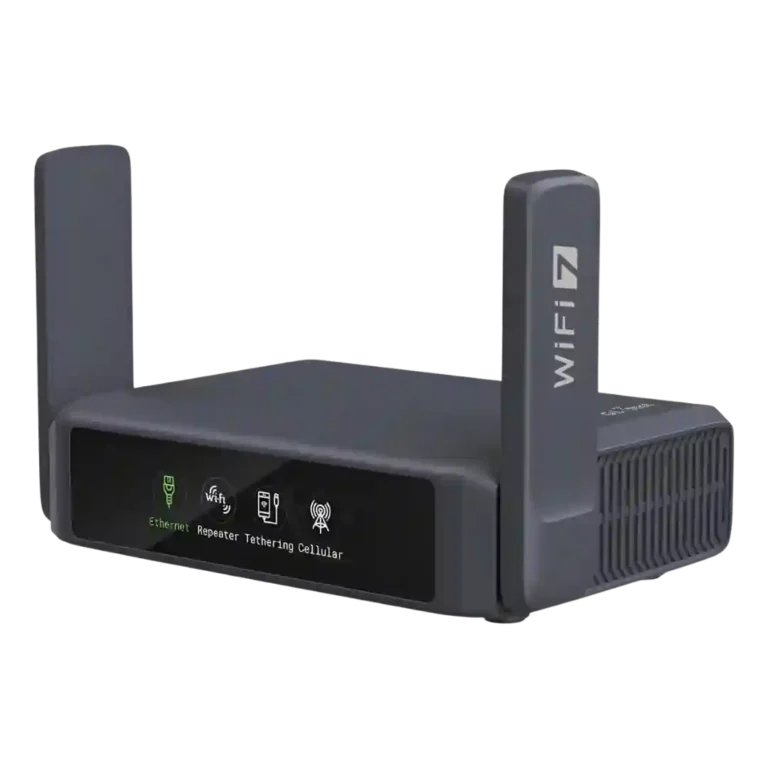
GL.iNet GL-BE3600 Slate 7

GL.iNet GL-BE3600 Slate 7 Review

Brand: GL.iNet
Released: March 4, 2025
Updated: 20 hours ago
4.5
Overall review score
359
Review evidence points
100
Scored features
27
Expert reviews

Bottom Line

Choose it for frequent travel, fast VPNs, dual 2.5GbE and resilient multi-WAN. Skip it if you need full 6GHz/320MHz Wi‑Fi 7, mesh, or desktop-class USB storage and long-range indoor coverage.

Best for

Frequent travelers, remote workers and privacy-focused users who want one compact router to secure many devices, run fast VPNs, and switch among wired, Wi‑Fi and tethered internet sources.

Not for

Buyers who need full 6GHz/320MHz Wi‑Fi 7, mesh roaming, large-home coverage, an internal battery or desktop-class USB storage performance should look elsewhere.

Verdict

The Slate 7 is a highly capable travel router built around the things travelers actually use: fast dual 2.5GbE, strong WireGuard performance, flexible multi-WAN failover, simple setup, low power draw, and unusually deep OpenWRT-based controls. Its 5GHz wireless performance is strong for the size, and the VPN, AdGuard, Tailscale, segmentation, and USB-tethering options make public-network use far easier to secure. The tradeoff is that its Wi‑Fi 7 label overpromises: there is no 6GHz band or 320MHz channel width, mesh is absent, USB storage is much slower than the port suggests, and some firmware/plugin behavior is uneven. For frequent travelers and remote workers, the flexibility is compelling; buyers chasing full-spec Wi‑Fi 7 or large-home coverage should look elsewhere.

Feature Scorecards

Summary

100 reviewed features
  • Very positive 4.5-5.0
    65 (65%)
  • Positive 3.5-4.4
    16 (16%)
  • Neutral 2.5-3.4
    10 (10%)
  • Negative 1.5-2.4
    6 (6%)
  • Very negative below 1.5
    3 (3%)

Pros

  • 5.0
    14 reviews strong consensus
    2.5 GbE support: 5.0, 14 reviews, strong consensus
    Dual 2.5GbE ports are one of the Slate 7’s clearest hardware advantages, enabling fast wired WAN and LAN links in a travel-sized device. Multiple tests found the ports genuinely useful rather than decorative.
  • 4.9
    14 reviews strong consensus
    WAN failover: 4.9, 14 reviews, strong consensus
    Multi-WAN failover is one of the most useful travel features, switching among Ethernet, repeater Wi‑Fi and tethered cellular sources. It is repeatedly praised for keeping remote-work connections resilient.
  • 4.8
    16 reviews strong consensus
    VPN client support: 4.8, 16 reviews, strong consensus
    VPN client support is a standout strength, especially WireGuard, which commonly lands around 400–540Mbps in the supplied tests. Broad provider support and quick toggles make secure travel use unusually convenient.
  • 4.9
    13 reviews strong consensus
    setup ease: 4.9, 13 reviews, strong consensus
    Basic setup is a consistent strength, with guided flows, QR codes and straightforward Wi‑Fi configuration making the router quick to deploy. Even fairly advanced travel setups can be brought online with little friction.
  • 4.8
    12 reviews strong consensus
    connection reliability: 4.8, 12 reviews, strong consensus
    Reliability is generally excellent, including a three-day stress test with no disconnects and many successful travel deployments. A few firmware/WISP quirks exist, but core connections are usually dependable.
  • 5.0
    9 reviews strong consensus
    security features: 5.0, 9 reviews, strong consensus
    Security is a major reason to buy the Slate 7: VPNs, WPA3, firewalling, network isolation and DNS-level protections are all available. The travel use case of creating a private network on public Wi‑Fi is especially compelling.

Cons

  • 1.4
    4 reviews strong consensus
    320 MHz support: 1.4, 4 reviews, strong consensus
    The router does not support 320MHz channels, one of Wi‑Fi 7’s headline bandwidth features. That materially caps peak wireless potential and contributes to the sense that its Wi‑Fi 7 implementation is partial.
  • 1.8
    7 reviews strong consensus
    6 GHz performance: 1.8, 7 reviews, strong consensus
    The biggest Wi‑Fi 7 caveat is the complete lack of a 6GHz radio. That omission repeatedly limits the router’s peak-speed and congestion advantages versus fuller Wi‑Fi 7 or Wi‑Fi 6E designs.
  • 1.0
    1 review
    mesh performance: 1.0, 1 review
    Mesh is a notable weakness: the Slate 7 does not mesh with other GL.iNet routers in the tested firmware. That prevents the smooth roaming and extension role some buyers may expect.
  • 1.0
    1 review
    seamless handoff: 1.0, 1 review
    Without true mesh support, the Slate 7 cannot deliver the seamless handoff expected when moving between it and another router. Repeater mode is available, but it is not equivalent.
  • 2.0
    2 reviews limited evidence
    battery portability: 2.0, 2 reviews, limited evidence
    The absence of an internal battery is a recurring portability compromise. USB-C makes external power easy, but buyers still need a laptop, charger or power bank to run it.
  • 1.5
    1 review
    tri-band support: 1.5, 1 review
    The Slate 7 is not tri-band because it lacks a 6GHz radio. That is one of the main reasons its Wi‑Fi 7 implementation falls short of higher-end models.

Consider This Instead

If you want better seamless handoff

Choose MSI Roamii BE Pro. It scores 5.0 vs 1.0 for seamless handoff, with a 4.3 overall score.

Compare

Compared in Reviews

Products reviewers directly compared with this model, grouped into quick takeaways.

ASUS RT-BE58 Go

  • Worse: 2.5GbE port count The Slate 7’s dual 2.5GbE setup is an advantage over the ASUS rival.
  • Better: boot and restart speed The Slate 7 takes nearly twice as long to boot or restart.

Beryl AX

  • Worse: overall technical capability The Slate 7 is judged technically superior to the Beryl AX overall.

Flint 3

  • Similar: mesh support The Slate 7 shares the Flint 3’s lack of mesh support.

FAQ

Does it deliver full Wi‑Fi 7 features?

No. It supports Wi‑Fi 7 features such as MLO, but lacks both the 6GHz band and 320MHz channel width, limiting peak wireless potential.

How fast is WireGuard VPN performance?

Multiple tests put WireGuard roughly in the 400–540Mbps range, making VPN throughput one of the Slate 7’s strongest features.

Is it easy to set up in hotels?

Yes. Guided setup, repeater mode, captive-portal handling and QR-based connection tools make hotel deployment straightforward, while your devices can keep using the router’s familiar private network.

Can it use more than one internet source?

Yes. Ethernet, repeater Wi‑Fi and USB tethering can be combined with multi-WAN failover, so another source can take over when the preferred connection fails.

Can it replace a home router?

It can work well in a small home or apartment, but its compact antennas, limited long-range indoor performance and lack of mesh make it better suited to travel and smaller spaces.

Is the USB port good for storage sharing?

It works well for basic file sharing and mini-NAS duties, but several tests capped storage transfers around 130–140MB/s, below the potential of USB 3.0 and 2.5GbE.

Sample Expert Reviews We Analyzed

These are a few of the reviews included in our analysis.
Video Reviews

Article Reviews

privacygear.nl

The GL.iNet Slate 7 is GL.iNet's first Wi-Fi 7 travel router: two 2.5G ports, a touchscreen, and built-in WireGuard VPN. The step up from the...

Review score
4.5

Top Wi-Fi Routers to Consider

#1 D-Link Aquila Pro AI R95
4.8

Choose the R95 for a busy home that needs fast Wi-Fi 7, strong range, multi-gig ports, and low-lag gaming. Skip it for a small, lightly connected space or if advanced...

Pros: wireless performance, Wi-Fi speed

Cons: content filtering
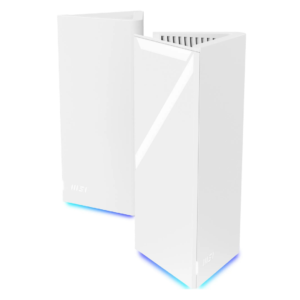
#2 MSI Roamii BE Pro
4.3

Best for affordable tri-band Wi-Fi 7, abundant 2.5GbE ports, and deep free controls. Skip it if you need consistently strong garden coverage, foolproof app setup, or proven top-tier speeds across...

Pros: close-range speed, download performance

Cons: automatic configuration, interface responsiveness