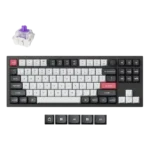
Keychron Q3 HE Feature Scores
Explore all 47 feature scores for Keychron Q3 HE, organized into pros and cons.
Scores by Feature
Summary
47 reviewed features-
Very positive 4.5-5.029 (62%)
-
Positive 3.5-4.415 (32%)
-
Neutral 2.5-3.43 (6%)
Pros
Sort
-
Build quality had unanimous strong praise, with every review describing the board as solid, sturdy, premium, or exceptionally well built.
-
Typing feel was one of the strongest positives, repeatedly described as tactile, satisfying, fast, comfortable, unique, and enjoyable.
-
Reviewers consistently described the magnetic switches as smooth, responsive, bouncy, soft, and enjoyable, with several calling the feel highly refined.
-
Design aesthetics were widely praised, with reviewers liking the clean colors, shell-white styling, and premium-looking TKL design.
-
Acoustics were a major strength: reviewers liked the quiet, muted, poppy, brilliant, or office-friendly sound profile.
-
Noise level was strongly positive, with reviewers repeatedly calling the keyboard quiet, subtle, not very loud, or free of annoying clickiness.
-
Software quality was broadly praised as smooth, intuitive, easy, web-based, slick, and useful for actuation and remapping.
-
Customization options were a major strength, spanning actuation tuning, key remapping, macros, lighting, keycaps, and per-key settings.
-
Materials quality was repeatedly praised, especially the aluminum body, premium feel, sturdy construction, and included materials.
-
Gaming performance was praised across reviews for responsive actuation, Rapid Trigger-style inputs, and competitive-feeling advantages.
-
Responsiveness was strongly praised, with reviewers describing accurate, ultra-responsive, twitch-fast key behavior that helped gaming and fast typing.
-
Typing comfort was consistently positive, with reviewers reporting no fatigue, comfortable keycaps, and a satisfying all-day typing experience.
-
Frame rigidity and desk stability were strong positives, with reviewers noting solidity, lack of movement, and clean manufacturing.
-
RGB lighting quality was generally praised as gorgeous, subtle, pleasant, and visually strong, though one reviewer called it only fairly subtle.
-
Rapid Trigger support was treated as a strong gaming advantage, described as handy, ideal for fast games, and outstanding.
-
Extra gaming features were strongly praised, especially Rapid Trigger, Snap Tap, and multi-action key behavior.
-
Connectivity was mostly strong thanks to wired, Bluetooth, and 2.4GHz options, though one reviewer disliked flipping the rear switch between modes.
-
Keycaps received positive comments for softness, crisp legends, lack of cheap feel, and overall quality.
-
Multi-depth input was useful for walk/run and steering-style control, though one reviewer questioned how useful the extra depth mapping would be personally.
-
Wireless performance was praised as accurate, responsive, and capable for wireless gaming.
-
Value for money was split: some reviewers felt the premium build justified the price, while others said cheaper rivals offered better value.
-
Size and form factor were mostly positive for compact TKL use, though reviewers noted it is not a travel-focused board.
-
Stabilizers were mostly praised as smooth, rattle-free, and excellent, with one review noting slight wobble on larger keys.
-
Volume control was generally praised for the knob feel and convenience, though one reviewer preferred a different knob placement.
-
Durability evidence was positive, with reviewers expecting lasting construction and associating the materials with durability and stability.
-
Compatibility was praised for easy Mac and Windows use and usefulness across different platforms.
-
Sound dampening was praised where discussed, with padding and internal construction credited for reducing unwanted noise and improving sound.
-
Reviewers praised the actuation behavior for detecting small presses and activating precisely, supporting high confidence in press registration.
-
Cable quality was positively received, with reviewers liking the braided cable and its practical connection options.
-
Layout options were praised for the full TKL arrangement and separated navigation area, especially for users who value a knob and traditional spacing.
-
Media controls were praised through the clickable knob, including satisfying quick mute behavior and a nice click-down control.
-
RGB customization was received positively, especially lighting effects that react to key presses and the praised Pixel Rain-style effect.
-
Legend visibility was positive overall, with crisp legends and usable visibility despite non-shine-through keycaps.
-
Desk space efficiency was praised by one reviewer who liked the Mac Magic Keyboard-like footprint for a compact workspace.
-
Macro customization was mixed: reviewers recognized game usefulness but also questioned how often deeper press macros would matter.
-
Key spacing was praised in the TKL layout because separated keys helped avoid accidental hits.
-
Latency evidence was positive in testing, with no input lag noticed during use.
-
Battery life was mixed: one reviewer found it really good, while another warned RGB wireless use noticeably taxes the battery.
-
Backlight brightness was viewed as restrained rather than intense, with reviewers describing it as not overly bright or not super bright.
-
Ease of switch replacement was positive in the hands-on demonstration, where reinstalling a switch was described as simply clicking it back in.
-
Polling-rate impressions were mixed: one reviewer found it quick and useful, while another criticized 1,000Hz against cheaper 8,000Hz competitors.
-
Ergonomics were mixed: one reviewer had no hand cramping, while another needed a palm rest because of the fixed angle.
-
Key stability had a moderate caveat because the spacebar was described as a bit wobbly in one review.
-
Reliability had a minor concern in one review due to rare Bluetooth reconnection issues.
Cons
Sort
-
Switch choice was the clearest hardware limitation: reviewers noted one included switch set or proprietary magnetic-switch compatibility as disappointing or limiting.
-
Hot-swap support was limited by compatibility, because the switches are swappable but not compatible with traditional mechanical switches.
-
Portability was a weakness because the compact layout helps, but the heavy metal board was described as best kept on a desk.