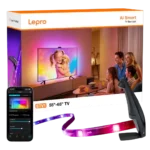
Lepro STV1 TV Backlight Feature Scores
Explore all 44 feature scores for Lepro STV1 TV Backlight, organized into pros and cons.
Scores by Feature
Summary
44 reviewed features-
Very positive 4.5-5.036 (82%)
-
Positive 3.5-4.46 (14%)
-
Neutral 2.5-3.42 (5%)
Pros
Sort
-
The wall glow consistently makes viewing feel more immersive and cinematic. It also softens the harsh contrast of a bright television in a dark room.
-
Reviewers repeatedly found little to no visible delay between screen changes and the backlight response.
-
Transitions are consistently fluid, with no harsh jumps and little sense that the lights are struggling to keep up.
-
Across games, movies, and rapid cuts, the lights react quickly enough to feel connected to the screen rather than delayed.
-
Fast screen matching is the product’s clearest strength. Colors keep pace with busy action and extend the image with little visible lag.
-
The STV1 is repeatedly described as a strong value because it delivers fast, vivid reactive lighting without premium sync-box pricing.
-
The app is easy to navigate and puts brightness, saturation, scenes, and behavior within quick reach. One tester preferred it to the apps from more established premium brands.
-
Multiple colors remain distinct while still blending into the on-screen palette, avoiding the flat single-color wash common to simpler strips.
-
Reds and blues look convincing, and RGBIC output can display several shades at once instead of turning the whole wall one color.
-
Reactive effects feel natural, lively, and better integrated with the screen than ordinary decorative RGB strips.
-
The wide-angle camera captures the full screen and the strip spreads light broadly around the TV. Dark walls can mute the visible glow, while plain light walls give the strongest extension effect.
-
Peel-and-stick mounting is generally simple and can take about 15 minutes. Wall-mounted televisions are more awkward and may need to be removed before installation.
-
Bright, colorful content looks especially lively, with vivid output that adds punch to games and animation.
-
The backlight produces clean gradients and a cohesive wall glow that noticeably upgrades movie nights. Its strongest appeal is making the screen and surrounding room feel like one visual experience.
-
The main screen-sync and lighting functions worked as advertised across extended viewing and varied content.
-
Most users found calibration and connection straightforward, often taking only a few minutes. A 2.4 GHz router caused repeated pairing attempts for one tester, so setup may not be equally smooth everywhere.
-
The strip gets bright enough to add real impact, especially in dark rooms with light-colored walls. Output remains strong enough that one household sometimes dimmed it for comfort.
-
Music mode follows rhythm and room or TV audio smoothly, adding movement without the jarring flashing some competing modes produce.
-
Modes cover movies, gaming, music, parties, sports, and softer ambient use. The range is broad, although some specialty effects may be occasional rather than daily features.
-
Screen colors are generally mapped accurately and stay true during fast content. Pure white is the weak spot, with one tester noticing slight pink or green tinting.
-
Bias lighting reduced squinting and made a bright screen easier on the eyes in a dark room.
-
The correctly sized kits fit tested 60-inch and 75-inch televisions well, with enough room for the stated size ranges.
-
The lighting expands the atmosphere around movies and games without feeling random or distracting.
-
Prompt-generated themes produce appealing combinations that users may not create themselves, with especially positive reactions for parties and team colors.
-
Generated and themed scenes can be creative, accurate, and fun for parties or sports. Their everyday value is less certain, as some users quickly returned to regular screen sync.
-
The camera-based design avoids a separate HDMI sync box, cutting both complexity and the cost of extra hardware.
-
Combining the camera and controller reduces the number of pieces behind the TV and keeps the setup comparatively tidy.
-
Sports-oriented presets are quick to activate and can make team-color viewing more playful.
-
The integrated hardware looks cleaner than many camera kits, but the top-mounted camera still lacks the seamless appearance of an HDMI-box solution.
-
App commands react quickly, which keeps adjustment from interrupting the viewing experience.
-
Once configured, TV-linked on/off behavior worked consistently enough that the system required no further attention.
-
The lights can turn on and off with the television, removing the need for routine manual control.
-
Extra corner-fixing stickers and the integrated controller help keep cable runs neat behind the television.
-
The lighting follows scene intensity without pushing colors into an exaggerated, artificial look.
-
The box is well organized and includes mounting clips, cable fixers, calibration pads, and the hardware needed for installation.
-
Unlike many bias-lighting kits that can look underpowered, this strip reaches a genuinely useful peak brightness.
-
Included clips, adhesive supports, and a camera pad provide several ways to secure the strip and top-mounted sensor.
-
Voice commands can adjust brightness quickly, making hands-free control genuinely useful rather than merely decorative.
-
The component design feels thoughtful and well assembled, with protective and mounting details that go beyond a bare-bones strip kit.
-
A silicone-wrapped strip protects the RGBIC chips and gives the lighting hardware a more durable feel.
-
Pairing was instant for one tester but required several attempts on another reviewer’s 2.4 GHz network.
-
Most cables are long enough for tidy routing, but the top sensor’s power lead may be about a foot too short for larger or higher-mounted TVs.
Cons
-
The 2.4 GHz-only connection can be finicky with some routers and may take repeated attempts before pairing succeeds.
-
Mixed white can reveal a little pink or green bleed when the LEDs are viewed closely, though the tint is less obvious on the wall.