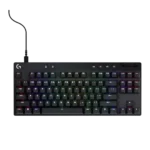
Logitech G PRO X Keyboard Feature Scores
Explore all 49 feature scores for Logitech G PRO X Keyboard, organized into pros and cons.
Scores by Feature
Summary
49 reviewed features-
Very positive 4.5-5.06 (12%)
-
Positive 3.5-4.424 (49%)
-
Neutral 2.5-3.416 (33%)
-
Negative 1.5-2.43 (6%)
Pros
Sort
-
Customization is one of the line’s clearest strengths, from hot-swap layouts to Keycontrol, though cost and closed ecosystems limit it on some versions.
-
Portability is consistently strong thanks to compact form factors, detachable/portable designs, dongle storage, and hard carry cases.
-
Wireless performance is a major strength when Lightspeed is present, with reviewers citing stable, fast, low-latency performance.
-
Build quality is often praised as sturdy, rigid, and premium-feeling, though the Pro X 60 drew sharp criticism for feeling cheap to some reviewers.
-
Gaming performance is generally strong, with fast, responsive, reliable play; criticism focuses more on value and missing cutting-edge features.
-
Frame rigidity is a major positive in many reviews, with repeated praise for no flex, sturdy frames, and inflexible plates.
-
Key responsiveness is mostly praised as quick, snappy, instant, or highly responsive, especially for gaming and rapid-trigger use.
-
Macro customization is powerful in G Hub and Keycontrol, though some reviewers found setup time-consuming or limited by software design.
-
Compact TKL and 60% layouts are repeatedly praised for freeing mouse space and maximizing smaller desks.
-
Connectivity is usually praised for easy Bluetooth/Lightspeed switching and stable use, but one reviewer disliked that a TKL unit could only be used wirelessly.
-
Latency is a strength in wireless models, where reviewers repeatedly describe Lightspeed as low-latency or effectively wired-like.
-
Volume control is usually appreciated as convenient, especially side rollers, though a few reviewers disliked placement or cheap feel.
-
Switch replacement is praised as simple on hot-swappable G Pro X models, but full-board swapping can still be time-consuming.
-
Durability is supported by sturdy builds, durable PBT keycaps, and reviewers expecting the boards to last, with a few variant-specific caveats.
-
Size and form factor are a strength for competitive desk space, though 60% sacrifices make the layout more polarizing than TKL.
-
Reviewers liked smooth or adjustable actuation when it was well tuned, but several noted that actuation advantages depend heavily on setup and switch type.
-
RGB lighting quality is often vibrant and attractive, but uneven shine-through and color limitations weaken some models.
-
Typing feel is usually pleasant or good on stronger models, but larger keys and some switch choices create mixed impressions.
-
Per-key lighting control is a strength where reviewers praise easy per-key RGB, custom lighting, and G Hub control.
-
Profile management is useful through saved onboard profiles, game profiles, and quick profile switching, though onboard limits appear on some models.
-
Ergonomics are generally helped by compact layouts and typing-angle feet, though comfort depends on posture and layout familiarity.
-
Design impressions are mixed: reviewers liked the simple, functional, and colorful looks, while some criticized stale or cheap-feeling styling.
-
Gaming extras such as Game Mode, Key Priority, and physical toggles are useful, but several reviewers question whether they justify the price.
-
Software quality is polarizing: G Hub can be powerful and polished, but also mediocre, tedious, buggy, or unintuitive depending on reviewer and version.
-
RGB customization is broadly praised for presets and per-key control, though G Hub difficulty hurts the experience for some reviewers.
-
Onboard memory is useful when present, letting reviewers save settings or profiles and avoid keeping software open.
-
Switch feel varies widely by variant, from smooth and snappy to hollow, overly light, wobbly, or disappointing tactile feel.
-
Typing comfort is generally good after adjustment, helped by PBT texture and familiar switch feel, but compact layouts can hurt comfort.
-
Media controls are useful when dedicated, but placement and limited customization create mixed opinions across models.
-
Battery life is usable for wireless play, yet reviewers split between excellent endurance on the 60% and merely average weekly charging on the TKL.
Cons
Sort
-
Noise level is one of the weakest areas on several units, with complaints about distracting clack, rattling, and loud sound.
-
Value for money is the most common concern, with many reviewers saying the boards are expensive for missing or niche features.
-
Sound dampening is weak overall; reviewers often found hollow sound or insufficient damping despite some included layers.
-
Stabilizer quality is mixed to poor, with rattly or mushy stabilized keys recurring despite occasional praise for limited rattle.
-
Materials quality ranges from premium-feeling PBT and metal plates to complaints about basic plastic and unremarkable stock parts.
-
Rapid Trigger support is sharply variant-dependent: the Rapid model earns praise, while other 60% models are criticized for lacking it.
-
Legend visibility is a repeated weak point, with complaints about secondary legends, dark spots, and uneven lighting on larger keys.
-
Polling rate is adequate at 1000Hz for some reviewers but criticized as behind competing high-polling keyboards.
-
Hot-swappability is a major plus on older Pro X boards but a major complaint on later TKL, 60%, and Rapid versions when absent or proprietary.
-
Compatibility evidence centers on software support; one reviewer specifically criticized lack of G Hub support on Mac.
-
Layout options are divisive: TKL is often a sweet spot, while 60% layouts require adjustment and sacrifice dedicated keys.
-
Cable quality varies by model: older braided or thick cables pleased reviewers, while micro-USB, silicone, and minimal cables drew complaints.
-
The lack of a wrist rest is a minor drawback for users who expect one with a premium compact keyboard.
-
Switch options are broad on some GX models but criticized on proprietary or closed switch ecosystems.
-
Acoustics range from deep and pleasant on some TKL units to hollow, loud, or clanky on the 60% models, making sound a mixed attribute.
-
Backlight brightness is usually usable, but multiple reviewers wanted brighter or more even output, especially on larger keys.
-
Key stability is inconsistent, ranging from firm, low-wobble keys to severe wobble complaints on the Pro X 60.
-
Reliability is generally good in stable wireless and rugged models, but bugs and accidental drop behavior created concerns in a few reviews.
-
Keycap quality is mixed: PBT and grip draw praise, while ABS caps, oil pickup, thin caps, and cheap feel draw complaints.