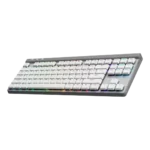
Logitech G515 Lightspeed Feature Scores
Explore all 51 feature scores for Logitech G515 Lightspeed, organized into pros and cons.
Scores by Feature
Summary
51 reviewed features-
Very positive 4.5-5.018 (35%)
-
Positive 3.5-4.423 (45%)
-
Neutral 2.5-3.44 (8%)
-
Negative 1.5-2.46 (12%)
Pros
Sort
-
Wireless performance was one of the strongest consensus points, with Lightspeed repeatedly described as stable, rock solid, and essentially lag-free.
-
Typing feel was one of the most consistently praised attributes, often described as satisfying, superb, smooth, or excellent for productivity.
-
Gaming performance was consistently strong, with reviewers describing responsive, reliable, and enjoyable play across shooters and general gaming.
-
Switch feel was strongly praised across reviews for smooth, tactile, snappy, and comfortable low-profile action, though a few preferences varied.
-
Macro customization was a standout strength, with repeated praise for KEYCONTROL, layers, per-key assignments, and up to 15 functions per key.
-
The design was widely praised as slim, clean, mature, and desk-friendly, with only a few reviewers calling the plastic look more generic.
-
Latency impressions were excellent over Lightspeed, with reviewers repeatedly saying the wireless connection felt indistinguishable from wired or showed no noticeable delay.
-
Responsiveness was a major strength, supported by short actuation, fast-feeling inputs, and good results in games.
-
Sound dampening was one of the clearest strengths, with many reviews crediting foam and lubrication for a quieter, more refined sound.
-
Keycap quality was mostly praised for PBT material, texture, grip, and shine-through legends, with isolated complaints about smoothness, wobble, or QC.
-
Customization was one of the strongest themes, with reviewers praising broad remapping, profiles, lighting control, and KEYCONTROL depth.
-
RGB customization was a strong point, with reviewers highlighting per-key color, effects, animations, presets, and deep G Hub control.
-
Value was generally positive because reviewers saw it as cheaper than premium Logitech alternatives while preserving most everyday strengths.
-
Build quality was usually praised as sturdy and substantial despite the plastic chassis, with a smaller set of reviews noticing cost-cutting or QC drawbacks.
-
Noise levels were widely praised as quiet or muted for a mechanical gaming keyboard, helped by low-profile switches and dampening.
-
The slim low-profile TKL form factor was consistently liked for balancing compactness, desk fit, and a familiar key layout.
-
Battery life drew mostly positive reactions in real-world use, especially with lighting managed, but several reviewers said it trails some competing wireless boards.
-
Typing comfort was a major strength, with reviewers adapting quickly and reporting comfortable, accurate, or error-free work sessions.
-
Software was mostly praised for depth and polish, especially G Hub and KEYCONTROL, though some reviewers found it dense, difficult, or resource-heavy.
-
RGB lighting quality was generally praised for clean, bright, or tasteful output, though some reviews noted uneven or dimmer areas.
-
Most ergonomic comments were positive, citing the low profile, usable tilt options, and comfortable angles for typing without a wrist rest.
-
Profile management was viewed positively, with reviewers liking per-game or per-app profiles, shared presets, and onboard profile storage.
-
Materials quality was generally seen as good for the price, especially the plastic and PBT keycaps, though not as premium as metal-bodied models.
-
Reviewers liked the mix of Lightspeed, Bluetooth, and wired modes, but Bluetooth limitations and single-profile comments kept this from being uniformly perfect.
-
Reviewers generally found the sound profile controlled and pleasant for a mainstream low-profile gaming board, though one noted some plastic-on-plastic character.
-
Frame rigidity was praised, with several reviewers reporting little to no flex despite the all-plastic construction.
-
Portability was helped by the slim TKL size, dongle storage, and light-enough weight, though the lack of a carry case limited one reviewer's enthusiasm.
-
The TKL layout was considered easy to adapt to and standard enough for broad use, though numpad users may miss the extra keys.
-
Onboard memory was positively received because it lets users carry profiles or settings without relying on G Hub on every PC.
-
Stabilizer impressions were mixed-positive: several reviewers found little wobble or rattle, while one noted rattling typical of prebuilts.
-
Key spacing was generally comfortable and familiar, with reviewers saying the standard layout avoided a steep learning curve.
-
Durability evidence was positive, focused on confidence in the construction and long-wearing PBT keycaps or replaceable-battery longevity.
-
Reliability was mostly positive for actual use, especially wireless stability and gaming dependability, but one review raised a double-pressing concern.
-
The included USB-C cable was described as generous, flexible, and reasonably protected, with no major complaints about charging or wired use.
-
The strongest actuation comments described the tactile switches as consistent across keys and comfortable under repeated use.
-
The TKL layout was treated as a useful space saver for mouse movement and cleaner desks, especially for users who do not need a numpad.
-
Game Mode and key-disabling options were useful, but reviewers repeatedly noted the G515 is light on extra hardware features.
-
Key stability was mixed: some reviews found wobble minimal or improved, while others complained about loose keycaps or rattle.
-
Polling-rate evidence was mixed: one review praised the steady 1,000 Hz implementation, while others treated missing adjustable polling as a competitive-feature gap.
-
Per-key RGB control was cited as a meaningful gamer-friendly advantage over some alternatives.
-
Compatibility evidence centered on useful macOS support and a limitation around single-device Bluetooth, making it good but not universally flexible.
Cons
Sort
-
Volume control was a frequent complaint because many reviewers wanted a dial or wheel instead of function-layer shortcuts.
-
Wrist-rest evidence was negative because several reviewers noted the G515 does not include one, even if the low profile softened the impact.
-
Hot-swap support was a clear weakness: reviewers repeatedly noted the switches are not hot-swappable or customizable at the hardware level.
-
Media controls were one of the most repeated weaknesses because reviewers missed dedicated buttons and disliked relying on function-key shortcuts.
-
Switch replacement scored poorly because the switches are soldered, limiting hardware customizability.
-
Rapid trigger support scored poorly because a reviewer specifically cited its absence versus similarly priced gaming boards.
-
USB passthrough was only discussed as an absence, and that absence was framed as a potential weakness.
-
Switch options were limited in one review's view because the G515 lacks a clicky option and offers only tactile or linear.
-
Brightness impressions were mixed: some found it sufficient or excellent, while others thought parts of the legends or overall lighting were dimmer than competitors.
-
Legend visibility was uneven: shine-through legends were often readable, but some reviews found uneven lighting, darker legend areas, or non-backlit regional characters.