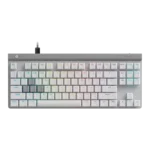
Logitech G515 Rapid Feature Scores
Explore all 44 feature scores for Logitech G515 Rapid, organized into pros and cons.
Scores by Feature
Summary
44 reviewed features-
Very positive 4.5-5.019 (43%)
-
Positive 3.5-4.414 (32%)
-
Neutral 2.5-3.48 (18%)
-
Negative 1.5-2.43 (7%)
Pros
Sort
-
Key responsiveness was consistently praised, especially for rapid movements, immediate input response, and magnetic switch speed.
-
Build quality was one of the strongest areas, with repeated praise for sturdy construction, premium feel, steel reinforcement, and minimal flex; one reviewer still found the plastic package less premium than rivals.
-
Gaming performance was the clearest consensus strength, with reviewers describing fast, responsive, competitive-focused performance and tangible in-game advantages.
-
Customization was a major strength, especially per-key actuation, key remapping, RGB, macros, and deep G Hub tuning.
-
The design earned broad praise for its slim, clean, professional look, two-tone styling, and attractive desk presence.
-
Rapid Trigger was strongly praised across reviews as a meaningful competitive feature for faster resets, movement, and repeat inputs.
-
Frame rigidity scored very well, with reviewers repeatedly noting steel reinforcement, heft, no flex, and strong desk stability.
-
Size and form factor were consistently praised for the very slim 22mm low-profile build and compact TKL footprint.
-
Noise level was a strength, with reviewers describing the keyboard as quiet, shared-space friendly, and quieter than many mechanical alternatives.
-
Macro and remapping support was praised as powerful, flexible, and useful through G Hub.
-
Keycap quality was praised for textured double-shot PBT, strong feel, and resistance to shine.
-
Reviewers generally liked the board's muted, clean sound, praising its rattle-free tone, satisfying thud, and audible-but-quiet character.
-
Ergonomics were praised for the low height, adjustable feet, relaxed hand position, and reduced strain over longer sessions.
-
Materials quality was viewed positively thanks to premium-feeling finishes, double-shot PBT caps, and rigid steel reinforcement.
-
Sound dampening was praised for reducing echo and creating a quieter, more controlled acoustic profile.
-
Software quality was mixed: G Hub is powerful and often easy to use, but some reviewers found it clunky, unfriendly, or unreliable with profiles.
-
Switch feel divided reviewers: many liked the smooth, satisfying magnetic switches, while others found the low-profile feel mushy, hollow, or too soft for typing.
-
RGB lighting quality was mixed: several reviewers liked the crisp, vibrant lighting, while others found uneven illumination on larger keys.
-
Durability impressions were positive where reviewers discussed lasting materials, especially sturdy PBT keycaps and a premium-feeling chassis.
-
The TKL layout was praised for saving desk space and leaving more mouse room while preserving most major controls.
-
RGB customization was generally praised through G Hub, though one reviewer disliked needing software for even small lighting tweaks.
-
The TKL layout was mostly viewed as clean and space-saving, but users who need a numpad or more top controls may miss them.
-
Per-key lighting control was positively described through G Hub, especially where RGB can be customized individually alongside actuation.
-
Adjustable actuation was praised when used per key, though the short low-profile travel made multi-stage precision harder in one review.
-
Reliability evidence was limited but favorable, with reviewers noting no issues during use and no problems on a newer rig.
-
Latency was considered strong for wired competitive use, though one review noted the absence of newer 8K polling limits the ceiling.
-
Value was mixed: some reviewers justified the price through performance and customization, while others saw wired-only or plastic construction as too expensive.
-
Stabilizer quality was positively noted in one detailed review, which found no rattle, echo, or sense of poor key mounting.
-
Extra gaming functions were useful for rapid input and multi-action setups, but one reviewer found multi-actuation less versatile or not personally useful.
-
Onboard memory was praised in the one review that evaluated it, because saved setups can follow the keyboard to another PC.
-
Portability evidence was limited but positive, with one reviewer emphasizing the light, lithe 800-gram design.
-
Backlight diffusion was judged clean in one hands-on review, though lighting criticism appeared more often around uneven legends than raw brightness.
-
Key spacing split reviewers: one found the keys not cramped, while another reported missteps during fast gaming and typing.
Cons
Sort
-
Volume control was repeatedly criticized because reviewers missed a dedicated dial or roller and disliked relying on secondary key functions.
-
Media controls were one of the most repeated complaints, with reviewers missing dedicated media keys, extra physical controls, or a volume roller.
-
Wireless performance scored poorly because reviewers treated the complete lack of wireless connectivity as a major lost convenience.
-
Analog-style depth control exists, but reviewers said the low-profile implementation is weak for joystick-like or gradual analog uses such as driving or flight games.
-
Connectivity was a tradeoff: reviewers accepted wired consistency for competitive play, but repeatedly criticized the lack of wireless versatility and desk tidiness.
-
Legend visibility was a recurring lighting weakness, with uneven illumination on longer legends and local-language legend backlighting called out.
-
Key stability had a notable caveat, with one reviewer calling out minor but definite keycap wobble during rapid presses.
-
Polling rate drew a caveat: the 1,000 Hz implementation was usable, but the missing 8K option limited its premium competitive spec sheet.
-
Profile management was mixed: reviewers liked profile features, but several criticized cumbersome onboard saving or unreliable automatic switching.
-
Typing feel was the most mixed core experience: some loved the smooth, quiet action, while others found it soft, hollow, mushy, or underwhelming.
-
Typing comfort was highly preference-dependent, ranging from smooth and comfortable for long sessions to too soft or uncomfortable for extended productivity.