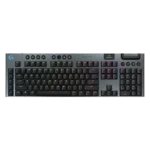
Logitech G915 X Lightspeed Feature Scores
Explore all 51 feature scores for Logitech G915 X Lightspeed, organized into pros and cons.
Scores by Feature
Summary
51 reviewed features-
Very positive 4.5-5.015 (29%)
-
Positive 3.5-4.425 (49%)
-
Neutral 2.5-3.48 (16%)
-
Negative 1.5-2.43 (6%)
Pros
Sort
-
Wireless performance was one of the strongest positives, with reviewers repeatedly describing Lightspeed as low-latency, stable, and close to wired.
-
Customization options were a major strength thanks to remapping layers, G-Shift, Keycontrol, lighting controls, and broad key assignment options.
-
Macro customization was a major strength, especially on the full-size model with G keys, app-specific macros, and deep assignment layers.
-
Gaming performance was broadly positive, with reviewers describing the keyboard as responsive, capable, and suitable even for competitive play, despite some rival-performance caveats.
-
Frame rigidity was one of the strongest areas, with reviewers repeatedly reporting little to no flex and a rigid aluminum-reinforced frame.
-
Design aesthetics were consistently praised for a sleek, premium, low-profile look that fit both gaming and professional desks.
-
Connectivity was widely praised for tri-mode flexibility and easy switching, with the main caveat being limited multi-device Bluetooth support.
-
Battery life was one of the strongest recurring positives, usually described as solid to excellent depending on RGB brightness.
-
Keycap quality was mostly praised for PBT texture, durability, and resistance to shine, though some reviewers still found the feel cheap or scratchy.
-
Latency was consistently praised in Lightspeed or wired use, with reviewers reporting no noticeable lag and very low input delay.
-
Volume control was consistently praised for the large smooth roller, its responsiveness, and its daily convenience.
-
Build quality was generally praised for a sturdy, premium body, though a few reviewers felt it was only mediocre or less premium than rivals.
-
Media controls were usually praised, especially the dedicated top controls, though some reviewers found them wasteful or less tactile than main switches.
-
Key responsiveness was generally praised for shallow actuation and snappy inputs, though one negative reviewer found the tactile switch actuation unclear.
-
RGB customization was strong overall, with many lighting effects and per-key options, but some reviewers found G Hub lighting tools limited or underwhelming.
-
Key stability improved over prior models, with reviewers noting reduced wobble, stable keys, and less rattling.
-
Typing feel was often praised as satisfying and tactile, though one negative reviewer found it poor and mushy.
-
Typing comfort was generally positive for low-profile use and long sessions, but cramped layout, shallow angle, and enthusiast feel concerns created mixed opinions.
-
Profile management was generally useful for app and game-specific setups, but some dependence on G Hub remained a limitation.
-
Switch feel was mixed but leaned positive: many liked the tactile, smooth, or balanced feel, while detractors found the switches mushy or resistant.
-
RGB lighting quality was mostly praised for brightness and evenness, though uneven legend illumination and reliance on RGB for visibility were drawbacks.
-
Per-key lighting control was well supported, with reviewers praising individual key lighting and detailed color control through G Hub.
-
Materials quality was mostly praised for aluminum, PBT, and premium finishes, though one reviewer felt the light body still seemed plasticky.
-
Durability evidence focused on improved PBT keycaps and stronger long-term wear resistance, with reviewers expecting better resistance to shine and damage.
-
Cable feedback was mostly positive for length, USB-C charging, and acceptable quality, with one reviewer noting the loss of the old braided cable.
-
Size and form factor were praised for slimness and compact TKL efficiency, but some reviewers still found layouts cramped or moderately sized.
-
Portability was better on TKL models, which reviewers said could travel easily, while full-size and fragile-feeling concerns reduced enthusiasm.
-
Backlighting brightness was praised as bright and useful, especially with per-key lighting, though it directly affected battery expectations.
-
Software quality was highly mixed: some reviewers liked G Hub's interface and power, while others called it awful, convoluted, unintuitive, or limited.
-
Switch options were appreciated for offering tactile, linear, and clicky choices, though buyers must choose before purchase.
-
Value for money was the most divided area: some reviewers said the feature set justified the price, while others found it overpriced against rivals.
-
Ergonomics were mixed: low-profile typing and adjustable feet helped some reviewers, while shallow tilt or sensitivity frustrated others.
-
Reliability evidence was generally positive for spill survival and issue-free use, though wake-from-sleep sluggishness was a minor frustration.
-
Desk space efficiency depended on layout: TKL models were praised for saving space, while the full-size model was criticized for taking more room.
-
Key spacing was mixed: roomy spacing helped typing for some, while the left-side G keys and cramped TKL layout caused awkwardness for others.
-
Stabilizer quality received limited but strong praise, with the space bar described as solid no matter where it was pressed.
-
Legend visibility was mixed: some reviewers found the legends legible and durable, while others said visibility suffers when RGB is off or uneven.
-
Extra gaming features received limited but positive evidence, especially for configurable Game Mode and key blocking.
-
Layout options received limited positive evidence, with the full-size layout described as sensible and complete.
-
Actuation consistency received limited but positive evidence, with the linear switches described as smooth and consistent.
Cons
Sort
-
Hot-swappable switch support was consistently criticized because the switches are soldered and cannot be easily replaced.
-
Ease of switch replacement was a clear weakness because reviewers repeatedly criticized soldered, non-hot-swappable switches.
-
Analog input support was a weakness because reviewers noted competing boards offered analog functionality while the G915 X did not.
-
Sound dampening was a weakness in the limited evidence, with one reviewer saying Logitech lacked the foam and tuning used by more enthusiast boards.
-
Rapid trigger support was a weakness because reviewers noted the G915 X lacks rapid trigger while competitors offer it.
-
Wrist rest feedback was mixed because the low profile reduced the need for one, but multiple reviewers disliked that no palm or wrist support was included.
-
Onboard memory was mixed: one reviewer valued portable saved profiles, while another found onboard support too limited for complex macros.
-
Polling rate was mixed: one reviewer found 1,000 Hz steady and suitable, while another criticized it as capped versus newer high-end boards.
-
Compatibility was mixed: reviewers liked Windows, macOS, Bluetooth, and USB use, but called out missing Bolt/Unifying support, Linux gaps, and limited Bluetooth switching.
-
Reviewers were split on acoustics: tactile/clicky sounds were sometimes satisfying or improved, but rattling, ping, and membrane-like notes bothered enthusiasts.
-
Noise level was mixed: some found tactile switches muted or mic-friendly, while others called the board clicky, loud, or mushy-sounding.