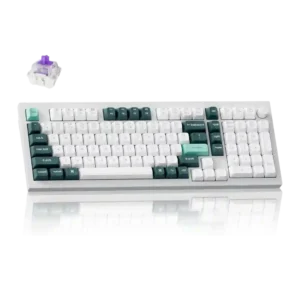
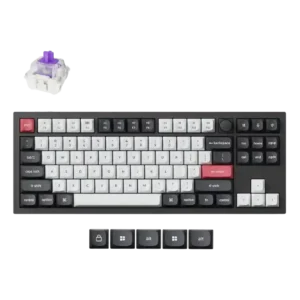
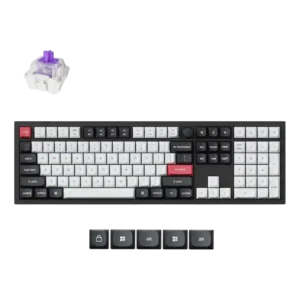
- Alternative: layout and desk-space needs The reviewer says the TKL version is a good alternative when the extra keys or numpad are unnecessary.
- Older model: battery life, feel, and build quality The G915 X is described as better than the older G915 in the areas that matter to the reviewer.
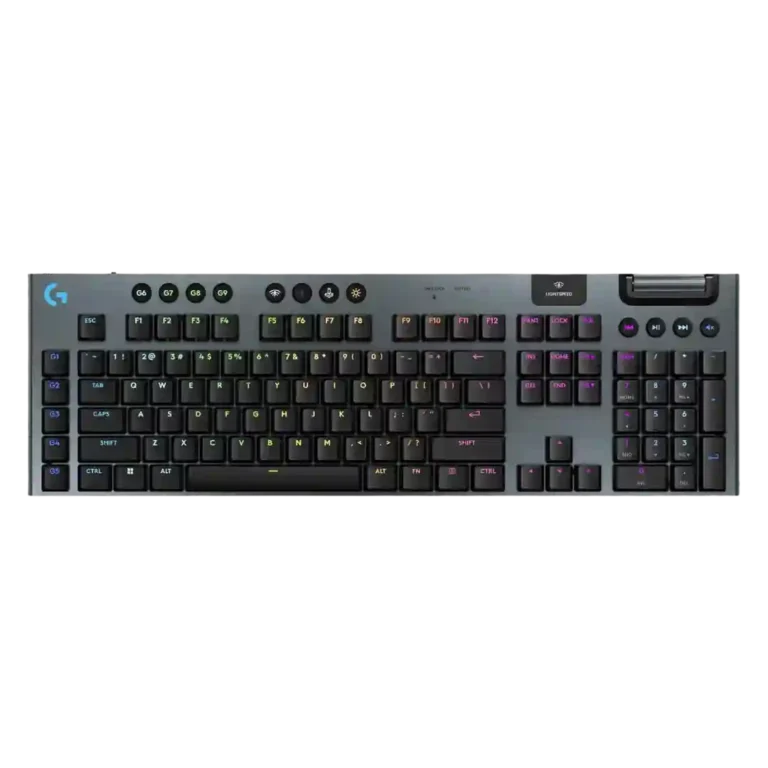
Logitech G915 X Lightspeed Review
Bottom Line
Choose the Logitech G915 X Lightspeed if you want a slim, premium wireless keyboard with strong battery life, macro depth, and media controls. Skip it if you need hot-swappable switches, analog or rapid-trigger features, quieter acoustics, or a lower price.
It best fits gamers and productivity users who want a refined low-profile wireless keyboard with strong Lightspeed performance, long battery life, dedicated media controls, and deep macro/profile customization.
It is not ideal for switch enthusiasts, bargain shoppers, users who need analog or rapid-trigger features, or anyone who wants quieter acoustics without relying on Logitech G Hub.
Reviewers frame the Logitech G915 X Lightspeed as a polished low-profile board that balances gaming and productivity better than most mainstream wireless keyboards. Its strongest evidence is the rigid aluminum build, fast Lightspeed connection, long battery life, useful media controls, and unusually deep G Hub remapping with G keys and profile layers. The tradeoff is that its premium price buys refinement more than enthusiast flexibility: multiple reviewers point to non-hot-swappable switches, missing analog and rapid-trigger functions, and software that ranges from clean to frustrating. Typing feel is generally praised, especially with tactile switches, but louder clacks, rattle, spring ping, or cramped TKL ergonomics appear often enough to make preference matter.
Compared in Reviews
Products reviewers directly compared with this model, grouped into quick takeaways.
- Compared: price and similar dimensions The G515 is framed as a less premium but similarly sized cheaper alternative.
- Compared: premium keyboard pricing The reviewer positions the G915 X against other premium keyboards including the BlackWidow V4 Pro.
Feature Scorecards
Pros
-
Stabilizer evidence is limited but positive, with PCMag specifically praising the space bar stability.
-
Frame rigidity is one of the clearest strengths: reviewers repeatedly report little to no flex, creaking, or warping.
-
Latency is a major strength: reviewers describe no noticeable lag, near-wired behavior, and strong Lightspeed responsiveness in gaming.
-
Connectivity is a consistent strength, with repeated support for Lightspeed, Bluetooth, wired USB, and easy switching between modes.
-
Wireless performance is one of the strongest areas, with reviewers reporting solid connections, no perceptible lag, no range issues, or wired-like behavior.
-
Per-key lighting control is supported by individual key lighting customization and per-key RGB, making lighting control a clear feature rather than only preset lighting.
-
Macro customization is a major strength, with G keys, KEYCONTROL, and remappable commands repeatedly highlighted for gaming and productivity.
-
Customization options are broad overall, especially with remapping, layers, per-key functions, and keycap changes, but not every reviewer found the options expansive.
-
Gaming performance is a strength, with reviewers calling it top notch, competitive, speedy, and responsive in FPS and other games.
-
Durability evidence centers on PBT keycaps, tough construction, and reviewers saying the board withstood abuse or feels built to last.
-
Extra gaming features are supported by Game Mode and programmable G-keys, though fewer reviews focus on this as a separate category.
-
Volume control is a standout feature, with many reviewers praising the roller’s smoothness, responsiveness, size, or everyday usefulness.
-
Materials quality is mostly praised for brushed aluminum, metal top plates, and premium finishes, with only isolated criticism around lighter plastic feel.
-
Profile management is strong, with evidence for app-specific assignments, productivity and gaming profiles, software profiles, and onboard profile saving.
-
Build quality is consistently strong, with reviewers emphasizing premium feel, sturdy construction, and well-built aluminum-heavy design.
-
The short 1.3 mm actuation and light GL switches are repeatedly tied to fast, responsive inputs, though sensitivity can cause accidental or double presses for some users.
-
RGB lighting quality is generally strong, with bright, even, per-key lighting, although one review says only that it shines through well rather than offering advanced effects.
-
Layout options are strong because reviewers discuss full-size and TKL versions, with full-size offering more keys and TKL serving portability or space needs.
-
Reviewers consistently note the choice of tactile, linear, and clicky low-profile switch options, with availability varying by color or model in some reviews.
-
Battery life is consistently strong, especially with RGB reduced or off, though full-brightness estimates fall closer to the 30–46 hour range.
-
Backlight brightness is praised through dedicated brightness controls and comments that the lighting gets very bright.
-
Keycap quality is usually praised for double-shot PBT texture, durability, and wear resistance, though a few reviews found the texture or premium feel lacking.
-
Media controls are well liked, with reviewers repeatedly praising dedicated media keys and their placement or feel.
-
Reliability is mostly positive, with water survival, stable connection, and wake behavior praised, but one reviewer noted sluggish wake-up behavior.
-
Key stability is broadly improved over older versions, with reduced wobble and stable keys, though one review flags low grip and sliding out of position.
-
Size and form factor are central strengths for TKL and low-profile models, though the full-size version can take more desk space.
-
Typing comfort is usually positive, especially with roomy layouts or low profile, though cramped TKL layout and adaptation issues appear in some reviews.
-
Typing feel is mostly positive, described as satisfying, responsive, and comfortable, but a few reviewers found it less premium or plainly not very good.
-
RGB customization is well supported through G Hub effects and per-key color control, but several reviewers found the controls limited, underwhelming, or too click-heavy.
-
Polling-rate evidence is positive when reviewers cite 1 ms or 1,000 Hz Lightspeed behavior, but one reviewer criticizes the fixed 1,000 Hz ceiling against newer high-end rivals.
-
Cable quality is adequate to good: reviews praise USB-C, useful extenders, and cable length, but one notes the cable is no longer braided.
-
Ergonomics are generally good thanks to low profile, multiple feet angles, and wrist-strain reduction, but some reviewers found tilt or layout less comfortable.
-
Switch feel is generally praised for smooth, tactile, or precise low-profile action, but one dissenting review found the tactile switches mushy and hard to read at actuation.
-
Key spacing is mixed: one reviewer liked the spaced function groups and another liked added space, while PC Gamer found G-keys interfered with modifier-key orientation.
-
Desk space efficiency depends on model: TKL reviews praise compactness and mouse-space gains, while full-size reviews note a larger footprint.
-
Onboard memory is useful but limited: reviewers mention saving profiles or lighting/macros, while one notes complex macros and G-Shift do not fully carry over.
-
Actuation consistency is mostly supported by smooth, stable, shallow keypresses, but a negative tactile-switch review reports mushiness that made actuation harder to identify.
-
Compatibility is mixed: reviewers like aftermarket keycap stems and Bluetooth/G Hub behavior, but criticize missing multi-device Bluetooth and lack of Bolt or Unify support.
-
Portability is good for TKL and slim models, but the full-size version is less backpack-friendly and can feel fragile to carry for one reviewer.
-
Acoustics are mixed: some reviews praise smoother or softer sound, while others hear rattle, spring ping, or intentional clack.
-
Noise level varies heavily by switch and reviewer, ranging from soft and muted to clicky, loud, rattly, or chonky.
Cons
-
Legend visibility is mixed: some reviewers praise bright legends, while others say legends become hard to read when RGB is off or unevenly lit.
-
Software quality is split; reviewers praise clean or easy G Hub behavior, but several complain about bugs, confusing navigation, or required background software.
-
Value for money is the most divided attribute: several reviewers say it is worth the premium, while others call it pricey, overpriced, or a poor upgrade value.
-
Sound dampening is a weakness in the limited evidence; reviewers compare it against boards with dampening or note missing foams.
-
Wrist-rest evidence is negative or conditional: reviewers note no included palm or wrist support, while one says the low profile may not require one.
-
Analog input support is also a limitation; reviewers directly note the lack of analog keys or compare the G915 X unfavorably with analog-switch competitors.
-
Rapid trigger support is a clear limitation because reviewers mention it as absent or as an advanced feature found on competing boards.
-
Hot-swappable switch support is poor; multiple reviewers explicitly say the switches are not hot-swappable.
-
Ease of switch replacement is poor because the switches are not hot-swappable and would not be simple to replace.
Compared With Category Average
Compared with other Gaming Keyboard, this product is above average in wireless performance, switch options, connectivity, below average in ease of switch replacement, hot-swappable switches, rapid trigger support.
| Attribute | This product | Category average | Difference |
|---|---|---|---|
| ease of switch replacement | 1.0 | 3.4 | -2.4 |
| hot-swappable switches | 1.0 | 3.3 | -2.3 |
| rapid trigger support | 1.3 | 3.5 | -2.2 |
| analog input support | 1.3 | 3.2 | -1.9 |
| sound dampening | 2.5 | 4.1 | -1.6 |
| wireless performance | 4.6 | 3.2 | +1.4 |
| switch options | 4.5 | 3.5 | +1.0 |
| connectivity | 4.6 | 3.9 | +0.7 |
FAQ
Is the Logitech G915 X Lightspeed good for gaming?
Yes. Reviews repeatedly describe fast actuation, strong Lightspeed wireless performance, and no noticeable input lag, with several reviewers using it successfully in competitive or fast-paced games.
How good is the battery life?
Battery life is a major strength, but it depends heavily on RGB. Reviewers cite roughly 30–46 hours at high brightness, much longer runtimes at reduced brightness, and hundreds of hours with lighting off.
Are the switches hot-swappable?
No. Multiple reviewers explicitly state that the switches are not hot-swappable, even though keycaps are easier to replace thanks to the newer cross-stem design.
Does it support analog input or rapid trigger?
No meaningful review evidence supports analog input or rapid trigger on this keyboard. Reviewers instead point to those as features found on some competing higher-end boards.
Is the G Hub software good?
Reviews are split. G Hub enables strong remapping, macros, profiles, lighting, and game mode controls, but several reviewers found it confusing, buggy, or too necessary for advanced features.
Is the TKL or full-size version better?
The TKL version is better for desk space and portability, while the full-size model is better for users who want a numpad and more dedicated G keys. Reviewers praised both but noted different tradeoffs.
Consider This Instead
If you want better hot-swappable switches
Choose Corsair K65 Plus. It scores 5.0 vs 1.0 for hot-swappable switches, with a 4.1 overall score.
If you want better ease of switch replacement
Choose Glorious GMMK 3 HE. It scores 4.9 vs 1.0 for ease of switch replacement, with a 4.1 overall score.
If you want better rapid trigger support
Choose Keychron Q3 HE 8K. It scores 5.0 vs 1.3 for rapid trigger support, with a 4.5 overall score.
If you want better analog input support
Choose Logitech G PRO X Keyboard. It scores 4.7 vs 1.3 for analog input support, with a 3.8 overall score.
Overall Top Gaming Keyboard Alternatives
Best for 8K polling, magnetic-switch gaming control, premium build, and deep web customization. Skip it if you need broad switch compatibility, USB passthrough, a wrist rest, or a portable keyboard.
Pros: latency, polling rate
Cons: portability, switch options
Good if you want a premium full-size Hall Effect keyboard with smooth switches, strong gaming controls, and quiet acoustics. Skip it if you need a portable, budget, or broadly switch-compatible...
Pros: key stability, frame rigidity
Cons: portability, switch options
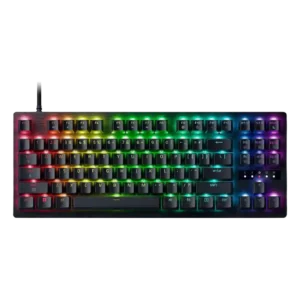
Best for a premium, quiet Hall Effect TKL with strong wireless, software, and gaming features. Skip it if price, switch flexibility, USB passthrough, or an included wrist rest matter most.
Pros: rapid trigger support, typing feel
Cons: switch options, portability
Best for a premium 96% metal keyboard with Hall Effect tuning, strong wireless, and excellent typing feel. Skip it for travel, bargain pricing, or maximum esports specs.
Pros: build quality, frame rigidity
Cons: portability, switch options