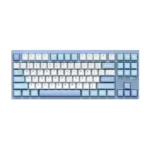
McHose GX87 Keyboard Feature Scores
Explore all 41 feature scores for McHose GX87 Keyboard, organized into pros and cons.
Scores by Feature
Summary
41 reviewed features-
Very positive 4.5-5.019 (46%)
-
Positive 3.5-4.417 (41%)
-
Neutral 2.5-3.43 (7%)
-
Negative 1.5-2.42 (5%)
Pros
Sort
-
Customization options were a major strength, especially the magnetic or ball-catch quick-disassembly case, hot-swap design, and easy access for mods.
-
Value for money was one of the strongest areas, with reviewers repeatedly calling the keyboard exceptional for its price and feature set.
-
Build quality was a major point of agreement, with every review giving positive evidence around the aluminum body, dense feel, assembly, or lack of flex.
-
Acoustics were a standout strength, with reviewers repeatedly praising the thocky, poppy, solid, and very nice sound.
-
Typing feel was one of the strongest areas, with reviewers calling it joyful, great, smooth, and close to ideal.
-
Hot-swappable switches were consistently treated as a benefit because users can replace switches without soldering and personalize the board.
-
Battery life was strongly praised, with reviewers emphasizing the large 8,000 mAh capacity and long time between charges.
-
Switch replacement was mostly easy thanks to tool-free access and hot-swap sockets, though one reviewer found reinstalling switches harder because the PCB flexes.
-
Reviewers generally liked the switch feel, calling the Vintage White or stock linear switches smooth, responsive, crisp, and satisfying, with only mild scratchiness or preference-based caveats.
-
Typing comfort was praised across reviews for its bouncy gasket feel, smooth typing, and balanced flex, though one reviewer found it slightly firm.
-
Design aesthetics were generally positive for clean, premium, and attractive looks, but some reviewers found the styling mundane or noticed mismatched colors.
-
Frame rigidity was mostly praised for its solid, flex-free construction, though the quick-release design was seen by one reviewer as less sturdy than screws.
-
Sound dampening was praised for reducing ping, refining the sound, and isolating vibration through the case design and internal layers.
-
Materials quality was praised for the aluminum case, smooth finish, premium feel, and solid components.
-
Software quality was mostly praised for VIA, QMK, and the dedicated MCHOSE software, with caveats around VIA being basic and RGB customization sometimes clunky.
-
Keycap quality was praised for PBT material, thickness, durability, and a profile that helped typing accuracy.
-
Key response was consistently praised, with reviewers describing the keys or switches as responsive and accurate enough for both typing and gaming.
-
Durability evidence centered on the solid aluminum build and PBT keycaps, which reviewers linked to lasting use.
-
Latency impressions were positive overall, helped by 1,000 Hz operation and an ultra-low-latency mode, though this is still framed as strong budget performance rather than elite Hall Effect speed.
-
Reviewers treated the 1,000 Hz polling behavior as a strength, linking it to responsive inputs and low-latency use.
-
RGB customization was broadly useful, especially through VIA, QMK, or the MCHOSE software, though one reviewer found the RGB controls clunky.
-
Gaming performance was viewed as more than adequate for casual or hybrid use, with reviewers reporting competent play across first-person and general gaming sessions.
-
Compatibility evidence was positive where reviewers connected QMK and VIA support to deep, flexible keyboard customization.
-
Macro customization was positively supported by reviewers who noted easy macro setup through VIA or QMK-style customization.
-
Stabilizer impressions were mixed: some reviewers found them tuned and issue-free, while others noted plate-mount tradeoffs or a need for more lube.
-
Extra gaming features received positive evidence from one reviewer who highlighted the ultra-low-latency mode as a surprise at this price.
-
Noise level received limited but positive evidence from a reviewer who described the sound as muted and thocky rather than harsh.
-
Onboard memory was positively supported by stored keyboard customizations that persist when moving between devices.
-
Profile management was supported by the ability to store customizations on the keyboard so settings persist across devices.
-
Key stability evidence was mixed: one reviewer disliked the plate-mounted stabilizer tradeoff, while another found the installed stabilizers secure and free of ticking.
-
Size and form factor earned positive evidence from one reviewer who found TKL a comfortable step down from full-size keyboards.
-
One reviewer found the switch actuation consistent, with only a slight scratchiness detectable during very slow presses.
-
Desk space efficiency was positive in one review, which liked that TKL saves space while leaving room for an optional macro pad.
-
Ergonomics received limited but positive evidence because the fixed typing angle was expected to be comfortable for most people.
-
Wireless performance received positive evidence from a reviewer who found the wireless functionality impressive and quick to reconnect.
-
RGB lighting quality was acceptable but not class-leading, with one reviewer saying the lighting options do not match bigger keyboard brands.
Cons
Sort
-
Cable quality was a weak point in one review, where the included cable was described as cheap and not very good.
-
Portability was a weakness because one reviewer said the heavy aluminum build makes it undesirable to carry to and from an office.
-
Switch choice was the clearest limitation: one reviewer wanted tactile options at checkout, while another wanted to try tactiles despite liking the included switches.
-
Reliability evidence was mixed to negative in one review due to occasional held-input recognition and rare multiple key registrations.
-
Connectivity was mixed: reviewers liked the wireless and tri-mode feature set, but noted mode-switch delay, visible front controls, and minor connectivity issues.