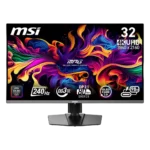
MSI MPG 322URX QD-OLED Feature Scores
Explore all 53 feature scores for MSI MPG 322URX QD-OLED, organized into pros and cons.
Scores by Feature
Summary
53 reviewed features-
Very positive 4.5-5.026 (49%)
-
Positive 3.5-4.414 (26%)
-
Neutral 2.5-3.48 (15%)
-
Negative 1.5-2.44 (8%)
-
Very negative below 1.51 (2%)
Pros
Sort
-
Color accuracy is a major strength, with strong factory calibration and excellent measured results after selecting the right mode. Minor warm white balance or preset differences were the main caveats.
-
Owners overwhelmingly describe the picture as beautiful, crisp, and dramatically better than previous LCD monitors. The combination of OLED blacks, vivid color, and 4K detail creates the strongest overall impression.
-
The 240Hz refresh rate delivers exceptionally smooth gameplay and desktop motion. The main limitation is the GPU power needed to approach 240 frames per second at 4K.
-
Motion clarity is consistently exceptional, with fast games looking crisp, fluid, and easy to track. This remains one of the monitor’s strongest gaming advantages.
-
The near-instant OLED response is universally praised, keeping action sharp and controls responsive. Reviewers found it among the best available for gaming.
-
Deep, inky blacks are one of the monitor’s most consistently praised strengths, giving dark games and HDR scenes exceptional depth. Bright ambient light can lift them toward purple or gray.
-
OLED contrast is effectively perfect, with bright elements set against truly dark pixels and none of the gray haze common to LCD panels. This is one of the strongest points of agreement.
-
4K detail and improved QD-OLED text rendering make images and text look crisp. Some fringing remains possible, and 27-inch 4K or LCD can look slightly sharper at close viewing distances.
-
Brief customer comments are overwhelmingly enthusiastic, often calling it the best monitor they have owned. These short reviews provide little detail beyond strong satisfaction.
-
The 32-inch 4K desktop is excellent for side-by-side windows, coding, editing, and mixed laptop/desktop use. Text clarity is strong for OLED, though 27-inch 4K or IPS can look slightly cleaner at close range.
-
The monitor is outstanding with a powerful gaming PC and works across a range of current GPUs. Reaching high frame rates at 4K requires expensive hardware, and some Mac-specific behavior is less reliable.
-
The large OLED panel excels in cinematic, horror, open-world, and HDR-heavy games. Deep blacks, vivid color, and scale make visually rich titles especially immersive.
-
The 4K resolution produces detailed games, sharp media, and a spacious desktop. It looks excellent at 32 inches, although 27-inch 4K remains slightly denser for close text work.
-
The faster USB hub, USB-C power delivery, and KVM switch are highly useful for sharing peripherals between systems. Some Mac wake behavior and default-disabled USB-C charging reduce polish.
-
Assembly, Windows configuration, and arm mounting were generally straightforward. Tool-free stand installation and clear basic setup earned repeated praise.
-
The QD-OLED panel covers a very wide range of color, with strong sRGB, DCI-P3, and HDR coverage. Reviewers consistently described colors as rich, vivid, and well saturated.
-
DisplayPort 2.1, two HDMI 2.1 ports, USB-C with power delivery, USB-A, and KVM support make the monitor highly flexible. The connection mix suits PCs, consoles, and laptops.
-
Dual HDMI 2.1 inputs and low latency work well with current Xbox and PlayStation consoles. Console-only players may not benefit enough from the expensive DisplayPort-focused upgrades.
-
The stand is sturdy and offers height, tilt, and swivel adjustment with smooth movement. Limited pivot and lack of full portrait rotation are the main ergonomic drawbacks.
-
Adaptive Sync and G-Sync keep gameplay free of tearing and stutter in the reviews that tested them. Motion stays especially clean at high frame rates.
-
Input lag is extremely low at high refresh rates, making controls feel immediate. One long-term user found it slightly less class-leading at 60Hz and 120Hz.
-
Most reviewers found the stand and chassis sturdy, stable, and easy to assemble. A few buyers reported loose fittings, dents, or other unit-specific defects.
-
Measured brightness and color uniformity were excellent overall, with only minor corner variation in some testing. Most users are unlikely to notice the small deviations.
-
The slim bezels, restrained branding, and clean black-and-silver styling suit both gaming and workspaces. A few reviewers found it plain or slightly gamer-oriented rather than distinctive.
-
The third-generation QD-OLED panel delivers a dramatic jump in contrast, color, and speed over typical IPS or TN screens. Its core panel performance is excellent, though largely unchanged from the previous MSI model.
-
HDR is often stunning in dark or mixed scenes, with vivid color, perfect blacks, and bright small highlights. Larger bright scenes and the choice between True Black 400 and Peak 1000 introduce noticeable compromises.
-
Most reviewers liked the responsive joystick and found the menus readable once learned. Others criticized split picture settings, confusing organization, or unreliable physical button presses.
-
The 32-inch screen creates strong immersion and useful workspace, especially on deeper desks. It can feel cumbersome in multi-monitor setups or cause discomfort when viewed too closely.
-
Near-instant response, 240Hz motion, and low latency make the monitor excellent for competitive play. Fully exploiting 4K at that speed still requires powerful hardware, and some AI aids may be best disabled.
-
Standard 100×100 VESA support makes arm mounting straightforward for most setups. The recessed mounting area can conflict with some quick-release systems, and the panel’s weight requires a sturdy arm.
-
DisplayPort 2.1 UHBR20 enables uncompressed 4K at 240Hz and adds future-facing bandwidth. Reviewers disagree on its present value, and several owners reported serious early DisplayPort failures.
-
Reviewers repeatedly reported crisp motion with little or no visible ghosting. OLED pixel response keeps fast action exceptionally clean.
-
Because each OLED pixel controls its own light, bright objects appear without blooming or halos. Reviewers described dark-scene separation as essentially ideal.
-
Viewing angles are essentially perfect, with little visible color shift from the side. The image remains consistent across wide seating positions.
-
Reviewers strongly praise the performance but disagree sharply on value. Sale prices near $1,000 can feel worthwhile, while the $1,300 launch price and small upgrade over the 321URX are frequently criticized.
-
The two HDMI 2.1 ports are well suited to consoles and high-bandwidth sources. One failed unit also showed severe HDMI color corruption after its DisplayPort stopped working.
-
The fanless heatsink and graphene-based cooling keep normal operation quiet. Two units in one customer report emitted a strong burning-electronics odor, creating a serious isolated concern.
-
G-Sync and Adaptive Sync support work broadly across PCs and consoles, keeping motion tear-free. Several reviewers still noticed the familiar OLED VRR flicker during loading screens or abrupt frame-rate changes.
-
The dark-area boost can make enemies easier to spot in competitive games. Reviewers preferred leaving it off for story-driven play because it weakens the OLED’s deep-black immersion.
-
MSI’s companion software provides picture-in-picture and picture-by-picture controls for multi-source setups. Feedback on actual day-to-day use was limited.
Cons
Sort
-
Support experiences were poor in the negative cases, with buyers describing referral loops, costly shipping, delayed refunds, and damaged RMA returns. These reports amplify concern around early hardware failures.
-
Several owners reported slow wake-up, repeated input searching, or failure to restore a signal after sleep or source switching. Power cycling or reopening a laptop was sometimes required.
-
The glossy coating scratches, smudges, and marks easily, so owners recommend careful cleaning with appropriate materials. Several buyers found maintenance unusually stressful.
-
Most units arrived intact, but several buyers received damaged packaging, dents, removed protective film, or signs of prior use. Delivery quality appears inconsistent.
-
Long sessions can cause fatigue for sensitive users, especially when the large screen is viewed too closely. One reviewer appreciated quick access to blue-light controls, but comfort feedback was limited.
-
MSI’s software can simplify control and firmware has improved some panel-care behavior. However, reviewers also reported confusing settings, failed updates, source-switching bugs, and one firmware update that bricked the monitor.
-
Panel-care tools and the three-year burn-in warranty reassure many owners, but maintenance prompts can be intrusive. More concerning, several buyers reported early DisplayPort failures, wake problems, bricked firmware, or complete unit failure.
-
The glossy coating preserves clarity and color depth, but windows and direct lights remain distracting. QD-OLED blacks can also take on a purple tint in bright rooms.
-
The monitor does not include built-in speakers, which disappointed buyers who expected them. A few customer posts described onboard audio, but expert testing and other owners explicitly found none.
-
Brightness is the clearest image-quality compromise. Small HDR highlights can look brilliant, but full-screen and bright-scene output trails Mini-LED and IPS alternatives, especially in daylight.
-
The sRGB and professional profiles can deliver balanced, accurate color, while some gaming presets add useful punch. The FPS mode and split menu organization drew criticism.
-
The stand cutout and downward-facing ports can keep cables reasonably organized. Thick high-bandwidth cables are still awkward to bend, and some reviewers wanted cleaner routing through the base.
-
The monitor looks substantial and high-end from the front, with a solid stand and thin panel. Plastic construction and a simplified logo keep it from feeling uniformly premium.