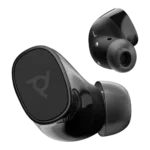
Poly Voyager Free 20 Earbuds Feature Scores
Explore all 47 feature scores for Poly Voyager Free 20 Earbuds, organized into pros and cons.
Scores by Feature
Summary
47 reviewed features-
Very positive 4.5-5.05 (11%)
-
Positive 3.5-4.430 (64%)
-
Neutral 2.5-3.45 (11%)
-
Negative 1.5-2.47 (15%)
Pros
Sort
-
Charging was a clear strength, with reviewers appreciating quick top-ups and wireless charging where mentioned.
-
Battery life was one of the more consistent strengths, with reviewers confirming long runtimes that fit workdays and extended listening sessions.
-
Reviewers generally praised ANC as effective for office chatter, engines, hums, and daily commuting, though one reviewer found it less impressive with sudden or higher-pitched disruptions.
-
Comfort was mostly a standout strength across reviews, including all-day wear praise, though one reviewer reported soreness after a couple of hours.
-
The design was generally viewed as sleek, professional, and more stylish than expected, with a restrained black-and-gold look.
-
Overall sound quality was broadly good to excellent for many reviewers, especially for calls and general listening, but music-focused reviewers found it less dynamic.
-
Call microphone quality was one of the product’s most consistent strengths, with reviewers describing clear, understandable, or great call performance.
-
Bluetooth was usually reliable with good range and seamless connection behavior, but one reviewer reported range falling short of the stated claim and another noted occasional dropouts.
-
Value depended heavily on price: reviewers called sale pricing excellent, while full price invited stronger competition.
-
Fit was usually praised as snug, secure, and supported by app-based fit testing.
-
Microphone noise reduction was praised for minimizing background noise and keeping voices clear in calls.
-
Multipoint was praised when seamless, simple, or handy, but one reviewer found switching delays and imperfect handoff behavior.
-
Midrange clarity was a consistent bright spot, with reviewers praising clear vocals and well-represented mids.
-
The Poly Lens app was often useful for settings, battery checks, updates, fit testing, and customization, but desktop limitations and EQ restrictions kept it from being universally praised.
-
The integrated microphones generally supported clear, understandable calls and were praised by callers in multiple reviews.
-
Weight comfort was a strength where mentioned, with lightweight earbuds contributing to extended-wear comfort.
-
Treble clarity was praised in music listening, though one review noted high-frequency distortion at maximum volume under a separate attribute.
-
Reviewers tended to separate the earbuds from the case: the buds themselves felt solid or premium, while the case drew more criticism.
-
Portability was praised for the compact case and pocket-friendly form.
-
Sensors were treated as useful convenience features, especially wear detection pausing and resuming media.
-
Physical stability was generally positive, with reviewers saying the buds did not slip and stayed in place securely.
-
Water and sweat resistance was useful for workouts and rain, but one reviewer warned against treating the rating as sink-proof.
-
Bass impressions varied sharply: some reviewers heard thumping or well-controlled low end, while others found it timid, compressed, or lacking energy for music.
-
Setup was often straightforward or app-guided, but firmware updates and confusing ANC choices created friction in some reviews.
-
Android use was supported by real-world Samsung pairing in one review, where switching among devices was described as seamless.
-
Instrument separation was praised in one detailed music test where the earbuds balanced vocals and bassline clearly.
-
Volume output received a positive remark in one video review, though detailed volume testing was limited.
-
Soundstage impressions ranged from merely solid to spacious and immersive, depending on the reviewer.
-
Multi-platform use was strong for phone/laptop switching in one review but less reliable for computer use in another.
-
Ear tip sizing was supported by a reviewer who found the large tips gave a secure fit, but broader praise was limited.
-
Find My-style location support was viewed positively when the app could locate the earbuds’ last known location.
-
Accessories and packaging received light praise for sturdy presentation and included tips, though this was not a major review focus.
-
USB-C was viewed positively as a modern, convenient charging choice.
-
Voice assistant integration was lightly praised through a versatile custom button, but it was not a major differentiator.
-
Passive isolation was described as decent by one reviewer, helped by the sealed earbud fit.
Cons
Sort
-
Smudge resistance was a recurring weakness because the glossy case attracted fingerprints and scratched quickly.
-
EQ customization was one of the most repeated criticisms, with reviewers wanting a multi-band or custom EQ instead of limited presets.
-
The lack of a dongle hurt computer and softphone convenience for reviewers who wanted stronger PC reliability or business-call controls.
-
Hinge durability was a concern because multiple reviewers described loose or fragile-feeling case hinges.
-
Sidetone adjustment was criticized because one reviewer said the Free 20 lacked that ability, making plugged-ear calls feel unnatural.
-
Spatial audio was a clear missing feature and was called out as a reason some buyers may prefer another model.
-
Case feedback was mixed to negative, with praise for style or magnet strength offset by complaints about plastic feel, loose hinges, fingerprints, and scratches.
-
The included USB-C cable drew a negative comment for being very short.
-
Controls were divisive: one reviewer liked reliable push buttons, but several found the physical buttons uncomfortable because pressing them pushed the buds into the ear.
-
Preset EQ quality was generally weak; reviewers liked Bass mode in some cases, but many found the presets limited or too similar.
-
Maximum-volume clarity had a caveat: one reviewer heard peaking and high-frequency distortion at max volume.
-
Transparency mode was mixed: some found it useful for conversation, while others said switching was limited or the mode simply amplified noise.