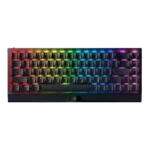
Razer BlackWidow V3 Mini HyperSpeed Feature Scores
Explore all 48 feature scores for Razer BlackWidow V3 Mini HyperSpeed, organized into pros and cons.
Scores by Feature
Summary
48 reviewed features-
Very positive 4.5-5.021 (44%)
-
Positive 3.5-4.417 (35%)
-
Neutral 2.5-3.45 (10%)
-
Negative 1.5-2.45 (10%)
Pros
Sort
-
Reviewers broadly liked the switch feel, especially the smooth Yellow switches and tactile Green option; the main caveat was that the light actuation could feel sensitive for some typists.
-
The compact 65% form factor was one of the strongest positives, repeatedly described as useful, functional, and well suited to gaming or travel.
-
Build quality was one of the strongest consensus areas, with reviews calling it excellent, sturdy, robust, substantial, and well built.
-
Gaming performance was a consistent highlight thanks to the compact footprint, quick switches, and responsive wireless, though one review reported a shift-key catch while gaming.
-
The 65% layout with arrows was widely praised as a useful middle ground, although some reviewers noted a learning curve and missing full-size keys.
-
Portability was consistently strong because reviewers liked the compact size, wireless use, travel friendliness, and easy movement around the home.
-
Desk space efficiency was highly praised, with reviewers valuing the extra mouse room, reduced footprint, and less clutter.
-
Latency feedback was mostly strong for wired and HyperSpeed use, with reviewers seeing little or no delay; lag mainly appeared with Bluetooth, low battery, or unified dongle issues.
-
Key responsiveness was a major strength, with reviewers repeatedly saying inputs felt fast, precise, and able to keep up during games and typing.
-
RGB lighting quality was praised as bright, vivid, even, and visually appealing across multiple reviews.
-
Wireless performance was usually excellent on HyperSpeed, but the unified dongle, Bluetooth, or interference produced notable negative cases in some reviews.
-
RGB customization was a clear strength, with reviewers noting broad Chroma color options, effects, sync, and onboard or software-based control.
-
Connectivity was broadly strong thanks to USB-C, Bluetooth, HyperSpeed, and multi-device support, but a few reviews noted buggy pairing or inconvenient mode switching.
-
Customization options were a major strength, with reviewers praising key remaps, macros, RGB, power settings, and broad Synapse controls.
-
Keycap quality drew praise for doubleshot ABS construction, clean legends, and durability, but reviewers still noted ABS tradeoffs such as slipperiness, shine, or clamminess.
-
Typing comfort was mostly positive once users adjusted, but prolonged work, cramped keys, and wrist fatigue produced mixed evidence.
-
Design aesthetics were mostly positive, with reviewers liking the sleek Razer styling, RGB look, and compact desk presence, though some found it plain or fingerprint-prone.
-
Durability evidence was strong, including confidence against scratches, surviving drops, child use, and expectations of long service life.
-
Software quality was generally good because Synapse is powerful and improved, but reviewers disliked dependence on it, navigation friction, and occasional bugs.
-
Frame rigidity scored well where discussed, with reviewers describing the keyboard as planted, rigid, free of flex, and unlikely to budge.
-
Cable quality was praised when mentioned, with reviewers liking the long, braided, thick cable and practical wired charging use.
-
Legend visibility was usually good, especially side legends and clean lettering, but a few reviewers criticized dark keys or non-backlit secondary legends.
-
Extra gaming features were praised for strong 65% gaming functionality, macro-ready keys, and dongle-related gaming features.
-
The Green and Yellow switch choices were viewed positively because they suit different typing and gaming preferences, though reviewers did not describe a wider switch ecosystem.
-
Sound dampening was praised in the Yellow-switch versions, with reviewers saying the dampeners made the board quieter and worked well.
-
Noise level was context-dependent: many found the Yellow switches relatively quiet, but reviewers stressed the board was not silent and could still bother people nearby.
-
Typing feel was generally smooth and satisfying, but compact-layout adjustment, sensitive switches, and accidental inputs made it mixed for heavier typists.
-
Onboard memory was useful for saved profiles and basic settings, but reviewers noted limitations such as RGB settings not carrying over.
-
Materials were generally praised for aluminum, textured plastic, and component quality, but one review criticized fingerprint-prone surfaces.
-
Key spacing was mostly praised for making inputs easier and avoiding distractions, with one review finding the keys slightly cramped.
-
Key stability evidence was mostly positive where scored, with reviewers noting no wobble or very minimal wobble on the keys they tested.
-
Acoustics were mixed: several reviewers liked the soft clack or subtle tap, while others heard pinging, rattle, or an irritating clack.
-
Profile management was helpful thanks to onboard/local profiles, though one review found toggling profiles unintuitive and onboard behavior limited.
-
Macro customization was useful for the right-side keys and software recording, but some reviewers found Synapse requirements or limited dedicated buttons restrictive.
-
One review specifically praised per-key RGB control through Synapse, supporting a strong score for granular lighting control.
-
One review gave explicit positive evidence for brightness, describing the RGB as nice, bright, and vivid.
-
One review gave clear positive evidence that key registration was consistent, saying every key registered as expected during typing and gaming.
-
One review gave positive opinionated evidence that swapping between the two sets of keys or switches was easy.
Cons
Sort
-
Stabilizer quality was the clearest repeated weakness, with reviews citing rattly stabilizers, loud larger keys, a catching shift key, and poor sound on stabilized keys.
-
Passthrough features scored poorly because a review explicitly criticized the lack of USB passthrough.
-
Wrist rest feedback was negative because reviewers felt the tall board needed a compact wrist rest and none was included.
-
Media controls were a drawback for reviewers who wanted dedicated keys and missed full-size media/function controls.
-
Compatibility scored low from one review because the keyboard could not connect to the reviewer’s PlayStation 5.
-
Volume control had limited negative evidence from one reviewer who specifically wanted a volume scroll wheel.
-
Value was divisive and often critical: the keyboard’s feature set impressed some reviewers, but most repeatedly called the price high, premium, or hard to justify.
-
Reliability had limited mixed evidence, with one review reporting missed keystrokes over Bluetooth.
-
Ergonomics were mixed: the small layout and feet could help posture, but height, wrist angle, and lack of palm rest caused discomfort for some.
-
Battery life was the most mixed major attribute: reviewers praised long life with lighting off or low, but full RGB drained the battery quickly.