- Compared: value versus other Razer premium keyboards The review says the BlackWidow V3 Pro may cost the same or less than the Mini.
- Cheaper: price without wireless The review notes buyers can spend less on the non-wireless BlackWidow V3.
Razer BlackWidow V3 Mini HyperSpeed Review
Bottom Line
Choose it if you want a premium compact wireless gaming keyboard with arrow keys, strong switches, and rich customization. Skip it if price, RGB-heavy battery drain, or rattly stabilizers will bother you.
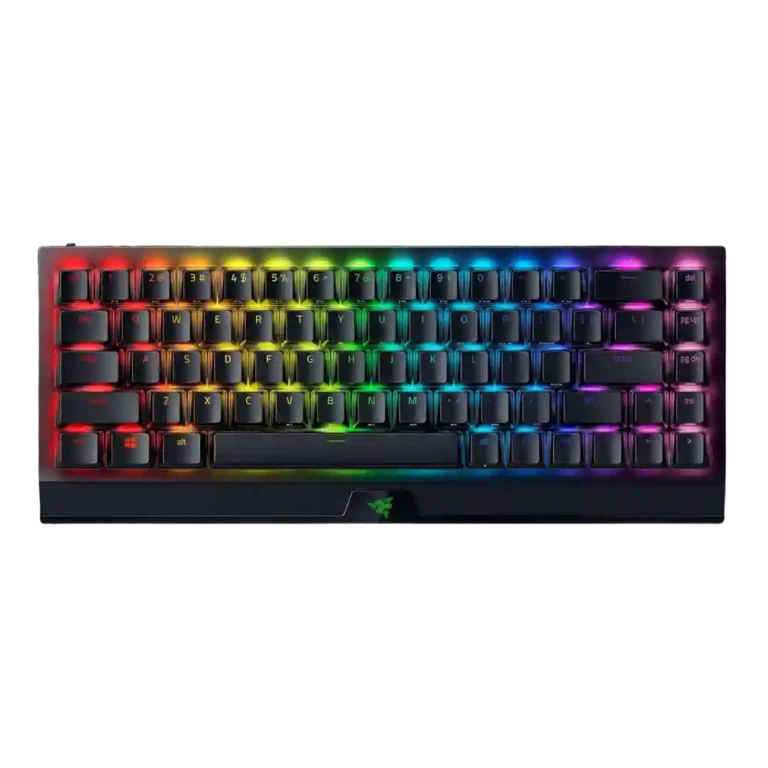
Best for gamers who want a compact wireless 65% board with arrow keys, fast-feeling switches, strong build quality, and deep Razer RGB/software customization.
Not for buyers who need a numpad, dedicated media controls, long RGB-on battery life, quiet stabilized keys, or the best value for money.
The BlackWidow V3 Mini HyperSpeed earns its strongest praise as a compact, premium-feeling 65% gaming keyboard: reviewers liked the arrow-key layout, strong build, fast HyperSpeed wireless, responsive switches, and deep Synapse/Chroma customization. The tradeoff is that its premium feature set comes with a premium price, and the reviews repeatedly show compromises around battery life with RGB enabled, no included wrist rest, and stabilizers that can sound rattly or make larger keys uneven. It works best when the buyer values wireless compactness and Razer customization more than dedicated media controls, full-size typing convenience, or maximum value.
Compared in Reviews
Products reviewers directly compared with this model, grouped into quick takeaways.
- Compared: RGB battery life The review compares the Mini’s battery limits with the full-sized Logitech G915 Lightspeed Wireless.
- Better: battery life and low-profile feel The review says the Logitech G915 TKL Lightspeed may be worth paying extra for.
- Better: price and features The review says the Asus ROG Falchion costs less and has more features.
Feature Scorecards
Summary
48 reviewed features- Very positive 4.5-5.0 44% 21 features
- Positive 3.5-4.4 35% 17 features
- Neutral 2.5-3.4 10% 5 features
- Negative 1.5-2.4 10% 5 features
- Very negative below 1.5 0% 0 features
Pros
-
One review specifically praised per-key RGB control through Synapse, supporting a strong score for granular lighting control.
-
Durability evidence was strong, including confidence against scratches, surviving drops, child use, and expectations of long service life.
-
One review gave explicit positive evidence for brightness, describing the RGB as nice, bright, and vivid.
-
Build quality was one of the strongest consensus areas, with reviews calling it excellent, sturdy, robust, substantial, and well built.
-
Key stability evidence was mostly positive where scored, with reviewers noting no wobble or very minimal wobble on the keys they tested.
-
Key responsiveness was a major strength, with reviewers repeatedly saying inputs felt fast, precise, and able to keep up during games and typing.
-
Customization options were a major strength, with reviewers praising key remaps, macros, RGB, power settings, and broad Synapse controls.
-
Desk space efficiency was highly praised, with reviewers valuing the extra mouse room, reduced footprint, and less clutter.
-
One review gave clear positive evidence that key registration was consistent, saying every key registered as expected during typing and gaming.
-
Portability was consistently strong because reviewers liked the compact size, wireless use, travel friendliness, and easy movement around the home.
-
RGB customization was a clear strength, with reviewers noting broad Chroma color options, effects, sync, and onboard or software-based control.
-
Reviewers broadly liked the switch feel, especially the smooth Yellow switches and tactile Green option; the main caveat was that the light actuation could feel sensitive for some typists.
-
The compact 65% form factor was one of the strongest positives, repeatedly described as useful, functional, and well suited to gaming or travel.
-
Extra gaming features were praised for strong 65% gaming functionality, macro-ready keys, and dongle-related gaming features.
-
Gaming performance was a consistent highlight thanks to the compact footprint, quick switches, and responsive wireless, though one review reported a shift-key catch while gaming.
-
The 65% layout with arrows was widely praised as a useful middle ground, although some reviewers noted a learning curve and missing full-size keys.
-
RGB lighting quality was praised as bright, vivid, even, and visually appealing across multiple reviews.
-
Frame rigidity scored well where discussed, with reviewers describing the keyboard as planted, rigid, free of flex, and unlikely to budge.
-
Sound dampening was praised in the Yellow-switch versions, with reviewers saying the dampeners made the board quieter and worked well.
-
One review gave positive opinionated evidence that swapping between the two sets of keys or switches was easy.
-
Latency feedback was mostly strong for wired and HyperSpeed use, with reviewers seeing little or no delay; lag mainly appeared with Bluetooth, low battery, or unified dongle issues.
-
Cable quality was praised when mentioned, with reviewers liking the long, braided, thick cable and practical wired charging use.
-
Keycap quality drew praise for doubleshot ABS construction, clean legends, and durability, but reviewers still noted ABS tradeoffs such as slipperiness, shine, or clamminess.
-
Key spacing was mostly praised for making inputs easier and avoiding distractions, with one review finding the keys slightly cramped.
-
The Green and Yellow switch choices were viewed positively because they suit different typing and gaming preferences, though reviewers did not describe a wider switch ecosystem.
-
Wireless performance was usually excellent on HyperSpeed, but the unified dongle, Bluetooth, or interference produced notable negative cases in some reviews.
-
Connectivity was broadly strong thanks to USB-C, Bluetooth, HyperSpeed, and multi-device support, but a few reviews noted buggy pairing or inconvenient mode switching.
-
Design aesthetics were mostly positive, with reviewers liking the sleek Razer styling, RGB look, and compact desk presence, though some found it plain or fingerprint-prone.
-
Typing comfort was mostly positive once users adjusted, but prolonged work, cramped keys, and wrist fatigue produced mixed evidence.
-
Materials were generally praised for aluminum, textured plastic, and component quality, but one review criticized fingerprint-prone surfaces.
-
Legend visibility was usually good, especially side legends and clean lettering, but a few reviewers criticized dark keys or non-backlit secondary legends.
-
Software quality was generally good because Synapse is powerful and improved, but reviewers disliked dependence on it, navigation friction, and occasional bugs.
-
Onboard memory was useful for saved profiles and basic settings, but reviewers noted limitations such as RGB settings not carrying over.
-
Profile management was helpful thanks to onboard/local profiles, though one review found toggling profiles unintuitive and onboard behavior limited.
-
Typing feel was generally smooth and satisfying, but compact-layout adjustment, sensitive switches, and accidental inputs made it mixed for heavier typists.
-
Noise level was context-dependent: many found the Yellow switches relatively quiet, but reviewers stressed the board was not silent and could still bother people nearby.
-
Macro customization was useful for the right-side keys and software recording, but some reviewers found Synapse requirements or limited dedicated buttons restrictive.
-
Acoustics were mixed: several reviewers liked the soft clack or subtle tap, while others heard pinging, rattle, or an irritating clack.
Cons
-
Battery life was the most mixed major attribute: reviewers praised long life with lighting off or low, but full RGB drained the battery quickly.
-
Ergonomics were mixed: the small layout and feet could help posture, but height, wrist angle, and lack of palm rest caused discomfort for some.
-
Reliability had limited mixed evidence, with one review reporting missed keystrokes over Bluetooth.
-
Value was divisive and often critical: the keyboard’s feature set impressed some reviewers, but most repeatedly called the price high, premium, or hard to justify.
-
Volume control had limited negative evidence from one reviewer who specifically wanted a volume scroll wheel.
-
Media controls were a drawback for reviewers who wanted dedicated keys and missed full-size media/function controls.
-
Wrist rest feedback was negative because reviewers felt the tall board needed a compact wrist rest and none was included.
-
Stabilizer quality was the clearest repeated weakness, with reviews citing rattly stabilizers, loud larger keys, a catching shift key, and poor sound on stabilized keys.
-
Compatibility scored low from one review because the keyboard could not connect to the reviewer’s PlayStation 5.
-
Passthrough features scored poorly because a review explicitly criticized the lack of USB passthrough.
Compared With Category Average
Compared with other Gaming Keyboard, this product is above average in portability, switch options, below average in stabilizer quality, compatibility, media controls.
Summary
8 compared features- Above average 0.4+ pts higher 25% 2 features
- Same as average within 0.3 pts 0% 0 features
- Below average 0.4+ pts lower 75% 6 features
| Attribute | This product | Category average | Difference |
|---|---|---|---|
| stabilizer quality | 2.0 | 3.9 | -1.8 |
| compatibility | 2.0 | 3.9 | -1.9 |
| portability | 4.6 | 3.4 | +1.2 |
| media controls | 2.4 | 3.7 | -1.3 |
| volume control | 2.5 | 3.8 | -1.3 |
| wrist rest quality | 2.2 | 3.3 | -1.2 |
| switch options | 4.3 | 3.1 | +1.1 |
| value for money | 3.0 | 3.7 | -0.7 |
FAQ
Is the Razer BlackWidow V3 Mini HyperSpeed good for gaming?
Yes. Reviewers repeatedly praised its compact gaming footprint, fast-feeling switches, and low-latency HyperSpeed wireless, though one review had a shift-key catch and a few noted Bluetooth or unified-dongle caveats.
How is the battery life?
Battery life is highly dependent on RGB. Reviewers praised long life with lighting off or reduced, but full Chroma lighting drained the battery quickly in many tests.
Is the 65% layout practical for work?
It is more practical than many 60% boards because it keeps arrow and navigation keys. Still, reviewers who rely on a numpad, function row, or dedicated controls found the layout slower or less comfortable.
Are the switches quiet?
The Yellow switches were often described as quiet, smooth, and dampened, but reviewers stressed the keyboard is not truly silent. Stabilized keys such as spacebar, shift, enter, or backspace were a recurring noise complaint.
Does it feel premium?
Most reviews said yes, citing strong build quality, aluminum/plastic construction, sturdy feel, and durable doubleshot ABS keycaps. The main premium-feel complaint was rattly stabilizers.
Is it worth the price?
Reviewers were divided. The feature set, wireless performance, and compact design earned praise, but many called the price high or hard to justify unless the buyer specifically wants this Razer 65% wireless package.
Consider This Instead
If you want better stabilizer quality
Choose Lemokey P1 HE. It scores 5.0 vs 2.0 for stabilizer quality, with a 4.2 overall score.
If you want better compatibility
Choose Corsair K70 Core. It scores 5.0 vs 2.0 for compatibility, with a 3.7 overall score.
If you want better wrist rest quality
Choose Keychron K2 HE. It scores 5.0 vs 2.2 for wrist rest quality, with a 4.2 overall score.
If you want better value for money
Choose McHose GX87 Keyboard. It scores 4.9 vs 3.0 for value for money, with a 4.2 overall score.
Overall Top Gaming Keyboard Alternatives
Good if you want a premium 96% Hall Effect keyboard for work and gaming with excellent build, sound, and customization. Skip it if you need cheaper esports-first speed, 8,000Hz polling,...
Pros: cable quality, typing comfort
Cons: portability, switch options
Good if you want a premium full-size Hall Effect keyboard with smooth switches, quiet sound, and deep customization. Skip it if you need a portable, budget-friendly board or broad switch...
Pros: key stability, frame rigidity
Cons: portability, switch options
Good if you want a compact Hall Effect keyboard with smooth typing, strong gaming response, bright RGB, and good value. Skip it if you need polished software, quiet heavy presses,...
Pros: desk space efficiency, layout options
Cons: compatibility
Good if you want a premium, quiet TKL Hall Effect keyboard for typing and gaming. Skip it if price, portability, 8,000Hz polling, or broad switch choice matters most.
Pros: build quality, extra gaming features
Cons: switch options, hot-swappable switches