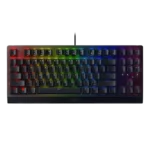
Razer BlackWidow V3 Feature Scores
Explore all 45 feature scores for Razer BlackWidow V3, organized into pros and cons.
Scores by Feature
Summary
45 reviewed features-
Very positive 4.5-5.015 (33%)
-
Positive 3.5-4.418 (40%)
-
Neutral 2.5-3.49 (20%)
-
Negative 1.5-2.43 (7%)
Pros
Sort
-
Build quality was a major strength across reviews, with repeated praise for the sturdy feel, aluminum top, rugged construction, and quality overall.
-
Reviewers generally liked the switch feel, describing the Green switches as tactile, clicky, responsive, and fun, though some treated the sound as a tradeoff.
-
RGB customization was consistently praised through Razer Chroma and Synapse controls, with reviewers noting flexible profiles, custom effects, and game-integrated lighting.
-
Customization options were a recurring strength, covering key remapping, RGB, macros, Hypershift, and flexible Synapse controls despite software caveats.
-
Gaming performance was broadly praised for responsive in-game behavior, reliable combos, and suitability for both MMO and shooter-style play.
-
Key responsiveness was one of the clearest strengths, with reviewers reporting quick actuation, reliable in-game inputs, and no keypress problems in normal play.
-
Volume control was one of the best-liked extras, with several reviewers calling the roller useful, handy, convenient, or life-giving.
-
Macro customization was well supported through Synapse, on-the-fly recording, Hypershift, and broad key assignment flexibility.
-
Materials quality was generally positive thanks to the aluminum top, sturdy feel, and durable parts, with only some caveats around ABS keycaps elsewhere.
-
Durability was strongly praised, especially around the hard-wearing construction, robust product design, and tough keycaps.
-
Value for money was generally positive for a sturdy, capable midrange board, but one TKL review argued the price faced stronger alternatives.
-
RGB lighting quality was divisive: many liked the vibrant Chroma glow, but Quartz lighting bleed, uneven shine-through, and toned-down brightness disappointed others.
-
Media controls were mostly liked, with reviewers praising the roller/button convenience even when some preferred dedicated media keys.
-
Typing comfort was mostly positive, with reviewers praising easy, enjoyable typing, but some slowed down or needed the wrist rest for longer sessions.
-
Typing feel was mostly positive, ranging from enthusiastic praise to decent performance, with some criticism when forceful typing caused sound or underpressing issues.
-
Cable quality was mostly positive for the braided, durable, manageable cable, though one reviewer warned cable routing could kink it.
-
Keycap quality split reviewers: textured doubleshot ABS was often liked for grip and durability, but ABS material, uneven aesthetics, and cheap-feeling keys drew criticism.
-
Latency evidence was strongly positive, with one review calling it remarkably low and another praising the fast Yellow switch for rapid-fire key presses.
-
Frame rigidity was mostly praised for low flex and stability, though one review found it less rigid than some Filco and Ducky boards.
-
Design aesthetics were highly subjective, with praise for the pink, black, and minimalist looks offset by Quartz cosmetic complaints.
-
Actuation consistency was praised through no-missed-input comments, especially during gaming and heavy key-bashing scenarios.
-
Portability evidence was positive, citing the lightweight full-size build and compact TKL packability.
-
Ergonomics were mixed: the wrist rest, feet, and angled setup helped comfort, but the full-size footprint made positioning difficult for some.
-
Switch choice was seen as useful because Green and Yellow options suit different preferences, but several reviewers wished the lineup offered broader switch variety.
-
Key stability was mixed: some evidence praised the switch/keycap stabilizing design, while another review noted wobble on larger keys.
-
Reliability was mixed: some reviewers reported no performance issues or called it reliable, while one long-term TKL review reported missing profiles.
-
Backlight brightness drew mixed but mostly favorable comments, with vibrant Chroma praise balanced against one reviewer finding the lights more toned down.
-
Onboard memory had limited but positive evidence, with up to five profiles described as convenient.
-
Polling rate received limited but positive support, with the reviewer tying the fast thousand-hertz rate to responsive keypress behavior.
-
Size and form factor evidence came from TKL coverage, where the smaller layout was praised as compact.
-
Profile management was mixed: onboard/profile customization was convenient in positive reviews, but one long-term reviewer reported profiles going missing.
-
Key spacing had limited positive support, with one review crediting the standard shape and spacing for comfortable typing.
-
Layout options received limited support, mainly from the suggestion that some users would be better served by the TKL version.
Cons
Sort
-
Noise level was the most consistent drawback, with multiple reviewers warning that Green switches are loud, pingy, or annoying in shared and quiet spaces.
-
Sound dampening appeared weak in the negative evidence, with pinging and hollow/cacophonous typing sounds standing out.
-
Passthrough features were criticized because reviewers noted the absence of USB or audio passthrough.
-
Connectivity was a limitation because reviewers repeatedly noted that the standard V3 is wired-only and lacks wireless or Bluetooth.
-
Desk space efficiency was mixed to negative for the full-size model, with reviewers struggling for mouse room or noting the wrist rest consumed desk space.
-
Acoustics were highly preference-dependent: one reviewer enjoyed the clicky sound, while others criticized pinging and a cacophonous din.
-
Stabilizer quality had limited negative evidence, centered on a hollow spacebar thud during typing.
-
Compatibility was mixed: basic USB PC use was easy, but deeper customization was limited for Linux and macOS users.
-
Extra gaming features were mixed: one review praised the loaded feature set, while another criticized the lack of gaming keys and other extras.
-
Legend visibility was uneven; reviewers disliked missing or unlit identifiers, while one TKL reviewer praised improved foreign-key visibility.
-
Wrist rest quality was mixed to weak: some found it useful or comfortable, while others called it hard plastic, uncomfortable, or an afterthought.
-
Software quality was sharply split: many liked Synapse customization, while others disliked multiple apps, clunkiness, or bugs.