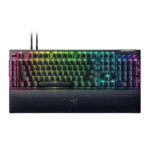
Razer BlackWidow V4 Pro Feature Scores
Explore all 49 feature scores for Razer BlackWidow V4 Pro, organized into pros and cons.
Scores by Feature
Summary
49 reviewed features-
Very positive 4.5-5.015 (31%)
-
Positive 3.5-4.417 (35%)
-
Neutral 2.5-3.415 (31%)
-
Negative 1.5-2.42 (4%)
Pros
Sort
-
Macro customization was one of the best-supported positives, with reviewers praising the eight macros, creative freedom, productivity shortcuts, and game advantages.
-
Wrist rest quality was a consistent highlight on full-size reviews for plushness, comfort and RGB integration, with a few fit or height complaints.
-
Switch feel was broadly strong, with praise for Yellow, Green, and Orange variants, though some reviewers wanted more checkout options or different stock switches.
-
Key responsiveness was a major strength, with reviewers citing instant, smooth, accurate, and sensitive keypresses across gaming and productivity.
-
Gaming performance was consistently strong, with reviewers reporting smooth play, no stutter or delay, top-tier responsiveness, and macro advantages in games.
-
RGB lighting quality was heavily praised for brightness, underglow, flawless implementation, and desk-filling visual impact, with minor visibility caveats.
-
Build quality was broadly praised on the full-size model for solidity and premium feel, though one 75% Pro reviewer criticized the case quality for the price.
-
Customization was one of the strongest themes, especially around remapping, the Command Dial, Chroma, and multi-layer programmability, with some Synapse limits.
-
Typing feel was one of the clearest positives, with several reviewers calling the board satisfying, fast, or fantastic to type on.
-
Sound dampening was generally effective, with reviewers crediting foam, tape mods, and damping for reduced ping, reverb, and a more refined sound.
-
Latency was praised on the wired full-size board, especially alongside high polling, where reviewers reported zero lag, smoothness, and low-latency gaming.
-
Switch replacement was excellent on hot-swap 75% variants, where reviewers found swapping solid or easy, but it was not a strength of the full-size board.
-
Media controls were mostly liked for convenience and productivity, though some reviewers disliked the awkward height or difficult-to-see legends.
-
Design reactions were mostly positive for premium, high-end styling and RGB-heavy looks, though one reviewer found the shine-through gamer look tacky.
-
Volume control was usually convenient and tactile, though some reviewers wanted a press-to-mute wheel or found dial-based volume less convenient.
-
Materials quality was praised through aluminum, premium finishes, and strong material choices across several full-size reviews.
-
RGB customization was a consistent Razer strength, with reviewers praising complex-to-simple controls, Chroma syncing, and game-reactive lighting.
-
Keycap quality was mixed: texture, shine-through and feel earned praise, but ABS material, PBT comparisons, sound, and wear concerns lowered confidence.
-
Typing comfort was generally strong when switches and wrist rest suited the reviewer, though one Green-switch reviewer wanted more cushioning for long writing.
-
Frame rigidity was praised where reviewers described the chassis and top plate as robust, solid, and free of noticeable creaking.
-
Layout evidence favored the 75% layout as a useful, welcome middle ground while the full-size layout drew space and adjustment complaints.
-
Value was divided: many full-size reviewers felt the $230 price was justified by features, while 75% Pro reviewers objected strongly to $300 pricing.
-
Hot-swap support depended on variant: 75% boards were praised for easy switch changes, while full-size models were criticized for locking users into one switch choice.
-
Stabilizer quality ranged from peaceful and low-rattle to merely acceptable or needing work, especially on some 75% and Yellow-switch units.
-
Profile management was useful for switching setups and game-linked profiles, though some functions still depended on Synapse or required manual management.
-
Actuation balance was described positively where reviewers noted accidental strokes were avoided and productivity work was not littered with misinputs.
-
Extra gaming features were praised most by macro-heavy and Snap Tap users, with reviewers highlighting benefits for tinkerers, strafing, and command-heavy games.
-
Key spacing evidence was positive, with reviewers saying the spacing reduced errors and let them play without looking down.
-
Reviewers varied by switch and model: some praised muted, clacky or lower-pitched sound, while others heard plasticky clicks, dinging, or a weaker stock sound.
-
Key stability evidence was positive but limited, with one reviewer praising the switches for practically zero wobble.
-
Polling rate impressed some reviewers with speed or snappiness, while others considered 8,000Hz niche or hard to notice on a keyboard.
-
Backlighting was generally viewed as focused and granular, with reviewers noticing improved brightness control and stronger LED presentation.
Cons
Sort
-
Battery evidence was split by model and settings, ranging from good light-use results to severe drain when RGB, OLED or wireless polling were active.
-
Size and form factor were a frequent concern on the full-size version, which reviewers called very large, while compact variants helped portability.
-
Switch options were a recurring weakness where reviewers wanted tactile, linear, or more checkout choices, especially on expensive or Pro models.
-
Desk-space efficiency was weak on the full-size board because its macro column and wrist rest make it huge, while the 75% variants earned better space praise.
-
Legend visibility was mixed: keycap shine-through could be clean and even, but media-key legends were criticized as hard to read or unlit.
-
Reliability concerns included one LED hiccup, app binding failures, an OLED darkening issue, and reported orange-switch problems on one 75% Pro review.
-
Compatibility evidence was limited but negative where Mac support was described as lacking for the keyboard.
-
Cabling drew mixed reactions: braided or detachable hardware felt solid, but two cables, non-coiled cabling, and a chunky dongle hurt desk neatness.
-
Connectivity was a recurring tradeoff: wired operation helped latency and passthrough, but reviewers missed wireless or noted cable-dependent clutter.
-
Ergonomics were mixed: wrist comfort and long-use ergonomics could be excellent, but side buttons and the extra left column caused accidental presses or reach issues.
-
Onboard memory was useful for profiles but limited by Synapse dependency, especially where custom dial modes did not carry over.
-
Portability was variant-dependent: the 75% board was bag-friendly, while the full-size board was problematic for transport and mouse space.
-
Passthrough was viewed as useful but limited, especially by USB 2.0 speeds, voltage constraints, and the need for a second cable.
-
Durability evidence centered on a sturdy frame and repair/mod potential, offset by one reviewer’s concern about keycap wear from a prior BlackWidow generation.
-
Noise level varied heavily by switch: Green switches were often loud, while Yellow or damped variants were quieter or satisfying rather than distracting.
-
Wireless performance evidence came from 75% Pro reviews and was mixed: wireless controls and performance were useful, but battery tradeoffs reduced appeal.
-
Software quality was polarizing: Synapse could be intuitive and reliable, but reviewers often disliked needing it open for advanced functions.