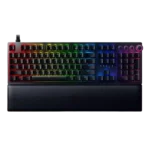
Razer Huntsman V2 Analog Feature Scores
Explore all 47 feature scores for Razer Huntsman V2 Analog, organized into pros and cons.
Scores by Feature
Summary
47 reviewed features-
Very positive 4.5-5.010 (21%)
-
Positive 3.5-4.422 (47%)
-
Neutral 2.5-3.411 (23%)
-
Negative 1.5-2.44 (9%)
Pros
Sort
-
Wrist rest quality was one of the strongest areas, repeatedly praised as plush, comfortable, improved, and premium-feeling.
-
Customization options were a major strength, with reviewers repeatedly citing deep per-key actuation, lighting, remapping, and input flexibility.
-
Gaming performance was broadly strong, especially when actuation tuning or analog features fit the game, although not every reviewer found the flagship features essential.
-
RGB lighting quality was widely praised for accuracy, glow, brightness, and visual impact, though one reviewer felt Razer’s own PBT keycap design held it back.
-
Build quality was consistently strong, with reviewers describing the keyboard as sturdy, premium, well-built, and solid on the desk.
-
RGB customization received strong praise through Synapse and Chroma, especially for color control, profiles, and Razer’s broader lighting ecosystem.
-
Keycap quality was usually praised for PBT texture, durability, grip, and feel, but some reviewers thought the legends and brightness were only average.
-
Design aesthetics were usually praised as sleek, classic, stylish, or visually striking, though a few reviewers found the look plain or typical for Razer.
-
Passthrough features were mostly praised, especially the USB 3.0 port, though one reviewer felt the extra port burden reduced its practical freedom.
-
Extra gaming features were broadly strong when reviewers valued dual actuation, game mode, and advanced inputs, but they remained niche or underused for some.
-
Ergonomics were generally helped by the plush wrist rest and support during long sessions, but one reviewer warned the tall keyboard makes the rest nearly necessary.
-
Frame rigidity was praised for heft, sturdiness, and resistance to sliding during use.
-
Responsiveness was often praised in games and rapid actions, though a few reviewers reported missed or insufficiently registered presses when actuation settings or typing style did not line up.
-
Macro customization and dual-step actions were valued for one-key multi-action setups, though some reviewers found setup or mastery less intuitive.
-
Media controls were generally liked for convenience and feel, but some reviewers criticized dark symbols or awkward-looking controls.
-
Typing feel ranged from excellent and pleasant to loud or stiff, with most praise focused on smooth key feel and most criticism tied to noise and switch weight.
-
Materials quality was praised for textured PBT keycaps and a tough aluminum frame, with reviewers connecting those materials to premium feel.
-
Analog input was the most divisive feature: reviewers praised it as game-changing or highly controllable in supported games, but several found support limited, hard to master, or not useful for most players.
-
Reviewers split on the analog linear switches: several liked their smoothness, speed, resistance, or sound, while others found them stiff, heavy, or less refined than preferred alternatives.
-
Adjustable actuation generally worked well and could be tuned effectively, but one reviewer reported occasional missed keypresses and others tied consistency to setup.
-
Per-key lighting control was praised when available, especially by reviewers who called per-key customization sublime or easy to configure.
-
Durability evidence centered on sturdy construction and long-lasting materials, with reviewers expecting the keyboard and keycaps to hold up well.
-
Backlight brightness was mixed: some found the lighting bright, colorful, or sharp, while others found legends dimmer than expected.
-
Volume control was praised by some for feel and convenience, while others disliked wobble, defaults, or the experience relative to the price.
-
Acoustics were mixed: some enjoyed the sound profile, thocky bottom-out, or satisfying clicks, while others objected to ping or sheer volume.
-
Software quality was mixed: Synapse enabled powerful customization and was sometimes easy, but reviewers also called setup complicated, frustrating, messy, or unintuitive.
-
Reliability evidence was mixed: reviewers trusted the overall build and purpose, but one reported occasional unregistered keypresses.
-
Connectivity was mixed: USB-C and passthrough support were appreciated, but port requirements, cable behavior, and inconsistent setup frustrated some reviewers.
-
Key spacing had limited positive evidence, with one reviewer saying the well-spaced layout helped long gaming sessions.
-
Rapid trigger was seen as potentially useful but niche, adding functionality mainly for users who can benefit from repeated fast presses.
-
Layout evidence was limited but positive where the standard keycap/bottom-row arrangement made customization easier.
-
Stabilizer quality had limited but positive evidence, with one reviewer judging the stock stabilizers as good overall.
Cons
Sort
-
Portability scored poorly because the full-size, heavy wired board was considered unsuitable for travel.
-
Legend visibility was a recurring weak point, with multiple reviewers noting hard-to-read symbols or longer legends that were not cleanly illuminated.
-
Cable quality was a consistent complaint due to non-detachable dual cables, awkward routing, tangles, and bulk despite some praise for braiding.
-
Polling-rate evidence was limited to one reviewer who disliked that this model lacks the higher 8,000 Hz polling seen on some related Huntsman boards.
-
Latency evidence was limited and negative, with one reviewer calling the delay higher than expected at this price.
-
Desk space efficiency was weak because reviewers noted the full-size keyboard and wrist rest take considerable desk space.
-
Noise level was one of the clearest tradeoffs, with many reviewers calling the keyboard loud, though one found it quiet and another called the switches not the quietest but acceptable.
-
Sound dampening drew one clear negative assessment: a reviewer said the keyboard did not dampen sound much.
-
Switch variety drew criticism because the analog implementation effectively means linear switches, with reviewers wishing for tactile feedback or finding that limitation disappointing.
-
Compatibility was a common caveat because analog or gamepad-style inputs depend on game support and sometimes conflict with normal keyboard or controller behavior.
-
Typing comfort was mixed: some reviewers found long typing pleasant, while others complained about fatigue or tough regular typing.
-
Onboard memory was appreciated in principle, but reviewers noted limitations such as lighting not being stored or profiles not assigning automatically.
-
Size and form factor were mixed, with reviewers valuing the full-size format but also describing the board as chunky, heavy, or space-consuming.
-
Value for money was highly split: reviewers liked it on sale or for committed enthusiasts, but many called the launch price difficult to justify.
-
Profile management was useful but imperfect, with onboard/profile support praised while RGB memory limits and lack of grouping drew complaints.