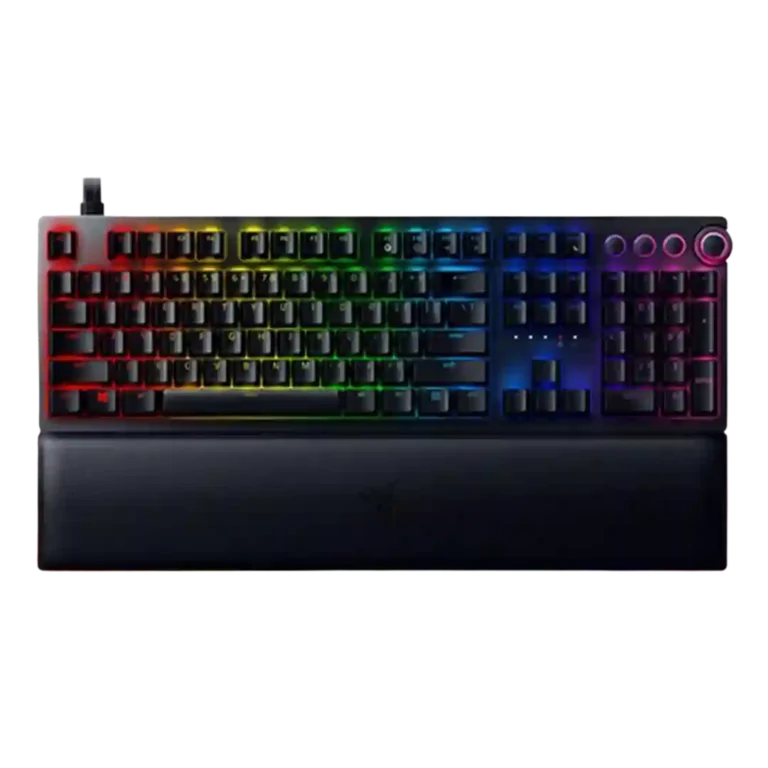
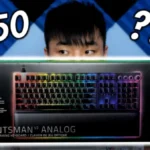
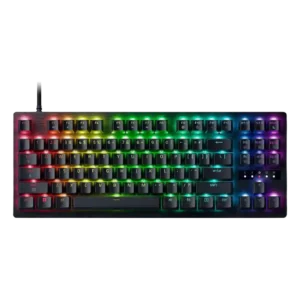
Choose the Razer Huntsman V2 Analog if you want premium build, deep actuation tuning, strong RGB and a plush wrist rest. Skip it if analog game support, loud keys, fixed cables or the high price will bother you.
Best for
Best for PC gamers and keyboard tinkerers who want a premium full-size wired board with per-key actuation, dual-step commands, strong RGB, media controls, and a plush wrist rest.
Not for
Not for buyers who want a quiet keyboard, wireless setup, compact travel board, detachable cables, or a simpler keyboard that works fully without Synapse and analog-compatible games.
Verdict
Reviewers largely describe the Huntsman V2 Analog as a flagship gaming keyboard with excellent build quality, vivid Chroma lighting, a very comfortable wrist rest, useful media controls, and unusually deep per-key customization. Its analog optical switches can feel responsive and open up dual-step actions or controller-like movement, and several reviewers found the gaming experience impressive when a title supports those inputs. The tradeoff is that the headline feature is niche: some reviewers found analog control hard to master, limited by game compatibility, or not worth the effort compared with a controller. Noise, non-detachable dual cables, dimmer legends on some keycaps, and the high launch price also kept enthusiasm from being universal.
Gaming performance was broadly strong, especially when actuation tuning or analog features fit the game, although not every reviewer found the flagship features essential.
RGB lighting quality was widely praised for accuracy, glow, brightness, and visual impact, though one reviewer felt Razer’s own PBT keycap design held it back.
Design aesthetics were usually praised as sleek, classic, stylish, or visually striking, though a few reviewers found the look plain or typical for Razer.
Keycap quality was usually praised for PBT texture, durability, grip, and feel, but some reviewers thought the legends and brightness were only average.
Ergonomics were generally helped by the plush wrist rest and support during long sessions, but one reviewer warned the tall keyboard makes the rest nearly necessary.
extra gaming features: 4.2, 12 reviews, moderate consensus
Extra gaming features were broadly strong when reviewers valued dual actuation, game mode, and advanced inputs, but they remained niche or underused for some.
Responsiveness was often praised in games and rapid actions, though a few reviewers reported missed or insufficiently registered presses when actuation settings or typing style did not line up.
Typing feel ranged from excellent and pleasant to loud or stiff, with most praise focused on smooth key feel and most criticism tied to noise and switch weight.
Adjustable actuation generally worked well and could be tuned effectively, but one reviewer reported occasional missed keypresses and others tied consistency to setup.
Reviewers split on the analog linear switches: several liked their smoothness, speed, resistance, or sound, while others found them stiff, heavy, or less refined than preferred alternatives.
analog input support: 3.8, 17 reviews, low consensus
Analog input was the most divisive feature: reviewers praised it as game-changing or highly controllable in supported games, but several found support limited, hard to master, or not useful for most players.
Connectivity was mixed: USB-C and passthrough support were appreciated, but port requirements, cable behavior, and inconsistent setup frustrated some reviewers.
Software quality was mixed: Synapse enabled powerful customization and was sometimes easy, but reviewers also called setup complicated, frustrating, messy, or unintuitive.
Noise level was one of the clearest tradeoffs, with many reviewers calling the keyboard loud, though one found it quiet and another called the switches not the quietest but acceptable.
Compatibility was a common caveat because analog or gamepad-style inputs depend on game support and sometimes conflict with normal keyboard or controller behavior.
Switch variety drew criticism because the analog implementation effectively means linear switches, with reviewers wishing for tactile feedback or finding that limitation disappointing.
Onboard memory was appreciated in principle, but reviewers noted limitations such as lighting not being stored or profiles not assigning automatically.
size and form factor: 3.4, 3 reviews, strong consensus
Size and form factor were mixed, with reviewers valuing the full-size format but also describing the board as chunky, heavy, or space-consuming.
Compared With Category Average
Compared with other Gaming Keyboards, this product is above average in passthrough features, wrist rest quality, analog input support, near average in software quality, RGB lighting quality, below average in latency, polling rate, sound dampening.
Summary
47 compared features
Above average0.4+ pts higher
8(17%)
Same as averagewithin 0.3 pts
20(43%)
Below average0.4+ pts lower
19(40%)
Largest category differences
Attribute
This product
Category average
Difference
latency
2.1
4.5
-2.4
passthrough features
4.3
2.3
+2.0
polling rate
2.0
3.9
-1.9
wrist rest quality
4.7
3.2
+1.5
sound dampening
2.4
4.2
-1.8
desk space efficiency
2.6
4.2
-1.6
portability
2.0
3.5
-1.5
noise level
2.8
3.9
-1.0
Consider This Instead
If you want better legend visibility
Choose Razer Huntsman V3 Pro. It scores 5.0 vs 2.5 for legend visibility, with a 3.9 overall score.
Better: typing speed and switch smoothnessTom's Guide recorded better typing speed and accuracy on the Logitech G915.
FAQ
Is the Razer Huntsman V2 Analog good for gaming?
Yes, reviewers generally found gaming performance strong, especially when actuation tuning or analog input fit the game. The main caveat is that analog-style movement depends on game support and takes practice.
Are the analog switches worth it?
They are worth considering for tinkerers and competitive players who will use per-key actuation, dual-step actions, or controller-like inputs. Reviewers who did not need those features often found them niche for the price.
Is it comfortable for typing?
Typing comfort was mixed. Some reviewers called the typing experience pleasant or excellent, while others found the heavier linear switches loud, stiff, or tiring over long sessions.
How good is the wrist rest?
The wrist rest was one of the most consistently praised parts. Reviewers described it as plush, comfortable, improved, and premium-feeling.
Does the RGB lighting stand out?
Yes. Reviewers praised the Chroma lighting, underglow, and per-key control, although some noted dimmer legends or less vibrant keycap lighting.
What are the biggest drawbacks?
The most repeated drawbacks were high price, limited analog-game compatibility, loud keys, non-detachable dual cables, and some software complexity.
Sample Expert Reviews We Analyzed
These are a few of the reviews included in our analysis.
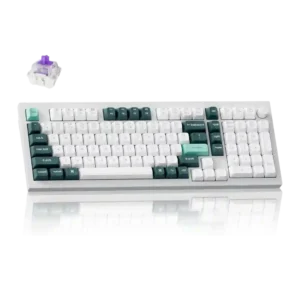
Good if you want a premium 96% Hall Effect keyboard for work and gaming with excellent build, sound, and customization. Skip it if you need cheaper esports-first speed, 8,000Hz polling,...
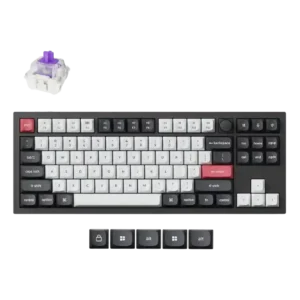
Good if you want a premium, quiet TKL Hall Effect keyboard for typing and gaming. Skip it if price, portability, 8,000Hz polling, or broad switch choice matters most.
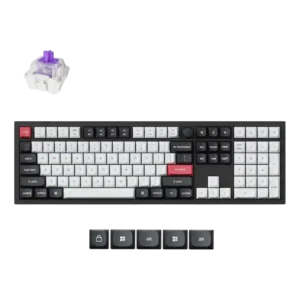
Good if you want a premium full-size Hall Effect keyboard with smooth switches, quiet sound, and deep customization. Skip it if you need a portable, budget-friendly board or broad switch...