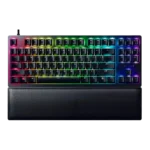
Razer Huntsman V2 TKL Feature Scores
Explore all 45 feature scores for Razer Huntsman V2 TKL, organized into pros and cons.
Scores by Feature
Summary
45 reviewed features-
Very positive 4.5-5.019 (42%)
-
Positive 3.5-4.418 (40%)
-
Neutral 2.5-3.43 (7%)
-
Negative 1.5-2.45 (11%)
Pros
Sort
-
Sound dampening was widely praised on red-switch models, but one clicky-switch review found stabilizer noise undermined Razer's dampening effort.
-
Gaming performance was broadly strong, especially for competitive play, with reviewers praising speed, control, and the TKL form factor.
-
Keycap quality was a standout, with repeated praise for doubleshot PBT texture, ruggedness, durability, and shine-through construction.
-
Noise level was usually a strength for red linear units, though clicky-switch reviews and stabilizer noise produced some negative scores.
-
Durability was a major strength, driven by PBT keycaps, rugged construction, resistance to shine, and long switch/keycap life expectations.
-
Latency measured as a strength in reviewer impressions, though several reviewers questioned whether users can actually feel the difference.
-
RGB customization was praised as extensive, with Synapse and Chroma offering abundant lighting effects and profile-level control.
-
Build quality was repeatedly praised as premium, sturdy, rock-solid, or excellent, despite some light plastic-body caveats.
-
Responsiveness was consistently praised, with reviewers calling the switches fast, instant, and easy to press quickly.
-
Customization options were broad, covering key remaps, secondary functions, shortcuts, RGB, macros, and profile controls.
-
Desk space efficiency was a clear TKL advantage, giving reviewers more mouse room and a more centered typing position.
-
Per-key lighting control was positively covered where reviewers noted individual-key customization and per-key RGB support.
-
Software quality was generally strong due to Synapse control and seamless peripheral integration, though Chroma Studio and macro setup drew small complaints.
-
Design aesthetics were mostly praised as sleek, muted, professional, or clean, though one reviewer found the board visually plain.
-
The TKL size was generally praised for compactness, portability, and gaming practicality without going as cramped as mini layouts.
-
The wrist rest was often comfortable and appreciated, but repeated complaints focused on the lack of magnetic attachment and possible wear.
-
Profile management was consistently praised, especially for game-specific profiles and onboard/hybrid memory.
-
RGB lighting quality was generally good to excellent, though reviewers noted brightness inconsistency and limited lighting coverage in a few cases.
-
Portability was a strength thanks to compact size, detachable cable, and a design reviewers felt encouraged moving the keyboard around.
-
Reviewers praised the red linear optical switches for speed and smoothness, but several noted dampened or mushy bottom-outs and disliked the clicky option.
-
Longer keys were described as stable in some reviews, though this did not erase broader stabilizer complaints.
-
Onboard memory was positively mentioned for saving profiles to the board or hybrid storage.
-
The 8,000Hz polling rate impressed as a technical spec, but reviewer consensus was mixed because its real-world benefit is hard to notice.
-
Typing feel ranged from dreamlike and crisp on red switches to mushy, muted, or hurt by stabilizer sound depending on reviewer preference.
-
Ergonomics were mostly positive thanks to incline options, centering, and wrist support, with some caveats about feet grip and wrist-rest use.
-
Macro customization was well supported through Synapse and on-the-fly functions, with one review noting setup friction.
-
Typing comfort depended on switch feel: several reviewers liked extended typing comfort, while one found the dampened bottom-out painful.
-
Cable quality was mixed-to-positive: reviewers liked detachable braided cables, but some disliked stiffness, placement, or third-party cable limitations.
-
Frame rigidity was strongly praised in the review that evaluated it directly, citing no creaking or flexing.
-
Key spacing received direct praise for avoiding a crowded feel despite the compact TKL design.
-
Layout options were praised where the TKL layout was judged one of the best balances for gaming and typing.
-
Acoustics were mixed: red-switch models sounded far better and quieter, while clicky versions, stabilizers, and case resonance drew complaints.
-
Extra gaming features were adequate rather than lavish, with useful gaming mode and Hypershift offsetting a stripped-down feature set.
-
Actuation consistency received positive evidence where optical switches were described as less bounce-prone and ready for subsequent inputs.
-
Compatibility was mixed: standard keycaps were a plus, but long-key fit and cable/customization friction lowered some scores.
-
Reliability was supported by limited evidence: durable construction and stable profile/cable fit suggested dependable daily use, but cable issues in some reviews kept it from being universal.
-
Materials quality received limited but positive evidence for the aluminum top plate finish.
Cons
Sort
-
Stabilizer quality was the most consistent hardware complaint, with rattling, poor sound, and Razer's unusual design repeatedly criticized.
-
Media controls were a repeated limitation because the TKL lacks dedicated media keys and relies on function-layer controls.
-
Volume control was a clear compromise because the smaller board lacks the full-size model's dial or convenient dedicated controls.
-
Legend visibility drew repeated criticism because secondary legends and some symbols were not illuminated or looked inconsistent.
-
Connectivity drew criticism where reviewers disliked left-side USB-C placement or found third-party cable disconnects.
-
Backlight brightness was acceptable but not a highlight; reviewers found it dimmer than some other backlit keyboards.
-
The red and purple switch choices gave buyers options, though opinion strongly favored the quieter red linears while clicky or silent-linear feel split reviewers.
-
Value for money split reviewers: some saw a strong premium TKL, while others considered the price hard to justify against cheaper competitors.