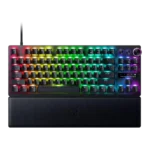
Razer Huntsman V3 Pro Feature Scores
Explore all 50 feature scores for Razer Huntsman V3 Pro, organized into pros and cons.
Scores by Feature
Summary
50 reviewed features-
Very positive 4.5-5.025 (50%)
-
Positive 3.5-4.411 (22%)
-
Neutral 2.5-3.49 (18%)
-
Negative 1.5-2.45 (10%)
Pros
Sort
-
Customization options were a major strength, with reviewers praising actuation tuning, onboard controls, deep Synapse options, and flexible per-game settings.
-
Gaming performance was the strongest consensus point, with many reviewers calling it exceptional, dreamlike, best-in-class, or especially suited to competitive play.
-
RGB lighting quality was a consistent positive, with reviewers calling it outstanding, excellent, vivid, precise, and strong-looking.
-
Build quality was usually praised for premium materials, sturdy construction, and solid feel, though a few reviewers found the plastic-heavy body cheaper than expected.
-
Keycap quality was broadly praised for textured PBT feel, grip, shine resistance, and premium feel, with only one reviewer more mildly positive.
-
Rapid Trigger was one of the most consistently praised features, described as palpable, fast, and effective for repeated inputs, though a few reviewers said casual players may not notice or may need tuning.
-
Reviewers generally liked the analog optical switch feel once tuned, often calling it smooth, controlled, or butter-smooth, though one reviewer found the light presses awkward for daily typing.
-
Responsiveness was a clear strength, with reviewers describing exceptional gaming responsiveness, more responsive feel in A/B testing, and latency-free input.
-
Design aesthetics were mostly positive, with reviewers describing the board as sleek, refined, premium-looking, tame, or stylish.
-
Latency impressions were mostly excellent, especially on 8K models, though one reviewer argued the measured advantage was too small for humans to feel.
-
Extra gaming features such as Snap Tap and competitive movement tools were praised as game-changing, helpful, or edge-giving for shooters.
-
Typing feel varied strongly by reviewer and version: some found it smooth, satisfying, or much improved, while others called it mediocre or less satisfying than premium mechanical boards.
-
Volume control was usually praised for tactile grip, quality metal feel, or convenient dial operation.
-
Profile management was praised for saved gaming and general-use profiles, onboard custom profiles, and quick switching between work and game actuation.
-
Size and form factor were positive overall, with reviewers praising the 60% model and TKL as practical gaming-friendly sizes.
-
Actuation precision was praised where discussed, with reviewers calling the switches incredibly accurate and the press measurement impressive.
-
Legend visibility scored well where discussed, with reviewers praising strong, even illumination and clear coverage across key legends.
-
Key stability was mostly positive because reviewers noted reduced stem wobble or well-controlled stabilizing, though larger keys could still wobble on the Mini.
-
Desk space efficiency was a strength for compact models and TKL layouts, especially for mouse room and cramped desks.
-
Sound dampening was mixed by model: reviewers praised added foam or reduced vibrations on some versions, while the Mini was criticized for needing more padding.
-
Ergonomics were praised in one 8K review for comfortable spacing, angle, and low-strain long sessions.
-
Layout options were praised on the Mini because its dual-step arrow-key implementation felt intuitive and useful.
-
Per-key lighting control was specifically praised because lighting patterns can be applied on a per-key basis.
-
RGB customization was praised for seemingly endless options through Chroma and Synapse.
-
Frame rigidity was split by version and reviewer, ranging from minimal or zero flex to a complaint that the chassis gave under twisting.
-
Polling-rate feedback split by version: several reviewers criticized or downplayed 1,000Hz models, while 8K reviewers praised the headline reporting speed but sometimes questioned its practical impact.
-
Stabilizer quality was generally positive but not perfect, with reviewers noting lubrication and tuning while also mentioning noise on some stabilizers.
-
Durability was supported by positive comments about PBT keycaps offering better long-term durability than ABS.
-
Key spacing was praised in the 8K TKL review for helping typing feel comfortable.
-
Materials quality was praised for doubleshot PBT plastic that resists wear and finger oils.
-
Portability was praised in one TKL review because the board was light, sturdy, and easy to carry to LAN events.
-
Typing comfort was mixed, with some reviewers finding the board comfortable or a good all-rounder and others not enjoying long typing sessions.
-
Backlight brightness was mixed: reviewers praised bright shine-through lighting, but one found the lighting dimmer than expected and another noted a whine.
-
Cable quality was mildly positive, with the included cable judged good enough for most users.
-
Onboard memory was positively noted because four editable onboard profiles were enough for the reviewer.
-
Ease of switch replacement was mixed-positive only for Razer optical parts, with one reviewer saying the switch mechanism can be replaced easily.
Cons
Sort
-
Noise level was a recurring concern; many reviewers called the keyboard loud, noisy, or unsuitable for shared spaces, despite one positive note about minimal noise.
-
Switch choice was a weakness: reviewers noted proprietary or non-swappable switch limitations, making the board less flexible for users who prefer changing switch types.
-
Passthrough features were a weakness, with reviewers wishing for extra ports or noting the lack of USB passthrough.
-
Reliability concerns came from RGB failures in one review and occasional spacebar double tapping in another.
-
Acoustics were one of the most disputed areas: 8K updates sounded improved to some reviewers, but many others criticized ping, hollow tone, or poor sound.
-
Hot-swappable switches were a weakness where discussed because the keyboard is not hot-swappable at the switch level.
-
Compatibility was mixed because Mac users lack Synapse and some games fought keyboard/controller input switching.
-
Connectivity drew criticism from one reviewer because the USB connection and cable routing could be better.
-
Macro customization was only lightly supported, with one reviewer noting that three custom macro buttons is not a huge number.
-
Wrist rest quality was highly divisive: a few reviewers loved the support, but many criticized the firm, thin, or uncomfortable design.
-
Analog input support was highly mixed: some reviewers loved controller-like precision, while others found game support limited, inconsistent, or too much hassle.
-
Value for money was the broadest tradeoff: reviewers respected the performance and upgrades but often questioned the high price for casual players.
-
Software quality was mixed: Synapse enables deep tuning and profiles, but reviewers repeatedly called it bloated, confusing, finicky, or overwhelming.
-
Media controls were mixed: some reviewers liked the dial and buttons, but others found buttons stiff, unclear, awkward, or unsatisfying.