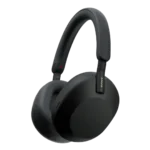
Sony WH-1000XM5 Premium Noise Canceling Headphones Feature Scores
Explore all 67 feature scores for Sony WH-1000XM5 Premium Noise Canceling Headphones, organized into pros and cons.
Scores by Feature
Summary
67 reviewed features-
Very positive 4.5-5.024 (36%)
-
Positive 3.5-4.434 (51%)
-
Neutral 2.5-3.46 (9%)
-
Negative 1.5-2.43 (4%)
Pros
Sort
-
Noise cancellation was one of the strongest points across reviews, with repeated praise for travel, offices, commuting, and loud environments.
-
Call microphone quality was one of the strongest upgrades, frequently described as clear, impressive, or best-in-class.
-
EQ customization was one of the most consistently praised features and often rescued or improved the sound signature.
-
Microphone noise reduction was a clear strength, with reviewers praising voice isolation and background-noise suppression.
-
Comfort was often a major strength, especially for long sessions, but fit issues appeared for smaller heads, large ears, or heat-sensitive users.
-
The companion app was widely praised for depth and customization, with a few caveats around privacy or minor annoyances.
-
Sound quality was broadly good to excellent, especially with EQ, but reviewers disagreed on stock tuning and technical performance.
-
Charging was consistently praised for fast top-ups that provide several hours of playback quickly.
-
Battery life was usually considered good to excellent for normal use, though some reviewers found it short versus newer or rival models.
-
Overall recommendations were mostly positive, but several reviewers added tradeoffs around price, stock tuning, portability, or hinge risk.
-
Multipoint was generally praised as seamless, reliable, or easy to enable.
-
LDAC was valued for higher-bitrate wireless audio, especially with Android, even though it was not enough for every codec-focused reviewer.
-
Low weight was a major comfort advantage and helped the XM5 feel lighter than many competitors.
-
Bluetooth reliability was generally strong, with reviewers reporting stable connections and few or no dropouts.
-
Smart listening features were generally praised, but Speak-to-Chat and adaptive switching could feel intrusive or overly sensitive.
-
Reviewers noted low hiss or natural-feeling ANC, with several saying the cancellation avoided the invasive artifacts of older products.
-
Clamp comfort was generally positive for secure, light pressure, though some reviewers felt the fit was tighter than before.
-
Wear detection auto-pause was generally praised as fast and convenient.
-
Touch controls were often intuitive and responsive, but some reviewers found them finicky or easy to misfire.
-
Midrange clarity varied from clearer and more expressive after tuning to recessed or muddied by bass in stock sound.
-
Treble was praised for clarity and detail in some reviews, but criticized elsewhere as muted, harsh, or masking-prone.
-
Value was mixed: reviewers liked discounts and long-term usefulness but criticized the launch price and stronger alternatives.
-
Smart pause was usually praised for convenience, though one reviewer found related speech detection too sensitive.
-
Bass drew mixed reactions: often fun, punchy, and energetic, but sometimes too boosted, muddy, or less refined.
-
Transparency/ambient mode was useful and customizable, but reviewers disagreed on how natural it sounded versus Apple or Bose.
-
Design reactions were mixed: reviewers liked the modern look but criticized the non-folding redesign and less premium feel.
-
Wind noise handling was praised in design and call contexts, especially for reducing wind-related disruption.
-
Instrument separation ranged from excellent and distinct to limited for critical listening, depending on reviewer expectations.
-
Travel friendliness benefited from comfort, ANC, battery, and analog fallback, but suffered from the larger non-folding case.
-
Build quality was polarizing: some found it flexible and durable, while others worried about plastic and hinge durability.
-
Reviewers valued the retained 3.5mm analog option, especially as a practical fallback for wired playback.
-
Soundstage ranged from spacious and immersive to narrow or intimate depending on reviewer and comparison set.
-
Spatial audio was useful and sometimes immersive, but compatibility and service limitations kept it from being universal.
-
Case impressions were mixed: reviewers liked the quality and compartments but criticized the larger footprint.
-
Recycled-material construction and packaging were noted positively by reviewers who discussed sustainability.
-
Frequency response accuracy was mixed: some praised clarity and balance, while others found stock tuning colored or bass-heavy.
-
Sustainability was viewed positively where reviewers mentioned recycled materials and packaging choices.
-
Sound leakage was praised as very low, even at high volume.
-
ANC was described as preserving clarity better than older implementations rather than dirtying or masking the music.
-
Passive isolation was strong where reviewers noted improved physical blocking and seal-based attenuation.
-
The sleeker, smoother exterior was praised where reviewers focused on styling and discreet modern design.
-
Auto-off behavior was viewed as useful for conserving battery when the headphones are removed and left idle.
-
The integrated microphone was repeatedly praised for calls and voice isolation in noisy environments.
-
Maximum volume was praised where reviewers said the headphones play loud without distortion.
-
Earcup padding was comfortable and plush for some reviewers but criticized for shallow fit, heat, compression, or wear.
-
Setup was described as straightforward through Sony’s app workflow.
-
Hi-res and enhancement features were useful but mixed: reviewers heard some benefit from DSEE or LDAC-dependent playback, but not always a major change.
-
Connectivity options were viewed as versatile thanks to Bluetooth, analog cable use, and multipoint support.
-
Voice assistant support was considered convenient where reviewers noted hands-free or touch-activated assistants.
-
Advanced software features were praised for ANC customization and carried-over smart capabilities, though they rely on the app ecosystem.
-
Android-related features were viewed positively where reviewers mentioned Fast Pair, LDAC access, or app compatibility.
-
Immersive audio quality was positive where reviewers described dimensional or awe-striking presentation.
-
Dolby Atmos/spatial support was mentioned positively as part of the XM5 feature set, though not always as a decisive advantage.
-
Smudge resistance was mixed: matte finishes resisted fingerprints, while soft-touch material showed grease and sweat.
-
Bluetooth 5.2 was treated as competent but no longer cutting edge when compared with newer headphones.
-
Durability over time raised concerns around padding wear and hinge reports despite some reviewers finding the frame solid.
-
Premium feel was mixed: some liked the softness and finish, while others felt older or rival models felt more premium.
-
Included accessories were viewed as simple but adequate, especially the case and included cables.
Cons
Sort
-
Water and sweat resistance was a weakness because reviewers repeatedly noted the lack of IP rating.
-
Hinge durability was the most repeated build concern, with multiple reviewers calling it frail, risky, or unreliable.
-
Portability was one of the biggest weaknesses because the headphones fold flat but not into a smaller shape.
-
USB-C charging was useful, but reviewers criticized the lack of USB-C digital audio playback.
-
The included factory cable drew a negative comparison against upgraded aftermarket cables.
-
Codec support was useful thanks to LDAC, AAC, and SBC, but reviewers criticized the limited modern codec set.
-
The headband adjustment was functional but less memorable than notched designs because it lacks repeatable settings.
-
Stability was mixed: secure for some movement, but small or narrow heads could experience shifting.
-
Streaming-service integration was limited because 360 Reality Audio did not work with all services.