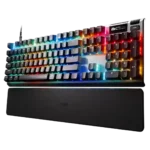
SteelSeries Apex Pro Gen 3 Feature Scores
Explore all 51 feature scores for SteelSeries Apex Pro Gen 3, organized into pros and cons.
Scores by Feature
Summary
51 reviewed features-
Very positive 4.5-5.014 (27%)
-
Positive 3.5-4.427 (53%)
-
Neutral 2.5-3.48 (16%)
-
Negative 1.5-2.42 (4%)
Pros
Sort
-
Rapid Trigger/Rapid Tap features were repeatedly praised for faster resets, movement, and competitive control.
-
Gaming performance was strongly praised across written and video reviews, especially for shooters, fast-paced games, and esports features.
-
Build quality was widely praised as sturdy, robust, premium, and tank-like despite some plastic construction caveats.
-
Responsiveness was one of the strongest themes, with multiple reviewers saying inputs felt immediate and kept up with fast keystrokes.
-
Extra gaming features such as Protection Mode, Rapid Tap, dual actuation, and OLED controls were often praised as genuinely useful.
-
Reviewers mostly liked the OmniPoint switches for smooth, linear, fast feel, though one found them too light and preferred another board.
-
Customization was a major strength, with reviewers praising granular actuation, bindings, RGB, and profiles despite occasional complexity.
-
RGB customization was a clear strength, with per-key control and many effects praised, though some reviewers found setup less straightforward.
-
Keycaps were generally praised for PBT texture, grip, visibility, or shape, with some caveats around non-premium caps on the Mini.
-
Typing feel was usually praised as smooth, satisfying, and enjoyable, though Mini and one video review found it less impressive.
-
The wrist rest was usually praised for comfort, angle, magnetic attachment, and materials, though a few reviewers found it hard or awkward.
-
Form factor sentiment depended on model: TKL and Mini layouts saved space, while compactness could require adjustment.
-
Profile management was useful through QuickSet, presets, and OLED controls, but five always-loaded profiles and clunky menus created friction.
-
Typing comfort was often excellent for long writing sessions, but TechRadar disliked the taller keycap typing experience.
-
RGB lighting quality was often praised for even, attractive, non-intrusive lighting, but color accuracy and brightness were not universally strong.
-
Design aesthetics were mostly positive for clean, minimal, premium looks, though one reviewer found the design nondescript.
-
Acoustics were mixed-positive: many liked the thocky or improved sound, while others heard hollow, clacky, or less refined notes.
-
Value was the most divided category: many reviewers justified the cost, while others found the premium price hard to defend.
-
Software quality was mixed: GG offered deep, useful tools, but several reviewers called it cluttered, bloated, or inconsistent.
-
Macro customization was viewed positively, with reviewers noting easy setup and access through software or onboard controls.
-
Latency evidence was mostly positive in wired use, but Bluetooth and some measured results kept it from being flawless.
-
Sound dampening was generally seen as improved and effective, though one video reviewer still found the sound less refined than expected.
-
Materials were mostly praised for aluminum, matte finishes, and sturdy construction, but the Mini plastic-only case felt less premium.
-
Connectivity ranged from smooth setup and simple wired use to serious wireless/dongle complaints in one PCMag review.
-
Per-key lighting control was useful and flexible, but some custom profiles required GG running in the background.
-
Reliability was supported by accurate input registration and no missed rapid presses in some reviews, but wireless reliability was not perfect.
-
Portability varied by model: Mini and TKL versions were easy to move, while the full-size wired model was desk-bound.
-
Noise level was usually considered reasonable, with reviewers saying it was quieter than before or not distracting.
-
Cable quality was praised when reviewers mentioned the braided, detachable USB-C cable as welcome or less intrusive.
-
Actuation was often praised as consistent and precise, but a few tests found software settings did not perfectly match physical results.
-
Ergonomics were strong for typing reach and long sessions, but some media-control placement and wrist positioning drew complaints.
-
Volume control was generally useful, but the small or recessed wheel hurt ergonomics on some models.
-
One review specifically praised durability, saying the board could withstand intense gaming and bumps.
-
Desk-space efficiency was polarizing: full-size models consumed space, while Mini and TKL versions freed up room.
-
One reviewer found the key reach comfortable, with nothing too far to stretch.
-
Layout options were appreciated in the review that noted full-size, tenkeyless, and wireless variants.
-
Legend visibility was mixed: the white TKL was praised for readable legends, while Mini front legends were criticized for not shining through.
-
The Mini review found the board difficult to flex or bend, supporting strong frame rigidity for that version.
-
Wireless performance was mixed, with one reviewer reporting dongle issues while others found wireless latency or claimed battery behavior acceptable.
-
Reviewers considered the 1000 Hz polling rate usable and solid, while noting it trails newer 8000 Hz rivals.
-
One review found individual key wobble small enough on the dual-rail Hall-effect switches, supporting generally stable key travel.
Cons
Sort
-
Passthrough was a clear weakness where reviewers missed USB passthrough or noted its absence alongside wired limitations.
-
Switch choice drew mixed reactions: reviewers praised the Hall-effect base but criticized limited hardware versatility and mixed switch types on some keys.
-
Brightness was a recurring caveat, with reviewers saying the lighting was dimmer than desired or less bright than nearby accessories.
-
Analog-style control was a weak point in the TechRadar review, which wanted more gamepad-like analog mapping options.
-
Hot-swap evidence was mixed by model and reviewer, ranging from no hot-swap support to Hall-effect switch swapping on TKL/Mini units.
-
Switch replacement sentiment was split: keycap swapping was easy, but non-swappable or hard-to-repair switch designs frustrated reviewers.
-
Media controls were mixed: OLED and volume controls were useful, but small wheels, cumbersome processes, and missing buttons drew complaints.
-
Onboard memory was useful for profiles and cross-PC settings, but lighting behavior and profile requirements limited the experience.
-
Battery life was acceptable but not standout: reviewers reported several days or about two heavy days, while IGN called it not the greatest.
-
Stabilizers were mixed: some reviewers praised reduced wobble or no rattling, while others reported rattly or inconsistent larger keys.