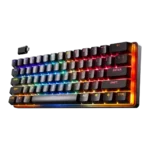
SteelSeries Apex Pro Mini Feature Scores
Explore all 48 feature scores for SteelSeries Apex Pro Mini, organized into pros and cons.
Scores by Feature
Summary
48 reviewed features-
Very positive 4.5-5.010 (21%)
-
Positive 3.5-4.423 (48%)
-
Neutral 2.5-3.412 (25%)
-
Negative 1.5-2.43 (6%)
Pros
Sort
-
Gaming performance received the strongest consensus: reviewers repeatedly called it seamless, phenomenal, snappy, responsive, or even their best dedicated gaming keyboard experience.
-
Responsiveness was one of the strongest areas: reviewers repeatedly described fast actuation, fewer missed strokes, quicker reactions, and very fast in-game feel, with only sensitivity-related caveats at low actuation.
-
Adjustable actuation was widely praised for meaningful tuning from hair-trigger to firmer presses, though a few reviewers noted accidental double-typing or that very low settings need care.
-
Keycap quality was consistently praised, especially the double-shot PBT caps, solid feel, texture, durability, and upgrade over older glossy ABS caps.
-
Customization options were a core strength, repeatedly praised for remapping, actuation tuning, dual actions, profiles, and deep per-key control.
-
RGB lighting quality was broadly positive, with reviewers praising brightness, smooth color cycling, bold colors, vibrant lighting, and clean shine-through.
-
Wireless performance was consistently strong, with reviewers reporting solid connections, no hiccups, no noticeable lag, and rock-solid performance.
-
Most reviewers liked the smooth linear OmniPoint feel, with repeated praise for speed and smoothness; one typing-focused review found the linear feel a little spongy and another noted only a basic smooth feel.
-
Desk space efficiency was consistently positive, with reviewers praising the compact layout for reclaiming desk space and enabling larger mouse movements.
-
Typing feel was generally good to excellent once adjusted, with several reviewers praising the typing experience, though one review only liked it and did not love it due to linear switches and layout.
-
Portability was generally positive for the small body and travel use, though one reviewer wanted better travel packaging and dongle storage.
-
Frame rigidity was usually praised: reviewers noted little or no flex during normal use, an inflexible body, and a stable aluminum-backed construction.
-
Latency impressions were very positive in gaming-focused reviews, where the board was described as lightning fast, hair-trigger, and immediately in sync with movement.
-
Connectivity was praised in wireless reviews for Bluetooth, 2.4GHz, wired options, and quick dongle performance, with multi-device use seen as useful.
-
Macro customization was strong, with reviewers noting macro assignment, extensive key binding control, and the ability to program macros deeply through SteelSeries GG.
-
Acoustics were subjective but often liked, with praise for thock, clocky sound, and satisfying clickety-clack; IGN was the clearest negative outlier on switch/stabilizer rattle.
-
Build quality ranged from strong praise for sturdiness and rigidity to criticism of plastic feel, slight flex, squeaking, and value mismatch at the price.
-
Backlight brightness was mostly praised for visibility and brightness, though one gaming-focused review noted the RGB was not the brightest.
-
Durability evidence was positive, with reviewers citing the 100-million keypress claim favorably and praising tough PBT caps with less worry about wear.
-
The 60-percent size was praised for compactness, travel, and gaming, but several reviewers found it too small or disruptive for productivity and typing.
-
Typing comfort was polarized: some reviewers found long sessions or on-the-go writing comfortable, while others reported typos or discomfort from the tiny layout.
-
Cable quality was positive overall, with reviewers describing the detachable USB-C cable as nice, braided, heavy duty, premium, or durable, though not exceptional.
-
Profile management was useful but not seamless, with praise for onboard/game/device profiles and a caveat that Bluetooth profile swapping takes time to learn.
-
RGB customization was generally liked for per-key and preset control, but one review found SteelSeries GG's illumination section broken during testing.
-
Compatibility evidence was positive, with reviewers citing useful profiles or successful operation across phones, tablets, PlayStation, and mobile devices.
-
Stabilizer quality was mixed-to-positive: several reviewers liked the sound and feel, while others heard rattle or wanted more lube.
-
Software quality was powerful but imperfect: reviewers praised expansive tuning and intuitive customization, while also noting learning curves, confusing firmware updates, bugs, and complexity.
-
Design aesthetics were mixed: some liked the simple, compact, sleek look, while others found the case generic, plastic-feeling, or not premium enough for the price.
-
Reliability was mixed: one reviewer reported no failures in daily use, while others mentioned an early Bluetooth issue or wake-from-sleep delay.
-
One review praised key stability, saying the keycaps felt nice with little to no wiggle on the switches.
-
Ergonomics were mixed: the compact shape fit one reviewer very comfortably, but several reviews disliked stability when feet were deployed or noted sliding.
-
Sound dampening was mixed: one reviewer heard rattle, while others reported minimal case ping or little high-pitched ringing.
-
Volume control had limited but positive evidence from one review that called the printed shortcut/volume-control setup really nice.
Cons
Sort
-
Value for money was the most repeated criticism, with many reviewers saying the keyboard is expensive or hard to justify unless the user will exploit its specialized features.
-
Ease of switch replacement scored poorly because the non-hot-swappable design forces caution and limits switch-level changes.
-
Hot-swappable switch evidence was negative because one review criticized that the switches are not hot-swappable, limiting sound-profile changes and modifications.
-
The wrist-rest evidence was negative because one reviewer specifically criticized the lack of an included wrist rest or extra accessories.
-
Key spacing was a negative adjustment point in the two scored reviews, where the keyboard felt unusually small or the keys felt too close.
-
Battery life was a mild concern rather than a strength: reviewers accepted the rated life but criticized regular charging, aggressive sleep behavior, and wake delay.
-
Legend visibility was mixed: shine-through legends and front legends helped some reviewers, while others found secondary functions hard to read or hidden by lighting, shadows, or the layout.
-
Materials quality was mixed because reviewers appreciated solid construction but repeatedly pointed out the plastic case, with one calling it disappointing for the price.
-
Noise level was a caveat for typing, with reviews describing loud clacking or a louder-side sound even when the reviewer liked the acoustic profile.
-
Media controls were mixed: one reviewer found secondary media toggles clunky in the 60-percent layout, while another successfully mapped play/pause behavior.
-
Onboard memory was mixed: one review praised up to five onboard profiles, while another criticized the inability to save lighting profiles to onboard memory.
-
Per-key lighting control drew one strong praise for being fantastic and one criticism because the software section handling illumination was broken.
-
Analog-like and dual-actuation features split reviewers: some liked walk/run-style control and dual bindings, while others found the behavior unintuitive, questionable in games, or difficult to train.
-
Layout options were the clearest usability tradeoff: some reviewers loved the intuitive secondary bindings, but others struggled with missing arrow, function, and navigation keys.
-
Extra gaming features split reviewers: dual actions and game-specific tuning were praised by enthusiasts but criticized by others as hard to master or not clearly beneficial.