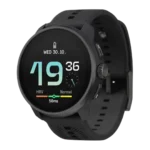
Suunto Race S Feature Scores
Explore all 51 feature scores for Suunto Race S, organized into pros and cons.
Scores by Feature
Summary
51 reviewed features-
Very positive 4.5-5.015 (29%)
-
Positive 3.5-4.418 (35%)
-
Neutral 2.5-3.412 (24%)
-
Negative 1.5-2.44 (8%)
-
Very negative below 1.52 (4%)
Pros
Sort
-
Value for money is the clearest consensus strength, with nearly every reviewer framing the Race S as aggressively priced for its mapping, GPS, AMOLED, and training feature set.
-
GPS accuracy received the strongest overall praise, with many reviewers calling tracks precise, strong, pristine, or among the best they had tested.
-
Display quality is a consistent strength, with repeated praise for the sharp AMOLED panel, color, clarity, and readability.
-
Brightness is consistently praised, with reviewers describing the screen as bright, vibrant, and easy to view in demanding conditions.
-
Workout variety is a clear strength, with reviewers praising the broad sport-mode support for running, cycling, swimming, triathlon, MTB, and many other activities.
-
Mapping and navigation are standout strengths, with repeated praise for offline maps, route planning, responsiveness, and trail usefulness, despite setup and routability limits.
-
Style and design are among the strongest attributes, with reviewers repeatedly calling the Race S sleek, attractive, premium, or one of the best-looking sports watches.
-
Battery life is strong overall for an AMOLED sports watch, but reviews vary from excellent to shorter-than-claimed depending on always-on display and navigation use.
-
Comfort is generally strong, with reviewers praising all-day wear, unobtrusive feel, and smaller case comfort, though some disliked bulk at night.
-
Outdoor visibility is strong; reviewers reported readability in midday sun, normal sunlight, forest shade, and other outdoor conditions.
-
The companion app was broadly praised for route planning, maps, layout, reliability, and modern design.
-
Build quality is a strength, with reviewers praising the watch and strap construction, premium feel, and high-quality form factor.
-
Charging speed is consistently praised, with several reviewers reporting fast full charges or quick top-ups.
-
Software smoothness improved across reviews, with several reviewers calling the UI faster or fluid, though a few still saw polish issues or minor lag.
-
Materials quality is highly regarded, especially the premium wrist feel, titanium option, and quality materials.
-
Touchscreen responsiveness is mostly positive after improvements, though moisture sensitivity and a less-slick feel kept scores from being perfect.
-
Band quality is mixed-positive, with comfort and secure designs praised but some straps criticized for tacky branding, stickiness, or glow-at-night drawbacks.
-
Durability is mostly positive, with strong scratch/impact evidence in one test, although Gorilla Glass and reduced water rating were noted as downgrades from larger models.
-
Customization is useful for routes, sport modes, complications, and modes, though it is not presented as a deep smartwatch-level customization system.
-
Fit is praised for smaller wrists and secure sport use, especially where reviewers noted stable wear during activities.
-
Music controls worked adequately for phone playback, but reviewers consistently treated them as basic controls rather than a full music solution.
-
Reliability is mostly positive for workout operation and GPS logging, but one scientific review and one software-focused review noted broader metric concerns.
-
Watch faces are improved and customizable, but one reviewer found accidental customization in the shower slightly annoying.
-
The operating system experience is mixed-positive: reviewers saw a basic, sports-first platform that improved in responsiveness but is not a rich smartwatch OS.
-
The app ecosystem was praised for useful SuuntoPlus tools, though one review said Suunto still lags Garmin on ecosystem depth.
-
Smartphone notifications generally worked, though reviewers framed them as basic and often noted limited interaction beyond reading alerts.
-
The user interface ranged from confusing at first to quick and easy once learned, with touch and app-driven navigation often helping.
-
Coaching features are capable but uneven, with praise for structured workouts and training planning but criticism for missing Garmin-style suggested workouts and weaker presentation.
-
Recovery insights are useful when presented clearly, especially HRV and Progress-style metrics, but some reviewers found the packaging weak or the conclusions discouraging.
-
Pairing reliability had one clearly positive review, with setup and app pairing described as simple and straightforward.
-
Safety features received limited but positive evidence, especially Find Back/navigation support that added peace of mind.
-
Size options are useful but not universally ideal; some reviewers liked the midsize case, while one found it still suited to thicker wrists.
-
Water resistance received limited opinionated evidence; one reviewer judged 50 meters acceptable for most but a downgrade for deeper use.
Cons
Sort
-
Onboard music storage is a notable weakness, with multiple reviewers calling out the absence of music downloads or internal playback.
-
Bluetooth connectivity is mostly discussed through sensor support, where reviewers criticized Suunto’s one-sensor limitations and weak pairing model.
-
Sleep tracking drew mostly negative or cautious evidence, with reviewers reporting underreported sleep, inaccurate stages, or a lack of confidence in the data.
-
Blood oxygen tracking was only clearly evaluated in one review, and that reviewer called the nighttime SpO2 results poor.
-
Contactless payments were clearly treated as missing in one review, making this a low-scoring feature for users who expect payments on-wrist.
-
A scientific review treated the broader health measurements as weak, especially because heart-rate and sleep-related results were not strong.
-
Charging convenience is more mixed because reviewers liked quick charging but disliked the proprietary pad, alignment, or travel requirement.
-
Button controls are mixed, with several reviewers finding the digital crown fiddly, delayed, awkward, or unpredictable despite useful physical input.
-
Step counting was mixed: one review found totals similar to comparison devices, while another found counts far enough off to be noticeable.
-
Menu navigation takes practice; reviewers liked short paths after learning the logic but criticized confusing menus and less-smooth swiping.
-
Flashlight usefulness is limited because it is screen-based, though one reviewer still found it functional for basic low-light tasks.
-
Call handling is limited to alerts and message/call visibility, with one reviewer wishing reply functionality were available.
-
Wi-Fi connectivity was evaluated mainly through map downloads, which work but were criticized for slow transfer behavior.
-
Third-party app support is useful but not fully baked in, with praise for the app store offset by criticism that some tools should be native.
-
Wellness insights were polarizing; one reviewer liked the quieter data approach, while another thought Suunto’s resource-style metric lagged Garmin-like alternatives.
-
Smartwatch features are intentionally limited: some reviewers liked the cleaner sports-watch focus, while others wanted a fuller smartwatch experience.
-
General fitness tracking was praised for workout capture in one review, but another scientific test found the accuracy only middling versus better devices.
-
Heart-rate accuracy is the most divided attribute: several reviewers found the updated sensor solid or precise, while others reported poor readings and recommended an external strap.