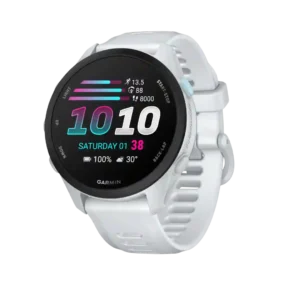
- Compared: GPS testing The Race S was compared against high-end Garmin and Apple watches in GPS testing.
- Compared: sports smartwatch positioning The Race S is positioned against the Apple Watch Ultra as a sports-tracking smartwatch rival.
Suunto Race S Review
Bottom Line
Choose the Suunto Race S for strong GPS, bright AMOLED maps, long battery and value. Skip it if wrist HR, sleep stages, onboard music, payments, or full smartwatch features matter most.
Best for runners, trail users, hikers and multisport athletes who want accurate GPS, offline maps, a bright AMOLED screen and strong training tools at a lower price than many rivals.
Not for users who want a full smartwatch with onboard music, contactless payments, LTE, voice assistance, robust call handling, highly gamified coaching or consistently excellent wrist-HR and sleep-stage accuracy.
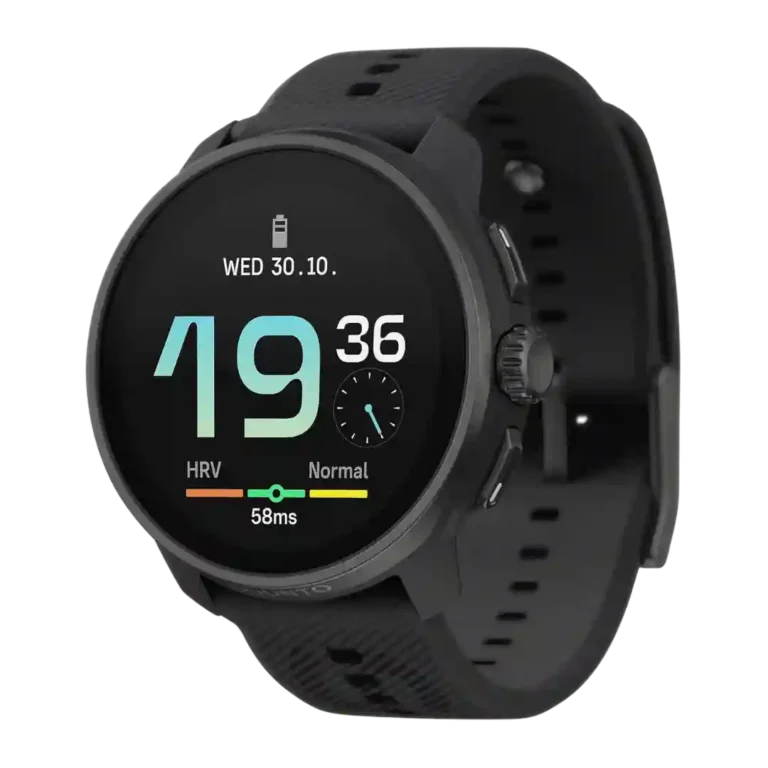
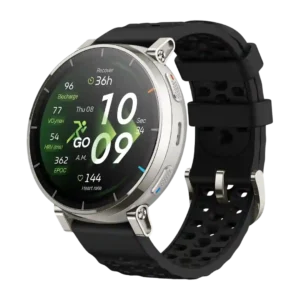
The Suunto Race S earns its praise as a training-first AMOLED sports watch with excellent GPS, offline maps, broad sport modes, strong outdoor visibility and unusually aggressive pricing. Reviewers repeatedly like its compact design, display and app-based route tools, and most find battery life strong for this class. The tradeoff is that it behaves more like a focused endurance watch than a full smartwatch: heart rate accuracy is inconsistent across reviewers, sleep-stage confidence is weak, and features such as onboard music, contactless payments, richer coaching and advanced call handling are limited or missing.
Compared in Reviews
Products reviewers directly compared with this model, grouped into quick takeaways.
- Compared: training and race testing The reviewer tested the Race S alongside a Garmin Forerunner 965 across road, trail, and bike sessions.
- More expensive: price The review says the Race S is priced well below the Garmin Forerunner 965.
- Worse: features for the price The review says the Race S beats the Coros Apex 2 on feature depth at the price.
Feature Scorecards
Pros
-
Build quality is praised as premium for the price, including strong comments on watch and strap construction.
-
GPS accuracy is one of the strongest consensus positives, with reviewers praising precise tracks across runs, rides, trails and mapping use.
-
Value for money is one of the strongest agreements, with reviewers repeatedly calling the feature set unusually strong for the price.
-
Workout variety is a major strength, with reviewers repeatedly citing broad sport modes, triathlon support and multisport coverage.
-
Reliability is strong where tested long-term, with no GPS drops, data loss or signal dropouts reported by key reviewers.
-
Display quality is a major strength, with AMOLED sharpness, color and resolution praised across reviews.
-
Charging speed is a strength, with several reviewers reporting roughly 40 minutes to an hour or rapid top-ups.
-
Outdoor visibility is excellent, with reviewers reporting easy readability in sun, shade and outdoor workouts.
-
Style and design are standout positives, with reviewers repeatedly calling the watch sleek, premium or great-looking.
-
Brightness is consistently praised, especially for the AMOLED screen and route-following visibility.
-
Fit is a strength for smaller wrists and active use, with secure strap fit and reduced case size praised.
-
Cross-platform phone support is solid, with explicit evidence for both Android and Apple compatibility.
-
The companion app is a standout for routes, maps and clean design, though a few reviewers wanted a more intuitive experience.
-
The app ecosystem is strong for routes, TrainingPeaks-style workflows and SuuntoPlus-style extensions.
-
Comfort is generally positive, especially for daily wear, though some found sleep wear or bulk less ideal.
-
Customization is strong across watch faces, widgets, map layers and personalized sport modes.
-
Battery life is strong for an AMOLED sports watch, though real-world daily use can fall below the largest headline claims.
-
Materials quality is good for the price, with steel, titanium and Gorilla Glass mentioned, though the plastic body and non-sapphire lens are tradeoffs.
-
Software smoothness is improved over earlier Suunto experiences, though one review still noted minor lag.
-
The operating system feels simpler and more focused than Garmin, with reviewers noting improved organization and responsiveness.
-
Size options improve wearability versus the larger Race, with reviewers praising the smaller 45mm format.
-
Safety features center on Find Back, offline maps, route guidance and battery reminders, all useful for outdoor use.
-
Stress tracking appears mainly through training-stress metrics, with reviewers noting Training Stress Score and Training Stress Balance displays.
-
Touchscreen responsiveness is mostly good or improved, with some caveats around ultimate slickness and moisture sensitivity.
-
Recovery insights are a real part of the platform, using HRV, sleep and training load, though presentation varies by reviewer.
-
Watch faces are customizable and improved, though at least one reviewer still wanted third-party watch faces.
-
Band quality is mostly positive for comfort and fastening, with some concerns about stickiness or discoloration.
-
Third-party support is useful through SuuntoPlus and connected services, but on-watch app limits hold it back.
-
Durability is generally solid, but the switch from sapphire to Gorilla Glass and 50m rating creates some caveats.
-
Water resistance is adequate for swimming and normal use, but it is lower than the larger Race.
-
Music control from a phone works across reviews, but it is not the same as phone-free playback.
-
Wi-Fi is mainly useful for map downloads and syncing map regions, with the process often tied to the app and charger.
-
Wellness insights exist and can be helpful, but they stay relatively low-key and are not always as persuasive as Garmin-style metrics.
-
Pairing is easy for the phone and external HR monitors, but multi-sensor management is a notable limitation.
-
Charging convenience is mixed: speed helps, but the proprietary cradle and alignment requirements can be inconvenient.
-
Smartphone notifications work for basic mirroring, though some reviewers found presentation limited.
Cons
-
Coaching is mixed: structured workouts and climb guidance help, but reviewers missed richer training plans or daily suggested workouts.
-
The user interface is functional but divisive, with comments ranging from easy to find features to less intuitive than rivals.
-
Calorie tracking is mentioned as part of basic workout feedback, but reviewer evidence is limited.
-
Heart rate accuracy is the clearest split: some reviewers saw improved or precise running/swim data, while many still recommended a chest strap.
-
Fitness tracking is generally competent for workouts, but wrist-HR weaknesses affect confidence in some activities.
-
Menu navigation takes practice; reviewers described the logic as initially confusing despite short navigation paths once learned.
-
Smartwatch features are intentionally basic: notifications, music control and widgets are present, but advanced smartwatch tools are limited.
-
Bluetooth works for sensors and notifications, but reviewers noted sensor-management limits and pairing compromises.
-
Button controls are mixed: the physical layout helps, but the crown is repeatedly described as tricky or awkward.
-
Step counting is mixed: one reviewer found totals similar to Garmin, while another saw substantial undercounting.
-
Call handling is limited to alerts rather than true calling, matching the watch’s training-first focus.
-
Sleep tracking drew repeated caveats, from underreported sleep and night comfort issues to poor sleep-stage confidence.
-
Blood oxygen is present, but evidence is thin and one reviewer called overnight SpO2 readings unreliable.
-
Health tracking is usable for HRV-style context, but reviewers flagged weak sleep-stage reliability and inconsistent body-resource style metrics.
-
Onboard music storage is a repeated limitation, with several reviewers saying there is no real music storage or streaming support.
-
Contactless payments are absent, making this a clear weakness for users who rely on wrist payments.
-
Activity auto-detection is weak in the available evidence, with one review saying not to expect auto exercise detection.
Compared With Category Average
Compared with other Smart Watch, this product is above average in value for money, size options, GPS accuracy, below average in activity auto-detection, contactless payments, onboard music storage.
| Attribute | This product | Category average | Difference |
|---|---|---|---|
| activity auto-detection | 1.0 | 3.8 | -2.8 |
| contactless payments | 1.0 | 2.9 | -1.9 |
| onboard music storage | 1.1 | 2.9 | -1.7 |
| health tracking accuracy | 2.7 | 3.9 | -1.2 |
| value for money | 4.7 | 3.8 | +0.9 |
| sleep tracking accuracy | 2.8 | 3.8 | -1.0 |
| size options | 4.2 | 3.1 | +1.0 |
| GPS accuracy | 4.8 | 4.0 | +0.8 |
FAQ
Is the Suunto Race S good for running and trail use?
Yes. Reviews repeatedly praise its GPS accuracy, offline maps, route tools, sport modes and bright AMOLED display for running, trail running and outdoor use.
How accurate is the heart rate sensor?
Reviewer evidence is mixed. Some found the updated sensor good for running or swimming, while others saw poor cycling, weightlifting or general wrist-HR results and recommended a chest strap.
How long does the battery last?
Reviews generally call battery life strong for an AMOLED sports watch, often around a week in real use, though some testers saw shorter daily-use results with always-on display or heavy GPS.
Does it have full smartwatch features?
No. It handles basics like notifications, phone music controls, widgets and find-my-phone style features, but reviewers note limited calling, no contactless payments and no true onboard music streaming.
Is the display easy to read outside?
Yes. Multiple reviewers describe the AMOLED screen as bright, sharp and readable in direct sunlight, forest shade and during outdoor workouts.
Is the Suunto app good?
Mostly yes. Reviewers praise route planning, maps, clean layout and integrations, while a few describe parts of the app or watch navigation as less intuitive at first.
Who is the Suunto Race S not ideal for?
It is less ideal for users who prioritize sleep-stage accuracy, wrist-based HR precision, music without a phone, payments, LTE, voice assistant features or highly gamified coaching.
Consider This Instead
If you want better contactless payments
Choose Apple Watch SE 3. It scores 4.8 vs 1.0 for contactless payments, with a 4.1 overall score.
If you want better onboard music storage
Choose Huawei Watch Fit 4. It scores 4.7 vs 1.1 for onboard music storage, with a 4.1 overall score.
If you want better activity auto-detection
Choose Samsung Galaxy Watch 6. It scores 4.8 vs 1.0 for activity auto-detection, with a 4.3 overall score.
If you want better health tracking accuracy
Choose Google Pixel Watch 3. It scores 4.8 vs 2.7 for health tracking accuracy, with a 4.2 overall score.
Overall Top Smart Watch Alternatives
Good if you want the most rugged Apple Watch, brighter outdoor screen, better battery, LTE, and top apps. Skip it if you need Garmin-like mapping, recovery analytics, smaller sizing, or...
Pros: display quality, heart rate accuracy
Cons: cross-platform compatibility, recovery insights
Choose the Galaxy Watch 6 for a polished Android smartwatch with a bright screen, strong apps, and broad health tracking. Skip it if battery life, iPhone support, or full non-Samsung...
Pros: outdoor visibility, workout tracking variety
Cons: cross-platform compatibility, battery life
Good if you need a rugged Garmin with deep outdoor, tactical, GPS, training, and battery features. Skip it if you want a cheaper lifestyle watch or do not need the...
Pros: materials quality, durability
Cons: LTE connectivity, value for money
Good if you want premium golf maps, virtual caddie tools, health metrics, music, notifications, and long battery life in one watch. Skip it if you only need basic yardages or...
Pros: pairing reliability, brightness
Cons: software smoothness, user interface