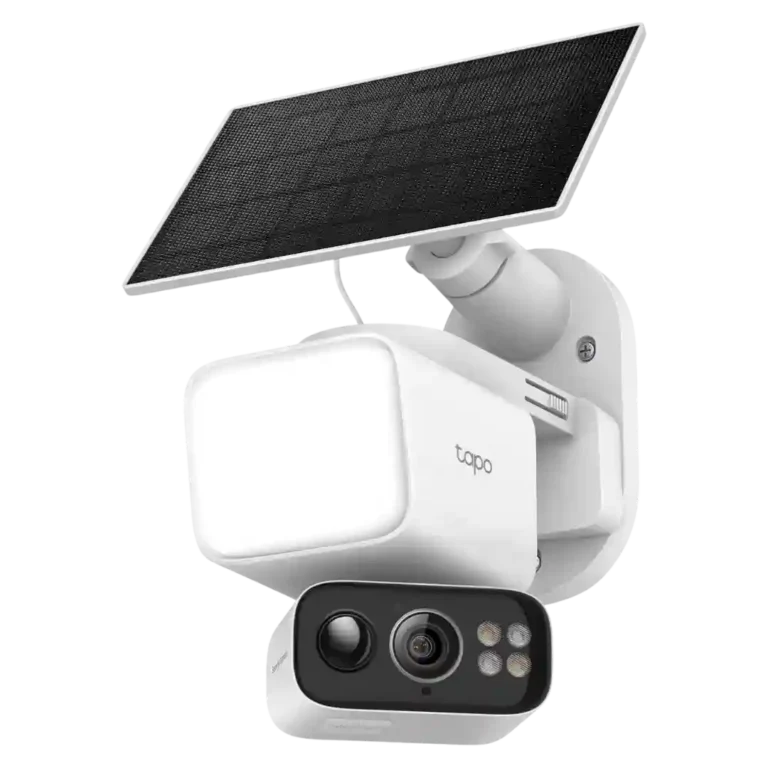
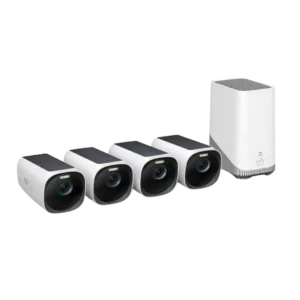
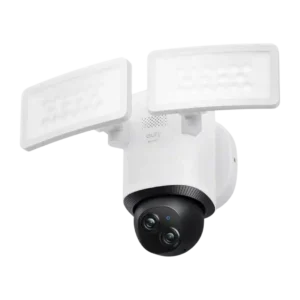
- Better: maximum floodlight brightness The comparison says Eufy's hardwired model is much brighter than Tapo's modest floodlight.
- Better: floodlight brightness and adjustment The review contrasts Tapo's single 800-lumen light with the brighter, multi-light Eufy E340.
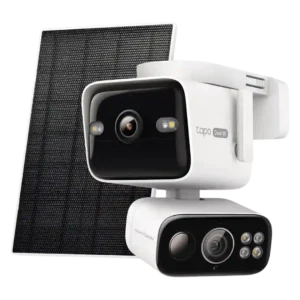
Tapo C615F Kit Review
Bottom Line
Choose the Tapo C615F Kit for a low-cost solar floodlight camera with 2K video, strong pan/tilt tracking, and local storage. Skip it if you need true continuous video, wider fixed-view coverage, or premium AI summaries.
Best for people who want outdoor coverage in places without wiring, especially yards, sheds, driveways, and homestead-style blind spots where solar charging, pan/tilt tracking, local storage, and no-fee detection matter most.
Not for shoppers who need a hardwired floodlight camera with much higher lumen output, true continuous video recording, HomeKit or Matter support, ONVIF or RTSP access, or advanced generative AI summaries.
The Tapo C615F Kit earns its strongest marks by combining solar power, a rechargeable battery, 2K video, pan/tilt tracking, local storage, and a usable 800-lumen floodlight at a price reviewers repeatedly framed as unusually aggressive. Hands-on reviewers liked the app’s depth, subscription-free detection, adjustable lighting, and the way solar charging reduced battery anxiety, even through cloudy or snowy testing. The tradeoff is that this is not a premium hardwired floodlight camera: the native lens view is narrow, true continuous recording is replaced by 24/7 capture or motion clips, rich notifications need Tapo Care, and detection can depend on sensor angle and distance. It is best understood as a flexible, high-value wire-free security camera, not the brightest or most advanced outdoor camera available.
Compared in Reviews
Products reviewers directly compared with this model, grouped into quick takeaways.
Arlo Pro 3 Floodlight Camera
- More expensive: price and included solar panel The review says Tapo undercuts Arlo's starting price while including a solar-powered kit.
- More expensive: battery floodlight camera and solar panel cost The article frames Arlo as the closest competitor but notes Tapo includes solar power for less.
Arlo Pro 3 Floodlight
- More expensive: 2K solar floodlight camera value The review says the Tapo package rivals Arlo's higher-priced 2K floodlight camera at a lower price.
Feature Scorecards
Pros
-
Articulation was one of the strongest repeated strengths, with reviews consistently highlighting 360-degree-style pan coverage and substantial vertical tilt that expand coverage beyond the narrow lens view.
-
Solar power is the strongest consensus point, with reviewers saying the included panel can keep the camera charged and enable wire-free placement.
-
The product is primarily valued as wire-free rather than wired: reviews repeatedly emphasize no household wiring, no outlets, and flexible placement without cables.
-
Motion-zone customization was a clear strength, with evidence for separate zones by people, pets, vehicles, and motion in multiple reviews.
-
Lens distortion was praised in one hands-on review, which found distortion practically nil because of the limited viewing angle.
-
Installation was widely considered easy and app-guided, though one review found the physical assembly less obvious and the waterproof USB-C connection fiddly.
-
Mounting flexibility is a major advantage, with support for wall, eave, pole, ceiling-style placements, and separable solar-panel positioning when sun exposure differs.
-
On-device or subscription-free features are a repeated selling point, especially AI detection, tracking, and core camera functionality without extra fees.
-
Local storage is one of the most consistent strengths, with many reviews citing microSD support up to 512GB and optional hub-based local storage.
-
Price value is very strong, with reviewers repeatedly calling the sub-$100 package impressive, affordable, and hard to argue against for its feature set.
-
PTZ responsiveness was widely praised, with reviewers saying the camera responds quickly, follows subjects smoothly, and tracks across yards or driveways.
-
System scalability is supported by multi-camera viewing, hub-based storage, and the sense that one Tapo ecosystem can cover multiple security points.
-
Battery power is central to the product: reviewers cite the 10,400mAh rechargeable battery, USB-C charging, and use without household wiring.
-
AI processing is repeatedly framed as included without subscription, including people, pets, vehicles, and in one case offline tracking that does not need cloud or internet.
-
Included accessories are broad: reviews mention the solar panel, mounts, screws, templates, USB-C cables, extension cable, and quick-start materials.
-
Detection features were widely praised, especially person, pet, vehicle, motion detection, and tracking that work without mandatory subscription fees.
-
Reviewers found the Tapo app feature-rich, with clear controls for live view, alarms, lights, pan/tilt, detection, and recording; the main caveat was one app bug and some setup-menu friction.
-
A hub is not required for core use, though reviews describe optional Tapo HomeBase or hub setups for centralized local storage and ecosystem control.
-
Microphone sensitivity was good in practical testing, including clear audibility at distance and adjustable microphone volume in the app.
-
Build quality was directly described as well made in the detailed hardware review, especially around the solar panel and compact camera body.
-
Spotlight and light-control features are broad, including lens-side LEDs, adjustable floodlight brightness, auto-on behavior, schedules, and manual controls.
-
Event recording reliability was generally good, with reviewers reporting quick motion-triggered recording, no missing clips, smooth tracking captures, and motion events switching from time-lapse into full recording.
-
Battery life evidence was strongly positive: several reviews repeated the 140-day claim, while hands-on tests reported the solar panel keeping the unit topped up during cloudy, rainy, or snowy periods.
-
Accessory and ecosystem compatibility is strongest inside Tapo's own ecosystem, including hubs, smart actions, other cameras, and shared app control.
-
Streaming and live-view reliability were mostly solid, with quick live-view loading, fast cloud or microSD playback, and Wi-Fi checks during setup.
-
Floodlight brightness was a standout positive, with nearly every hands-on review saying the 800-lumen light was effective, surprisingly bright, or able to light a yard.
-
Night vision was consistently supported, with reviewers citing both infrared and color night modes and generally positive real-world night footage.
-
Durability evidence is favorable, with IP65 construction and one reviewer reporting real rain exposure during testing.
-
Video detail is consistently good for 2K, with reviewers praising sharpness, facial detail, and useful footage, though artifacting can appear during motion or low light.
-
Weather resistance is consistently supported by IP65 evidence, with reviewers calling out dust, water, rain, and outdoor year-round use.
-
Low-light performance is strong when the floodlight or spotlights are active, but one detailed reviewer found tracking image quality weaker without enough light.
-
Automation compatibility is supported through Tapo smart actions and app recommendations, with one reviewer explicitly describing an if-this-then-that style workflow.
-
Privacy controls include both privacy zones and privacy mode; one review also praised allowing the floodlight to remain active while camera privacy mode is on.
-
Smart-home integration is mainly Alexa, Google, and Tapo ecosystem support; there is no positive HomeKit, Siri, Matter, or Thread evidence in the reviews.
-
Mobile app reliability is mostly positive for setup, live view, and controls, but not flawless; one review had a privacy-mode error and others noted setup friction.
-
Recording start-time lag is mostly favorable but not perfect: one review saw no noticeable delay, one tested motion-to-recording directly, and one wanted faster notifications.
-
Motor and rotational noise was not a major issue in the detailed audio test; the reviewer said the camera was unlikely to pick up that movement sound.
-
Digital zoom benefits from the 2K sensor and app pinch-to-zoom, but evidence frames it as digital rather than optical zoom.
-
The device is compact and feature-dense, though reviewers also note the solar panel adds bulk and the arm/floodlight assembly affects footprint.
-
Notifications are configurable by activity type and schedule, but richer snapshot notifications are tied to Tapo Care in several reviews.
-
Speaker and siren output is generally strong enough for alarms and two-way talk, though one reviewer found responses from the camera side sometimes hard to understand.
-
Pre-event and clip-buffer controls are supported through record-buffer and interval settings, though evidence is about app configuration rather than a long pre-roll feature.
-
LED status visibility is modestly supported by setup evidence showing the red and green flashing indicator during onboarding.
-
Two-way audio and captured audio were generally usable to good, with clear voice pickup in several tests, though one review found responses harder to understand and another noted lower audio while tracking.
-
Cable handling is mostly flexible thanks to extension cables, separable mounts, and tie-down options, but one review criticized the thick waterproof USB-C seal as hard to seat confidently.
-
Cloud storage is optional and reasonably priced in the evidence, with several reviewers emphasizing that most core functions and local recording do not require a paid plan.
-
Detection range was useful but not unlimited: one review identified faces around 30 feet, another measured detection around 30 feet, while a third criticized the smaller PIR sensor as a limiting factor.
-
Color output was mostly positive under strong lighting, with one reviewer praising accuracy and another noting muted daytime colors but good night color under the floodlight.
-
Notification speed is acceptable but not instant: one reviewer measured about 30 seconds while another captured a 6-second alert in testing.
-
Connectivity evidence was limited but positive for Alexa and Google integration; other reviews noted Wi-Fi details separately, including mixed claims around 2.4GHz-only versus dual-band support.
-
Frame rate is modest but acceptable, with the evidence consistently placing the camera at 15 or 20 fps rather than high-frame-rate video.
Cons
-
The built-in lens field of view is repeatedly described as narrow or only fine at about 100 degrees, but the pan/tilt mechanism helps offset that limitation.
-
False-alert filtering was mixed: some reviews liked people-only configuration and reduced unwanted alerts, while others reported false positives and sensor-triggering limitations.
-
Wi-Fi evidence is mixed: one review says the camera has dual-band 2.4/5GHz Wi-Fi, while two video reviews say their unit only connected over 2.4GHz.
-
The strongest caveat is recording continuity: reviewers repeatedly clarified that 24/7 capture is a time-lapse or still-image feature rather than true continuous video recording.
-
There is no optical zoom evidence; the detailed review explicitly says the zoom is digital rather than optical.
Compared With Category Average
Compared with other Surveillance Cameras, this product is above average in IFTTT/automation compatibility, Power options (solar panel), Local storage option convenience, below average in Optical zoom performance.
| Attribute | This product | Category average | Difference |
|---|---|---|---|
| Optical zoom performance | 1.5 | 3.5 | -2.0 |
| IFTTT/automation compatibility | 4.2 | 2.6 | +1.6 |
| Power options (solar panel) | 4.7 | 4.0 | +0.8 |
| Local storage option convenience | 4.6 | 3.8 | +0.7 |
| wired | 4.7 | 3.8 | +0.9 |
| PTZ (pan/tilt/zoom) control responsiveness | 4.5 | 3.7 | +0.8 |
| Price value | 4.5 | 3.8 | +0.7 |
| Power options (battery) | 4.5 | 3.9 | +0.7 |
FAQ
Does the Tapo C615F Kit require a subscription?
No. Reviewers repeatedly said person, pet, vehicle detection, tracking, and local microSD recording work without a subscription. Tapo Care mainly adds cloud storage, richer notifications, and extra history.
Is 24/7 recording truly continuous video?
Not in the reviewed evidence. Reviewers described 24/7 Capture as still images or time-lapse intervals plus motion-triggered video, rather than uninterrupted video recording.
How bright is the floodlight?
The floodlight is repeatedly described as 800 lumens. Several hands-on reviews said it was surprisingly bright and effective for lighting a yard, though comparisons note some hardwired competitors reach 2,000 lumens or more.
How good is the battery and solar setup?
Reviews were very positive. Several repeated the 45-minutes-of-sunlight claim, and hands-on testers reported the solar panel keeping the battery topped up during cloudy, rainy, or snowy conditions.
Does the camera work with Alexa, Google, or HomeKit?
The reviews support Alexa and Google Home or Google Assistant compatibility. They do not provide positive evidence for HomeKit, Siri, Matter, Thread, ONVIF, or RTSP support.
What are the main drawbacks?
The common caveats are a narrow native field of view, sensor-angle limits for detection, mixed false-alert evidence, rich notifications requiring Tapo Care, and 24/7 capture not being true continuous video.
Consider This Instead
If you want better Continuous recording capability
Choose TP-Link Tapo ColorPro C325WB Outdoor Camera. It scores 4.7 vs 2.9 for Continuous recording capability, with a 4.0 overall score.
If you want better Field of view
Choose Tapo C675D. It scores 4.8 vs 3.3 for Field of view, with a 4.2 overall score.
If you want better Cloud storage plan value
Choose eufy 4K NVR Security Camera System S4 Max. It scores 5.0 vs 3.9 for Cloud storage plan value, with a 4.3 overall score.
If you want better False alert filter effectiveness
Choose Eufy EufyCam S3 Pro Security Camera. It scores 4.3 vs 3.3 for False alert filter effectiveness, with a 4.2 overall score.
Overall Top Surveillance Cameras Alternatives
Choose the S4 Max for fast PoE reliability, local AI search, and cross-camera tracking; Skip if you cannot run Ethernet or need HomeKit or ONVIF flexibility.
Pros: Cloud storage plan value, PoE)
Cons: ONVIF/RTSP support, IFTTT/automation compatibility
Choose the EufyCam S3 Pro for subscription-free 4K footage and standout color night vision; Skip it if you need smoother high-fps motion or can’t guarantee strong Wi-Fi and at least...
Pros: Weather resistance rating (IP code), Recording start-time lag
Cons: Cloud storage plan value, Frame rate
Best for a low-cost solar floodlight camera with 2K video, strong pan/tilt tracking, and local storage. Skip it if you need true continuous video, wider fixed-view coverage, or premium AI...
Pros: Articulation range, Power options (solar panel)
Cons: Optical zoom performance, Continuous recording capability
Good if you need wide outdoor coverage, solar power, local storage, and fast tracking in one camera. Skip it if you need compact hardware, direct HomeKit, wired/PoE, or clean audio...
Pros: Low-light performance, Event recording reliability
Cons: Customer support responsiveness, Echo/noise cancellation