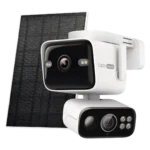
Tapo C675D Feature Scores
Explore all 56 feature scores for Tapo C675D, organized into pros and cons.
Scores by Feature
Summary
56 reviewed features-
Very positive 4.5-5.029 (52%)
-
Positive 3.5-4.419 (34%)
-
Neutral 2.5-3.46 (11%)
-
Negative 1.5-2.42 (4%)
Pros
Sort
-
The dual-camera design was one of the strongest positives, solving the wide-view versus close-up tradeoff and covering motor blind spots.
-
Solar power was one of the clearest strengths, praised for placement flexibility and strong charging performance.
-
Local storage was a major strength, praised for simplicity, local recording, and avoiding cloud dependence.
-
Video detail earned repeated praise, with reviewers calling footage clear, holding up, and showing good clarity.
-
Detection features were consistently praised for well-rounded smart detection and fewer unnecessary alerts.
-
Event recording reliability was excellent in the strongest test evidence, with every checked event captured and recorded.
-
Night vision was strongly praised, including color night vision that looked crisp and balanced.
-
Installation was generally praised as simple and clean, with multiple reviewers calling the mounting process easy.
-
PTZ control and tracking were praised, especially in normal placement where tracking was described as near perfect.
-
Cross-camera tracking was praised for keeping movement in frame and letting the tracking lens follow across the scene.
-
Battery power was praised for removing outlet dependence and reducing the need for manual power attention.
-
Continuous capture was viewed as useful, though evidence frames it as interval snapshots rather than full wired-style video.
-
Battery life was viewed positively, especially with solar assistance and ordinary use not quickly draining the unit.
-
Weather resistance was praised across year-round outdoor language and a hands-on cold-weather result.
-
On-device features were valued for local AI filtering and fast basic detection without cloud dependency.
-
Notification speed ranged from under a minute in one test to almost zero delay in automation testing.
-
Floodlight brightness was praised as very strong in night testing.
-
Low-light performance was exceptionally strong in testing, with the reviewer struggling to find anything to criticize.
-
Recording start-time lag looked minimal in testing, with detection beginning immediately.
-
Connectivity was praised in an off-grid setup, with the camera holding signal better than many tested alternatives.
-
Dual-stream recording was praised because the two lenses produce separate 4K recordings rather than one stitched image.
-
Field of view was praised for covering almost an entire backyard from one fixed lens.
-
On-device AI processing was praised for enabling faster alerts without relying on the cloud for basic detection.
-
Operating temperature performance was praised after the camera handled minus 20 Celsius conditions.
-
Accessory compatibility was praised around Amazon Echo Show integration.
-
System scalability was supported by an off-grid reviewer using multiple Tapo cameras consistently around a property.
-
Cable length was praised because it allowed a clean solar-panel setup without needing the extension cable.
-
Detection range looked strong in hands-on testing, including detecting from behind and to the side of the camera.
-
Dual-band Wi-Fi was praised because 5 GHz can reduce network strain from multiple cameras.
-
Durability was praised after the camera was characterized as tough in stress testing.
-
A hub was not treated as required; the camera could be used on its own with local recording.
-
Mobile app reliability was praised because live view loaded quickly.
-
Streaming reliability was praised because live view opened quickly.
-
Reviewers liked the app’s easy layout, but one hands-on reviewer flagged missing guard-home/default position controls.
-
The fixed lens and adjustable mount were praised for letting the camera cover a wider monitoring area.
-
Activity zones were described as useful for reducing alerts from streets or neighboring activity.
-
Pre-event coverage was praised because continuous capture reduced the chance of missing the beginning of events.
-
The physical build received a positive hands-on impression as solid.
-
Included accessories were viewed positively, especially the generous cable length.
-
Mounting flexibility was praised for under-eave and gutter-adjacent setups.
-
Speaker output was considered clear and good in testing.
-
Digital zoom was useful but somewhat qualified, with tap-to-zoom and in-app zoom working acceptably rather than impressively.
-
Microphone sensitivity was mixed: it picked up distant speech well but was also sensitive to wind.
-
Spotlight and alarm features were useful, but control was imperfect because the spotlight could not always be disabled.
-
Firmware updating received a positive note because the setup prompted auto update.
-
Automation was powerful but not seamless, with workarounds needed for some setups.
-
Price value was viewed positively when considering the two cameras and solar panel in the package.
-
False-alert filtering helped reduce noise, though one test noted minor misclassification of some events.
Cons
Sort
-
HomeKit integration was a clear limitation because direct HomeKit support was not available in the review evidence.
-
Noise handling was a weak point, with wind noise clearly noted in recordings.
-
Audio recording drew criticism in testing, with recordings described as tinny.
-
Size was a drawback, with one reviewer calling it one of the biggest home cameras they had seen.
-
Notification management was a weakness because one reviewer wanted snooze alerts and custom notification sounds added.
-
Frame rate was a caveat: the reviewer noted blur could appear with very fast movement.
-
Cloud storage was treated as optional, but one reviewer noted a tradeoff where local storage could fill quickly for some features.
-
Smart-home integration was mixed: automation was fast elsewhere, but Google integration was specifically called a problem.