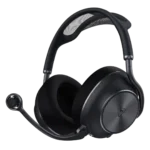
Turtle Beach Stealth Pro II Feature Scores
Explore all 66 feature scores for Turtle Beach Stealth Pro II, organized into pros and cons.
Scores by Feature
Summary
66 reviewed features-
Very positive 4.5-5.022 (33%)
-
Positive 3.5-4.427 (41%)
-
Neutral 2.5-3.412 (18%)
-
Negative 1.5-2.45 (8%)
Pros
Sort
-
Two roughly 40-hour removable batteries make battery anxiety almost disappear, with reported runtime ranging from about 30 to 50 hours per pack. The spare is normally charged and ready before the active one is depleted.
-
The compact transmitter dock keeps the spare battery charged and ejects it cleanly for a seconds-long swap. This rotation gives desk users nearly uninterrupted wireless operation.
-
The broad consensus favors rich, punchy, highly immersive sound with strong detail for games, music, and movies. Its stock bass and treble are not neutral, and a minority finds the result muddy, sharp, or inferior to cheaper alternatives.
-
CrossPlay switching, dual wireless audio, and optional transmitters make the headset exceptionally flexible across rooms and systems. Extra dongles cost more, only one 2.4GHz stream plays at a time, and some launch setups were unreliable.
-
Most users describe a premium, sturdy mix of metal, soft-touch plastic, fabric, and tactile controls that withstands normal knocks well. Concerns center mainly on the thin suspension mesh and isolated durability complaints.
-
The Xbox version works across Xbox, PlayStation, PC, Switch, and mobile, making it the safest all-platform purchase. The PC/PlayStation version is similarly flexible except for its complete lack of Xbox support.
-
The rigid fitted case is widely praised for protecting the headset, batteries, dock, mic, and accessories. It feels suitably premium, although its large footprint makes it less travel-friendly than it first appears.
-
The understated metal-and-fabric design looks far more luxurious and less overtly gamer-like than earlier Turtle Beach headsets. Its large earcups remain bulky, but most reviewers are comfortable wearing it in public.
-
The angled memory-foam cushions are usually described as soft, breathable, plush, and glasses-friendly. A minority find the cloth scratchy or warm, and it isolates less completely than leatherette.
-
The detachable 9mm boom is one of the strongest headset microphones in this class, often described as clear, warm, and suitable for meetings or casual content creation. Some listeners hear thinness or sibilance, and a few launch units suffered severe bugs.
-
The onboard-saving 10-band EQ can tame the strong bass and treble or create game-specific profiles. It is effective, though some reviewers want finer bands, more presets, or a truly neutral starting point.
-
Most reviewers locate footsteps, gunfire, distance, and movement with excellent precision, especially in tactical shooters. Dense action, low-volume complaints, and a few negative customer experiences show performance is not flawless for everyone.
-
The dominant view is that this is a flagship headset with exceptional audio, battery convenience, microphone quality, and platform flexibility. The premium price, polarized headband comfort, and early software bugs keep it from being universally safe.
-
ANC is unusually effective for a gaming headset, cutting steady hums, appliances, and even nearby construction. A few users report cabin pressure, seal-related rumble, wind weakness, or occasional artifacts.
-
Mids and vocals are generally detailed despite the strong bass, supporting both games and music well. The stock tuning can recess dialogue in dense scenes or become muddy before EQ correction.
-
The large cushions and ProSpecs relief channels are repeatedly praised for avoiding painful pressure on glasses arms. Even long-session glasses wearers generally report a comfortable fit.
-
Simultaneous Bluetooth and 2.4GHz audio is excellent for calls, music, and gaming at once, with separate volume control. Pairing and call-volume bugs appear in some units, and this is not true multi-device Bluetooth multipoint.
-
The dual-driver design produces powerful, physical bass that makes games feel cinematic without always sacrificing detail. The stock tuning can be overly boomy, and extreme boost or ANC behavior may introduce distortion.
-
The closed-back headset creates a surprisingly broad, enveloping stage with strong depth and atmosphere. It still trails good open-back designs in openness, and one customer found it narrower than an older Turtle Beach model.
-
Certified 24-bit/96kHz playback gives the headset ample detail and headroom over compatible USB connections. Platform caps and subtle real-world differences mean the hi-res badge matters more to PC listeners than every console player.
-
The 2.4GHz connection and low-latency Bluetooth options produce effectively immediate game audio, with multiple reviewers reporting no perceptible lag.
-
AI processing and noise-gate controls can reduce keyboards, chatter, and machinery without heavily damaging speech. It is not always aggressive enough, and some reviewers prefer it off because it flattens the voice.
-
Dolby Atmos adds enjoyable height, distance, and environmental detail in supported games and movies. Competitive players may prefer native game audio because virtualization can add reverb or soften precise cues.
-
The dual drivers usually keep layered effects, music, and ambience distinct, even in busy shooters. Separation can become less convincing in chaotic battle-royale mixes or beside strong open-back and planar competitors.
-
Removing the boom mic quickly converts the headset into a cleaner-looking pair of everyday headphones, while flip-to-mute is usually convenient. A few users prefer retractable designs or trigger mute accidentally when moving the boom.
-
The Xbox version works natively with Microsoft consoles while retaining broad support for PC, PlayStation, Switch, and mobile. It is the preferred version for buyers who own multiple console families.
-
Swarm II exposes ANC, microphone controls, button mapping, EQ, and device settings on PC and mobile. Its breadth is a strength, but several launch-period users encountered crashes, stalled updates, or transmitter-detection failures.
-
The contoured pads and swiveling yokes usually form a secure ANC-friendly seal across varied head shapes. Small heads, unusually large heads, and seal-sensitive users report slipping, pressure, or vacuum sensations.
-
Soft sculpted cushions and good weight distribution let many reviewers wear the headset for full workdays or marathon gaming. Others develop top-of-head pain within an hour or two, making long-session comfort the product’s most divisive trait.
-
The physical wheels and buttons are generally tactile, logically placed, and partly remappable. Some find the controls crowded, the volume steps too coarse, or individual functions hard to identify by touch.
-
Teams, Discord, party chat, and work calls usually sound clear and full through the boom mic. The integrated microphones are less dependable, and one customer experienced unusably low voice volume.
-
Transparency mode is useful for hearing family, calls, or surroundings without removing the headset, and its level can be adjusted in the app. On-headset mode control is less flexible than some users expect.
-
Highs are crisp and reveal fine effects, but the stock tuning often pushes them too far. Sensitive listeners report sibilance or painful sharpness, which is usually reduced with EQ.
-
At about $350, the headset is undeniably expensive, but enthusiasts often see the money in its audio, ANC, mic, batteries, case, and connectivity. Casual players and comfort-sensitive buyers can obtain solid results for much less.
-
The built-in profiles provide quick tonal changes and several reviewers enjoy them. Bass-heavy or competitive modes can sound exaggerated or hollow, making custom EQ the more reliable option.
-
The sculpted cushions create a useful passive seal that blocks a surprising amount of room noise before ANC is enabled. Cloth coverings and imperfect fit can still let voices and sound leakage through.
-
The included second transmitter is a major convenience for switching between separated systems without moving cables. Expansion units cost extra and have sometimes been unavailable, defective, or unrecognized by Swarm II.
-
The cups generally swivel and tilt far enough to sit flush or rest comfortably around the neck. One customer found the movement slow enough to make single-ear listening awkward.
-
USB-C supports charging and wired digital playback on compatible PC and PlayStation setups. Wired platform support and included cable types are limited enough that some users will need an adapter.
-
The headset can play very loudly while staying impressively clean in many tests. At the extremes, boosted bass or sharp treble can become distorted, fatiguing, or painful.
-
Basic pairing and source switching are often instant and intuitive out of the box. Firmware updates, first-time CrossPlay configuration, and Swarm II detection caused serious friction for a notable minority.
-
The Android version of Swarm II mirrors the useful PC controls, letting players adjust headset settings from a phone while using another gaming source.
-
Support for modern Bluetooth codecs such as LC3+ and LDAC can deliver high-quality wireless streams on compatible devices, though availability varies by headset version.
-
The cushions use simple twist locks, making them straightforward to remove and reinstall without tools.
-
The presentation feels premium and carefully organized, matching the headset’s flagship positioning.
-
The stock pads can be removed with easy twist locks, simplifying replacement or reseating when the ANC seal is wrong.
-
The removable mic and restrained styling make the headset usable away from a desk. Nearly 400 grams, deep earcups, and an oversized case prevent it from being genuinely compact travel gear.
-
The dedicated mix wheel is convenient where supported and can be reassigned. Its function depends on the headset version and platform, and mobile control behavior was inconsistent for at least one tester.
-
The package is generous, with a hard case, two batteries, charging transmitter, second dongle, detachable mic, and cable. Some buyers still wanted another transmitter or charging cable included at this price.
Cons
Sort
-
The metal sliders hold their position securely but can require excessive force and are awkward to change while worn. Several users also need frequent repositioning or cannot size the headset down enough.
-
The headset mixes one Bluetooth source with one 2.4GHz source, but it does not provide true Bluetooth multipoint. Some users report device-priority confusion or call-volume failures when multiple connections are involved.
-
Mic monitoring is useful for controlling speaking volume, but current implementation is inconsistent. It can be very quiet, fail to work as expected, or become unavailable when ANC is active.
-
An incorrectly seated earpad can cause unwanted ANC noise or rumble. Reinstalling and fully twisting the pad into place resolved the issue in testing.
-
Only the battery-side faceplate is removable, so the design does not meaningfully support interchangeable cosmetic plates or broad aftermarket customization.
-
The breathable cloth cushions do not contain sound as effectively as denser leatherette pads, so some audio can escape at higher levels.
-
The Xbox model offers the broadest native compatibility, while the PC/PlayStation model cannot connect to Xbox. Game/chat mixing and certain codecs are also tied to the selected version, creating avoidable fine print.
-
The default signature is intentionally V-shaped rather than neutral, emphasizing bass and upper treble while keeping most mids audible. Listeners seeking studio accuracy will need EQ and may still notice uneven low-end character.
-
The frame feels robust overall, but one owner added a headband accessory out of concern that the suspension structure might deteriorate over time.
-
Soft-touch surfaces and ridged metal plates readily show oils, dust, and trapped debris, although fingerprints generally wipe away without much effort.
-
The built-in beamforming mics are convenient for calls when the boom is removed and provide more discreet public use. They pick up more room noise, sound less polished, and were buggy or inaccessible for some reviewers.
-
Output ranges from extremely powerful on some PCs to unexpectedly quiet on PS5 or Bluetooth for several users. Coarse wheel increments and occasional control bugs make level adjustment less consistent than it should be.
-
LDAC can provide higher-quality Bluetooth listening, but support is restricted to the PC/PlayStation version rather than the broadly compatible Xbox model.
-
At roughly 382–396 grams, the headset is objectively heavy, though good cushions and distribution make it feel manageable for many. Others develop head or neck discomfort quickly because the narrow mesh carries too much load.
-
The main 2.4GHz link is usually rock-solid, reconnects quickly, and reaches through walls farther than most rivals. Isolated low-battery hiccups, Bluetooth pairing problems, and defective dongles temper that strength.
-
Superhuman Hearing can make footsteps and gunfire more obvious in tactical shooters. Its heavy rebalancing often hollows out music, dialogue, and other effects, so many prefer a custom EQ instead.
-
Clamp is comfortable or moderate for many heads and helps maintain a reliable seal. Others experience initial tightness, vacuum-like pressure, or concentrated discomfort, so fit is highly head-shape dependent.