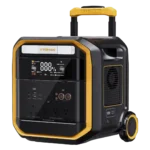
Vtoman FlashSpeed Pro 3600 Feature Scores
Explore all 64 feature scores for Vtoman FlashSpeed Pro 3600, organized into pros and cons.
Scores by Feature
Summary
64 reviewed features-
Very positive 4.5-5.048 (75%)
-
Positive 3.5-4.49 (14%)
-
Neutral 2.5-3.46 (9%)
-
Negative 1.5-2.41 (2%)
Pros
Sort
-
Fast AC charging is the most consistent point of praise, with most reviewers reporting or citing roughly two hours for a full refill.
-
The overall verdict is highly positive: reviewers see it as a powerful, fast-charging, well-priced large-format station. Most drawbacks are physical rather than electrical.
-
The 3,600W inverter is the product’s defining strength, comfortably supporting multiple high-wattage appliances and equipment that smaller stations cannot handle.
-
This is where the station excels: reviewers ran heaters, compressors, saws, washing machines, kettles, and even electric vehicles without trouble.
-
Dual 100W USB-C ports are a standout convenience, fast-charging laptops, drones, power banks, and other demanding mobile devices without separate bricks.
-
Large, grippy, solid wheels roll smoothly over concrete, gravel, and indoor floors and appear durable enough for frequent movement.
-
At sale pricing, reviewers repeatedly called it a bargain and a strong cost-per-watt-hour choice compared with other large LFP stations.
-
The metal suitcase-style handle feels sturdy, offers useful height adjustment, and is essential for moving the heavy station.
-
The capacity and 3,600W output make it a credible short-term home backup source for refrigeration, heating, networking, tools, and other essentials.
-
Its wheels and suitcase handle make rolling surprisingly easy, but true portability is limited by the more-than-80-pound weight. It is better moved occasionally than carried frequently.
-
Top and rear compartments keep charging cables, manuals, batteries, and small accessories organized and ready with the station.
-
Reviewers expect many years of service from the LFP pack, with several describing a decade of useful life as realistic when treated well.
-
For a 3.1kWh station, the body is impressively compact and luggage-like. Several reviewers were surprised by how much capacity VTOMAN packed into the footprint.
-
The LFP battery is viewed as a major advantage for safety, thermal stability, and long service life. Its chemistry suits a unit intended for repeated backup and off-grid use.
-
The station comfortably runs many devices together, with enough ports and inverter headroom for mixed USB, DC, and AC loads.
-
Clear controls, labeled banks, and straightforward activation buttons make this large station unusually approachable.
-
Four AC outlets, multiple USB ports, dual car sockets, barrel connectors, and a high-current connection create an unusually versatile port array. One 120V-focused review flagged the lack of a 240V outlet.
-
The front lighting is more than decorative: it illuminates the ports, provides room or campsite light, and includes red warning or SOS modes for emergencies.
-
The large battery delivers strong endurance, from powering two wash cycles with modest depletion to running low-draw lighting or fans for days.
-
The UPS mode is widely praised for keeping computers, networking gear, refrigerators, and medical devices running through brief outages with little or no noticeable interruption.
-
A 3,000-plus-cycle rating puts the battery in long-life territory and compares favorably with major brands.
-
Heavy and mixed loads were handled confidently, including draws that commonly trip smaller power stations.
-
Dual car-style sockets are an uncommon strength, giving 12V users more flexibility than many large power stations. Reviewers especially liked that VTOMAN did not drop these ports in a home-backup-focused design.
-
VTOMAN’s load-management behavior impressed reviewers by ramping or reducing output instead of immediately shutting down under difficult startup loads.
-
The multi-layer BMS inspires confidence through protections for heat, voltage, current, sparks, and other electrical risks.
-
Solar refill times of roughly five to eight hours under good conditions are considered respectable for such a large battery.
-
The roughly 3.1kWh pack is consistently described as substantial, giving the station enough reserve for multiple devices, long low-draw runtimes, and serious backup work.
-
Power delivery remained steady under demanding loads, including electric equipment and multi-device use.
-
An 800W solar ceiling is considered strong for this capacity, and the broad voltage range gives users practical array flexibility.
-
Covered input and output panels provide useful protection from drips and light rain, though reviewers still caution against operating it in wet weather.
-
Expansion is appealing because an add-on pack can roughly double capacity, but availability and documentation appear inconsistent across markets and review dates.
-
Construction feels strong and purposeful, with sturdy fixed handles, a well-built chassis, and components that appear ready for demanding use.
-
Clearly organized, labeled port banks make the station quick to understand during an outage or job-site setup.
-
The inverter and fans manage heat well under heavy loads, staying stable and activating cooling only when needed.
-
Fan noise is minimal and often masked by the appliance being powered; at lighter loads, reviewers described the unit as effectively silent.
-
The 12V-to-80V input range supports a wide variety of panel arrangements and makes series wiring easier than on lower-voltage competitors.
-
The outer shell feels rugged enough for outdoor, workshop, and job-site use rather than delicate indoor-only storage.
-
Pure sine output is valued for safely running sensitive electronics, computers, and other equipment that benefits from clean AC power.
-
The angular yellow-and-black styling drew positive reactions, with the covered front giving the unit a clean, distinctive look.
-
The huge battery percentage is easy to see from across a room, but smaller data can become difficult to read in bright sunlight. Outdoor visibility is the screen’s clearest weakness.
-
Four AC receptacles were repeatedly called generous, making it easier to run several household appliances without an external power strip.
-
Indoors, the display feels premium and presents the information users want in an easy-to-understand format.
-
Operation is genuinely plug-and-play, with no complicated wiring required for common appliance, workshop, or backup uses.
-
The screen clearly shows remaining charge plus live input and output wattage, making load management simple.
-
The inverter stayed cool, stable, and reliable while handling vehicle charging and other demanding loads.
-
The soft-start behavior successfully ramped a demanding compressor without tripping protection, showing strong motor-start capability.
-
Appliance startup loads were handled exactly as claimed, including a 1,500W kettle and other equipment with higher initial draw.
-
The phone app is presented as a convenient way to check exact power information from a phone.
-
A compartment under the top lid keeps the heavy-duty AC charging cable with the unit instead of loose in a vehicle or garage.
-
The included AC cable uses suitably thick wiring for the station’s high charging current, and reviewers recommend using it rather than a random replacement.
-
The hinged front cover helps keep dirt and debris away from the outlet banks when the station is stored or transported.
-
Low internal power consumption is presented as a strength, helping the station remain ready without wasting much stored energy.
-
Charging during cheap overnight electricity periods or from solar could reduce day-to-day energy costs over time.
-
The dedicated RV connection is a useful option for caravans and mobile setups that need a direct high-current feed.
-
Most users found the labeled ports easy to reach, though one reviewer felt the large hinged cover could get in the way during regular use.
-
With the matching panels, solar conversion is considered efficient enough to make five-to-eight-hour off-grid charging dependable.
-
The 20ms switchover is considered adequate for sensitive equipment such as CPAP machines, but one reviewer noted it trails newer 10ms UPS designs.
Cons
Sort
-
More than 80 pounds is the product’s biggest physical drawback. A few reviewers considered that reasonable for the capacity, but most found it genuinely heavy.
-
Rolling is easy, but lifting is not. At more than 80 pounds, the station generally requires two hands or two people.
-
One reviewer questioned how the advertised 6,000W figure relates to true surge output, making the peak-power wording less clear than it should be.
-
The box covers basic charging with an AC cable and USB leads, but the accessory bundle feels sparse for a station in this class.
-
The high peak figure looks promising, but the exact distinction between surge power and V-Beyond voltage reduction is not consistently explained.
-
The Anderson input is flexible, but the lack of an included MC4-to-Anderson cable means many solar users will need an aftermarket adapter.
-
The footprint is compact relative to capacity, yet still large enough to be awkward on counters or in tight rooms. Its tall, deep body needs deliberate storage space.