Access logs are a meaningful benefit in several reviews, showing event history and helping track who unlocked when, with retention commonly described in the weeks-to-month range.
Access logs are repeatedly described as detailed, showing who locked/unlocked and which method was used, supporting accountability and household tracking.
The lock provides audible prompts and alarms, and some reviews like the adjustable volume options; others find default voice volume loud or note that certain door-open alarms can be inconsistent.
An alarm is mentioned for failed attempts and jam events, and some demos show volume controls, but loudness itself is not rigorously evaluated in the reviews.
The Aqara app is described as feature-rich for user management, logs, automations, and settings; a recurring complaint is that some controls (like sounds/volume) may require pairing to an Aqara hub.
The app is described as feature-rich for access sharing, logs, and automations, but one hands-on review notes clunky device selection and occasional onboarding or calibration retries.
Auto-lock features are frequently praised, including timed auto-lock and door-closed-based locking; reviewers also like modes that temporarily bypass auto-lock for high-traffic situations.
Auto-lock is described as configurable with delays and schedules, but practical intelligence may be limited because at least one hands-on review says there is no door-ajar sensor. Auto-unlock is presented primarily via arrive-home automations (location-based routines), which depend on phone location permissions and user setup rather than a dedicated proximity sensor.
Failed-attempt protections are discussed as a plus, with temporary keypad lockouts after repeated wrong codes and continued access via key or app for admins.
Reviewed setups commonly mention support for the two typical US backset depths, which helps it work with most standard doors.
Backset compatibility appears solid: multiple install demos note the latch can be adjusted to fit common door prep measurements.
Battery life is commonly positioned as months on four AA cells, with USB-C emergency power as a safety net; several reviewers report better battery behavior than early U100 units.
Battery life is commonly described around eight months using eight AA batteries; USB-C emergency power and a physical key are emphasized as backup access paths, while at least one reviewer dislikes the non-rechargeable approach.
Bluetooth is central for HomeKey/HomeKit-style setups and works well up close, but it is also the main source of perceived latency or flakiness in remote-style control when a hub is not handling communication.
Build quality is widely seen as solid (heavy feel, good materials), with the main complaints being a bulky footprint and a few plastic parts or covers that may feel less premium over time.
Build quality is described as improved versus the older version, with tempered glass, gaskets, and a lower-profile design helping it feel more premium than its price suggests.
Door status sensing is a standout feature thanks to the built-in gyroscope approach, though at least one review finds it less reliable than a dedicated door sensor in tricky installs.
Evidence is mixed: one hands-on review explicitly says there is no integrated door-ajar sensor, while other writeups imply door-detected behavior; overall, door-sense is not consistently validated.
Multiple strike/bolt plate options help the lock fit many common deadbolt cutouts, but proper alignment matters to avoid binding or abnormal bolt behavior.
Several reviewers highlight rekeyability to match existing keys as a major convenience, though installation still replaces the deadbolt hardware and some users reuse or swap strike components depending on fit.
Reviews and demos suggest standard deadbolt installation with typical door prep, including the ability to reuse common existing door hardware components like strike plates.
At least one review notes that Aqara has expanded passcode controls over time (more granular periodic schedules), suggesting ongoing firmware and app improvements.
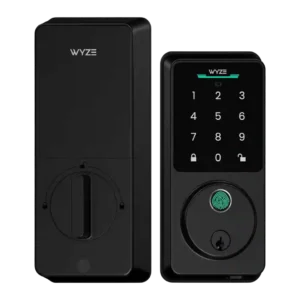
Multiple sources emphasize the lack of a fingerprint reader as the main feature loss versus the U100, which is a dealbreaker for users who rely on biometric entry.
Fingerprint access is commonly described as very fast and improving over time, though at least one hands-on review notes occasional missed scans rather than perfection.
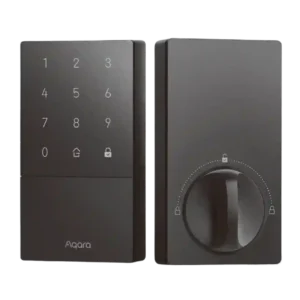
The matte black finish is praised for hiding fingerprints and looking modern, but limited color options and bulky styling are recurring nitpicks.
Finish durability is positioned around tempered glass with anti-glare and smudge or scratch resistance, with multiple sources framing the new exterior as more resilient and modern-looking.
Geofencing-style automations are highlighted in app demos, including routines that lock when leaving and unlock when arriving, positioned as a standout convenience feature.
Passcode features are repeatedly highlighted, including multiple household codes, guest sharing, one-time use codes, and scheduled codes for regular visitors; some setups enforce longer minimum PIN lengths.
Guest access is a strong point: reviews cite up to 50 codes, plus one-time and scheduled codes that can expire automatically for visitors and contractors.
A hub is frequently recommended to unlock full functionality (broader integrations, Matter bridging, richer automations), but adds cost and can introduce placement or connectivity considerations.
Multiple reviews explicitly emphasize no hub is required for Wi-Fi remote control, improving simplicity and total cost.
Installation is generally described as quick and straightforward for standard single-cylinder deadbolts, with app-led calibration; a few reviews note instructions can be picture-heavy or require minor door/strike adjustments.
Installation is generally portrayed as quick DIY with included hardware, though one review notes minor tool-fit friction and occasional setup retries during onboarding or calibration.
Some reviews describe abnormal bolt or door-not-closed situations triggering alerts, helping users catch a misaligned door or failed latch/bolt extension.
Jam-related protection is mentioned via jam alarms or warnings, and calibration behavior is described as retracting and extending to avoid binding during normal use.
Mechanical key backup is consistently included and the hidden keyhole cover is appreciated for aesthetics and casual security, with reviewers generally treating it as a dependable fallback.
The addition of a mechanical key is repeatedly framed as an important reliability upgrade for emergencies and battery-related scenarios.
The keypad is widely liked for large, backlit digits and reliable code entry, but it typically needs a wake touch first and some users want the first press to register immediately.
The keypad is described as illuminated and responsive, with anti-peep entry supported so users can add extra digits before or after the real PIN.
Keyway and cylinder design are often framed positively because the lock can be rekeyed; one reviewer cautions that cylinder swaps can be non-standard and may have constraints.
HomeKey taps and keypad entry are usually described as fast, and the motor action feels smooth once the door is aligned; app-based commands can be slower when Bluetooth is involved.
Lock and unlock speed is consistently described as quick across fingerprint, keypad, and app control, including claims of roughly half-second fingerprint entry.
Lock operation is repeatedly described as smooth and quiet when aligned correctly, with less risk of grinding compared with poorly fitted smart locks.
The locking motor is generally described as quiet, and operation sounds or chimes are referenced as adjustable in app settings.
Overall locking reliability is viewed as strong in daily use, including remembering codes and auto-lock behavior even when hub connectivity is imperfect, provided the door and strike are properly aligned.
Locking reliability is broadly positive in hands-on use, with users describing consistent locking and unlocking via multiple methods.
Notifications and alerts are commonly used for status awareness (locked/unlocked, abnormal events, and user activity), with some reviews highlighting customizable alert behavior.
Reviews mention activity and security notifications, including alerts tied to failed attempts or tamper events, with no consistent complaints about delivery.
Physical security is generally treated as appropriate for typical homes, with the hidden keyhole design adding a small deterrent and overall construction seen as sturdy.
Physical security is generally positioned as solid for typical homes, with BHMA or ANSI Grade 2 level claims cited in multiple sources, but not presented as top-tier Grade 1 hardware.
One review references residential-grade security positioning and acknowledges that higher pick/drill resistance usually requires spending more, framing U50 as adequate rather than high-security.
Remote control is generally available through smart-home ecosystems or hubs, and checking lock status is valued for peace of mind; performance varies, with Bluetooth-based paths sometimes feeling slower than hub-based control.
Remote access is consistently described as responsive for locking/unlocking and checking status from anywhere through the Wyze app.
Security is framed around modern app and platform controls, with some reviews explicitly calling out AES-style encryption and secure ecosystem integrations.
Security posture is framed around local biometric storage and standard app-based control; reviews emphasize fingerprints staying on-device rather than in the cloud, but do not deeply audit encryption specifics.
Integration is repeatedly cited as a strength, especially Apple HomeKey and Apple Home support; broader platform support (Google, Alexa, Matter/SmartThings) is often possible but typically depends on using an Aqara hub or compatible controller.
Smart-home integration is largely limited to Alexa and Google (including routines), with multiple sources explicitly noting no HomeKit or Matter support at launch.
Tamper and failed-attempt alerts are referenced, including alarm triggers and app notifications, though sensitivity tuning and real-world false positives are not deeply tested.
The touch interface is generally responsive and easy to use, with minor learning curve around waking the panel before entering a code.
The tempered-glass touch surface is framed as a meaningful design upgrade, improving visibility and modernizing the exterior compared with the earlier version.
User access management is a strong point, with support for multiple users, one-time codes, scheduled or periodic access, and code-specific automations in the Aqara ecosystem.
User management is generally described as straightforward, with options for permanent, recurring, temporary, and limited-access roles.
Value is a major theme: most reviews call U50 one of the most affordable HomeKey-capable options, though the need for an additional hub to unlock full functionality can reduce the perceived bargain.
Across reviews, the standout theme is value: a sub-$100 price for Wi-Fi remote control, keypad, and fingerprint access is repeatedly framed as best-in-class for budget buyers.
Voice control is supported through major platforms, but often requires a hub integration and may be gated by platform security steps such as PIN requirements for unlocking.
Voice control is described in the context of Alexa and Google routines for locking, while unlocking by voice is typically restricted for security.
Support and warranty considerations come up mainly around modifications: at least one review warns that swapping the lock cylinder can void warranty and puts the user on their own.
Weather protection is generally presented as suitable for outdoor exposure, but the exact IP rating varies across reviews (often IPX5; one source claims higher) and one review notes reduced dustproofing versus pricier models.
IP53 weather resistance is frequently mentioned as adequate for typical residential use, though one review calls it less impressive than some competitors.
Most U50-focused reviews say there is no built-in Wi-Fi and that Wi-Fi-style remote/integration features depend on hubs; one included video appears to cover a different Aqara lock with built-in Wi-Fi, which can confuse expectations.
Built-in Wi-Fi (commonly described as 2.4GHz) is praised as the biggest upgrade, enabling true remote monitoring and control without helper devices.