Amplifier power requirements
P1Product 1: Kanto REN Speakers
No score yet
P2
Product 2: KEF LS50 Meta Passive Bookshelf...
3.7
Most sources call the LS50 Meta moderately demanding: 85dB sensitivity and low-impedance dips benefit from an amp with good current and quality. They can play well on modest power at moderate levels, but stronger electronics unlock better dynamics, clarity, and control.
Bluetooth connection stability
P1
Product 1: Kanto REN Speakers
4.8
Bluetooth playback is reported as stable, with reviewers mentioning smooth pairing and no meaningful dropouts in normal use. The limitation is more about codecs than connection reliability.
P2Product 2: KEF LS50 Meta Passive Bookshelf...
No score yetCohesive presentation
P1
Product 1: Kanto REN Speakers
4.8
Several reviewers highlight how cohesive and orderly the REN sounds, even on dense mixes or movie soundtracks. It presents a unified stereo image rather than a disjointed hi-fi effect.
P2
Product 2: KEF LS50 Meta Passive Bookshelf...
4.5
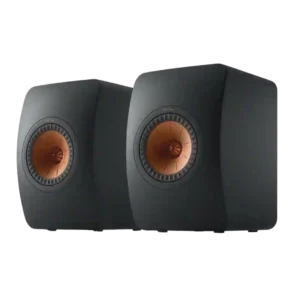
Uni-Q coherence is a repeated theme: the speakers are often described as seamless, integrated, and single-driver-like in how they blend bass, mids, and treble once properly set up and broken in.
Design and aesthetics
P1
Product 1: Kanto REN Speakers
4.7
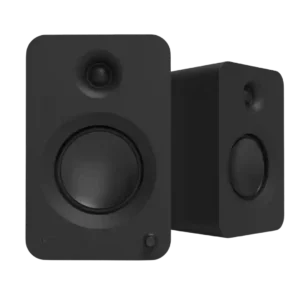
Reviewers consistently praise the REN's matte finishes, curved cabinets, color options, and living-room-friendly look. Minor knocks are fingerprint and scuff sensitivity on the matte finish and a few comments that the styling is softer or rounder than some rivals.
P2
Product 2: KEF LS50 Meta Passive Bookshelf...
4.6
The LS50 Meta’s futuristic Uni-Q look and matte finish options (including newer colorways) are widely liked, with frequent praise for fit, finish, and visual appeal on matching stands.
Detail retrieval
P1
Product 1: Kanto REN Speakers
4.6
Detail retrieval is strong for the class, with reviewers noting good low-level insight and clear rendering of vocals and instrumentation. A few higher-end comparisons say it stops short of pricier speakers, but it rarely sounds vague or smeared.
P2
Product 2: KEF LS50 Meta Passive Bookshelf...
4.6
Detail retrieval is consistently highlighted as a key strength, with reviewers citing strong micro-detail, separation in complex mixes, and the ability to reveal upstream gear differences and recording quality.
Dialogue clarity (for TV/soundbar use)
P1
Product 1: Kanto REN Speakers
4.7
Dialogue clarity is consistently strong, both in normal playback and with the optional Vocal Boost mode. Reviewers found speech easy to follow in films, TV, sports, and documentaries.
P2
Product 2: KEF LS50 Meta Passive Bookshelf...
4.7
When used with TV or films, spoken-word intelligibility is described as excellent, with clear articulation and strong image focus that helps dialogue lock to the screen.
Distortion at high volume
P1
Product 1: Kanto REN Speakers
4.0
The REN generally stays clean, but several reviewers noticed bass strain, port noise, or low-end looseness when it is pushed hard without a subwoofer. Using the sub output and 80Hz crossover reduces that behavior substantially.
P2
Product 2: KEF LS50 Meta Passive Bookshelf...
4.2
At sane volumes, the presentation stays clean and composed, with MAT frequently credited for reducing treble distortion and harshness. When driven beyond comfort zones, some listeners report treble peakiness, flattening, or compression rather than graceful scaling.
Dynamic headroom
P1
Product 1: Kanto REN Speakers
4.4
Dynamics are good for a compact powered speaker and improve meaningfully with a subwoofer connected. At higher output the REN can sound a bit held back compared with larger systems, but it remains lively for TV, gaming, and moderate-room music listening.
P2
Product 2: KEF LS50 Meta Passive Bookshelf...
3.9
Dynamic headroom is strong for a compact standmount but not unlimited; multiple sources note the speakers are most comfortable at moderate listening levels and can feel restrained or compressed when pushed hard, depending on amplification.
EQ customization
P1
Product 1: Kanto REN Speakers
4.5
Bass and treble controls, Vocal Boost, and Night Mode add welcome flexibility. These features are useful rather than gimmicky, especially in TV use or when tailoring bass around a subwoofer or room placement.
P2Product 2: KEF LS50 Meta Passive Bookshelf...
No score yetFrequency response balance
P1
Product 1: Kanto REN Speakers
4.5
Most reviews describe the REN as balanced, neutral-leaning, and easy to listen to, with smooth treble and clear mids. The recurring caveat is the bass, which some heard as a little lumpy, boomy, or uneven depending on placement and volume.
P2
Product 2: KEF LS50 Meta Passive Bookshelf...
4.3
Tonality is generally described as smooth, balanced, and neutral-to-slightly-warm, with the Meta revision reducing treble glare and sibilance versus earlier LS50 versions. Bass reaches impressively low for size but does not deliver true sub-bass extension.
HDMI ARC)
P1
Product 1: Kanto REN Speakers
4.9
HDMI ARC is repeatedly cited as the REN's signature feature, making TV hookup simple and helping it behave more like a polished soundbar alternative. ARC and CEC control were widely appreciated, though some setups required switching the TV to PCM.
P2Product 2: KEF LS50 Meta Passive Bookshelf...
No score yetHome theater integration
P1
Product 1: Kanto REN Speakers
4.8
As a TV and movie speaker system, the REN earns strong marks for combining true stereo separation, easy ARC hookup, and optional sub integration. Reviewers broadly agree it outperforms similarly priced soundbars for fidelity, though it remains a 2.0 or 2.1 solution rather than surround.
P2
Product 2: KEF LS50 Meta Passive Bookshelf...
4.0
Several reviews find the LS50 Meta compelling in home-theater roles (2.0/2.1 or as part of 5.1), but also note that a subwoofer is the easiest way to add the low-end weight and impact movies demand.
Inter-speaker connectivity
P1
Product 1: Kanto REN Speakers
4.6
The active-passive speaker arrangement is straightforward, and the ability to swap which side is powered is genuinely useful for room layout. Included speaker cable length is generally seen as sufficient and flexible.
P2Product 2: KEF LS50 Meta Passive Bookshelf...
No score yetLoudness / maximum volume
P1
Product 1: Kanto REN Speakers
4.0
Output is adequate to strong for typical living rooms, desks, and nearfield use, but it is not a room-shaking SPL monster. Reviewers wanting party-level volume or bigger effortless slam consistently preferred adding a subwoofer.
P2
Product 2: KEF LS50 Meta Passive Bookshelf...
4.0
Maximum loudness is respectable for the size, but several reviews caution that these are not the right choice for sustained very high SPL or 100dB+ peaks, especially in larger rooms.
Low-volume performance
P1Product 1: Kanto REN Speakers
No score yet
P2
Product 2: KEF LS50 Meta Passive Bookshelf...
4.5
Low-volume performance is commonly praised, with many noting that imaging, vocal focus, and fine detail remain convincing even at quiet listening levels.
Remote control usability
P1
Product 1: Kanto REN Speakers
4.4
The remote is feature-rich and usually considered better than average for the category, with quick access to inputs, bass and treble, sound modes, and speaker-side swapping. Common complaints are that it is chunky, batteries are not included, and responsiveness can occasionally feel slow.
P2Product 2: KEF LS50 Meta Passive Bookshelf...
No score yetSetup simplicity
P1
Product 1: Kanto REN Speakers
4.6
Setup is widely described as plug-and-play, especially for HDMI ARC TV use. The main caveats are the need to place the speakers thoughtfully, sometimes change TV audio settings to PCM, and understand the left-right speaker swap behavior.
P2
Product 2: KEF LS50 Meta Passive Bookshelf...
3.9
Setup is not difficult but is placement-sensitive: stands, some distance from walls, and careful toe-in/positioning are repeatedly recommended. Port plugs and room placement tweaks can help if space is tight.
Smart features
P1
Product 1: Kanto REN Speakers
4.7
Auto-wake, Vocal Boost, Night Mode, sub mute, and other DSP conveniences help the REN feel thoughtful in everyday use. These extras strengthen its TV-first appeal without requiring an app.
P2Product 2: KEF LS50 Meta Passive Bookshelf...
No score yetSoundstage height
P1Product 1: Kanto REN Speakers
No score yet
P2
Product 2: KEF LS50 Meta Passive Bookshelf...
3.6
While width and depth are often excellent, at least one review notes soundstage height is less spectacular, describing a lower perceived ceiling compared with some alternatives.
Stereo imaging accuracy
P1
Product 1: Kanto REN Speakers
4.7
Stereo imaging is one of the REN's standout strengths. Multiple reviews call out strong left-right separation, stable center images, and a wide soundstage that makes it a convincing soundbar alternative.
P2
Product 2: KEF LS50 Meta Passive Bookshelf...
4.8
Stereo imaging accuracy is one of the most praised attributes, with a stable center image, precise placement, and strong off-axis behavior contributing to a wide, convincing soundstage.
Value for money
P1
Product 1: Kanto REN Speakers
4.6
Value is a consistent strength. Most reviewers see the REN as expensive only relative to cheap soundbars, but very competitive once sound quality, inputs, and TV-friendly features are factored in.
P2
Product 2: KEF LS50 Meta Passive Bookshelf...
4.2
Value for money is usually rated highly because the LS50 Meta competes with pricier designs on imaging and resolution, but there is a minority view that the current price is too high given bass and dynamics limitations versus cheaper rivals.
Voice clarity
P1Product 1: Kanto REN Speakers
No score yet
P2
Product 2: KEF LS50 Meta Passive Bookshelf...
4.4
Voice clarity is a standout strength, with repeated praise for natural, centered vocals and reduced sibilance compared with earlier LS50 models. A few listeners still hear a hint of metallic character or a slightly recessed/veiled vocal range depending on gear and preferences.
Wired input
P1
Product 1: Kanto REN Speakers
4.9
Connectivity is a major selling point, with HDMI ARC, optical, USB-C, RCA, 3.5mm, and sub out appearing in nearly every review. The only recurring omissions mentioned are a built-in phono stage and Wi-Fi streaming.
P2Product 2: KEF LS50 Meta Passive Bookshelf...
No score yet