
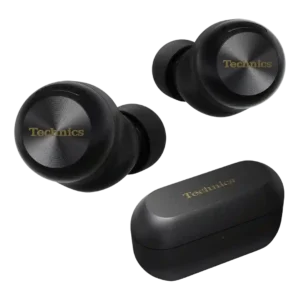
ANC is widely rated top-tier for everyday noise and transit rumble, but several reviews stop short of calling it the absolute best in the category. Noise control is highly adjustable, with adaptive ANC plus granular sliders that let you tune intensity and reduce pressure effects.
Wired playback on Android phones works well with the right USB-C adapter or DAC, according to the reviews that tested it.
The Technics Audio Connect app is feature-rich (ANC, EQ, multipoint, spatial settings), but some reviews call the interface clunky or menu-heavy.
Several reviews explicitly note aptX codecs are not supported.
Where tested, audio-video sync is reported as excellent with minimal to no noticeable lag.
Bass is generally controlled, punchy, and well-balanced rather than bloated, but seal sensitivity can thin it out and bassheads may want more weight or texture.
Bass is repeatedly called deep and unusually controlled for true wireless, though one review found it can feel heavy or change with ANC settings.
Battery life is commonly reported around 10 hours with ANC on (AAC) plus substantial case recharges, with lower figures when using high-res modes.
Bluetooth stability is generally reported as reliable with few dropouts across devices and environments.
Build quality is usually viewed as solid and functional for the price, but the plastic shells feel less premium than higher IE models.
The IE 200 has no inline remote or physical controls, so playback and volume changes must be handled on the source device.
The cable is the most divisive part: some like the light braided design, but many criticize tangling, microphonics, cheap feel, or proprietary fit frustrations.
The included pouch is serviceable for storage, but reviewers often describe it as basic, soft, and not especially protective or premium.
The case is generally pocketable and premium-feeling, but some reviews mention weak magnets, slight rattle, or scratch/scuff issues.
Charging is praised for USB-C plus Qi wireless and quick-charge support; full recharge times are typically a few hours.
Codec support is strong (SBC/AAC plus LDAC and LC3/LE Audio features noted), appealing to both iOS users and Android audiophiles.
Comfort is a major strength, with many reviewers calling the small shells easy to wear for hours, even in bed or during long sessions.
Comfort is widely rated high thanks to a smaller/lighter fit, though some users may still experience fatigue or fit variability over long sessions.
Reviewers like the compact, understated black design and discreet fit, even if it lacks the luxury feel of metal-bodied siblings.
Design is viewed as premium and more compact than the prior model, though not everyone finds it the sleekest-looking option.
Removable MMCX cables improve repairability, but the recessed connector design limits easy aftermarket replacements and reduces convenience.
The package includes both silicone and foam tips in multiple sizes, but several reviews say seal quality is highly tip-dependent and stock silicone tips can be finicky.
Multiple ear tip sizes are commonly included, helping most users achieve a seal, though tip choice remains key to fit.
EQ customization is a strength, often cited as an 8-band EQ plus presets that can significantly change the sound.
Find My/location features are present, but feedback varies; some appreciate the feature, while others complain the locating beep or accuracy is limited.
The tuning is commonly described as balanced, mildly V-shaped, or reference-leaning, with strong overall coherence even if it is not perfectly neutral.
Accessory coverage is good for the class with multiple ear tips and a pouch, though the case and cable quality keep it from feeling especially generous.
Instrument separation and imaging are standout traits, making individual lines easy to place, though a few reviews find layering flatter than top competitors.
Instrument separation is frequently praised on busy tracks, helping the AZ100 stay clean and layered.
These earbuds do not include an integrated microphone.
LDAC support is frequently highlighted for higher-quality Android streaming, with the usual battery-life tradeoff.
Limited evidence says the IE 200 stays composed at higher playback levels without turning muddy or congested.
Voice noise reduction is often effective at cutting wind and background noise, though aggressive processing can create artifacts.
Because there is no mic, the IE 200 is a poor fit for calls unless you use another microphone.
Call quality is mixed: many find it usable or improved, while others report robotic processing or, in one case, serious call glitches.
Mids and vocals are usually clear, natural, and well-positioned, though some reviewers hear slightly lean lower mids or a cooler tone on guitars.
Midrange is generally clear and natural for vocals, with occasional notes that bass-heavy mixes can push voices slightly back.
The 3.5mm connection works broadly across laptops, music players, and phones with appropriate adapters, making the IE 200 flexible across devices.
Three-device multipoint is a major differentiator and is often described as seamless; occasional switching lag is mentioned but not common.
Passive isolation is generally good with a proper seal and improves with foam tips, though silicone tips can leak more and it is not close to ANC silence.
Preset EQ options are generally useful, though some (like extra-bassy modes) may be too much for neutral listeners.
Case finish durability is mixed, with some noting scratches/scuffs and others calling it relatively scratch-resistant.
Setup is mostly straightforward, but the lack of a case pairing button and some app UX quirks can add friction.
Reviewers consistently praise clear, balanced, high-fidelity sound with strong detail and musicality, though a few say it lacks some technical finesse or excitement versus stronger rivals. Across laptops, phones with adapters, DACs, and desktop gear, the IE 200 sounds notably clean and revealing, and several reviews say it scales up with better sources.
Reviews consistently praise the AZ100 for highly detailed, spacious sound with strong dynamics; a few note the default tuning can be bass-forward or benefit from EQ.
The stage is unusually spacious for the price, often described as wide and sometimes tall, though depth and layering are less impressive than on pricier IEMs.
Soundstage is a standout: multiple outlets describe an immersive, wide presentation that feels larger than typical earbuds.
Dolby spatial audio/head tracking is supported and can add immersion, but some reviewers find it subtle or prefer it off for music.
Once fitted correctly, the over-ear design and secure seal keep the earbuds stable for long listening or light movement.
Fit stability varies: many report a secure hold, while some reviewers experienced looseness or buds falling out during vigorous movement.
Touch controls are responsive and highly configurable, with the main complaint being occasional over-sensitivity.
Transparency/ambient mode is strong and adjustable, but some reviewers note hiss at higher levels, an unnatural voice-focused mode, or not enough outside sound for awareness.
Treble is widely seen as crisp and detailed without being brutally harsh, but it can sound bright, spicy, or a touch sibilant on some material.
Treble is described as airy and detailed without harshness, but a few critics wanted more sparkle or presence.
USB-C charging is consistently supported and frequently mentioned as a modern convenience.
Power demand is mixed: some find it easy enough to drive, while others report limited headroom from weaker phone outputs and better dynamics from DACs or amps.
One review explicitly says there is no water resistance, and no review presents it as a workout-focused model.
The earbuds are commonly cited as IPX4-rated for sweat and light rain, but not for heavy water exposure.
The tiny 4-gram earpieces are repeatedly praised for disappearing in the ear and reducing fatigue.