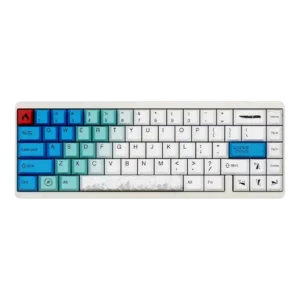
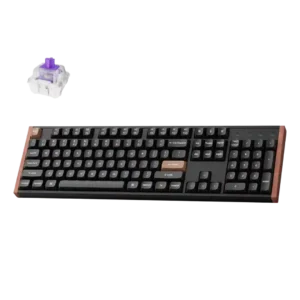
Varmilo Muse65 HE Magnetic Keyboard
Where It Has the Edge
- desk space efficiency is 4.0 vs 2.8. Desk space efficiency is supported by the lack of a function row and number pad, fitting the compact...
Acoustics are mixed-positive: several reviewers liked the sound, but one criticized the spacebar as cheap-sounding.
Reviewers consistently liked the K10 HE's sound, describing it as amazing, thocky, creamy, and very nice across hands-on and unboxing reviews.
Actuation control is well supported, with adjustable ranges, accuracy claims, slider control, and rapid-trigger actuation repeatedly mentioned.
Actuation was described as consistent and smooth, with reviewers highlighting stable keypresses and smooth actuation behavior.
Analog input support was a clear strength, with reviewers tying it to controller-like input, racing games, and adjustable press depth.
Backlight brightness was generally positive: reviewers could increase brightness and still see the lighting, though legends do not shine through.
Battery evidence was mixed but mostly positive: one review cited up to 120 hours with RGB off, while another had not long-term tested it.
Build quality is a major strength, with repeated praise for the aluminum case, heavy feel, and tank-like construction.
Build quality was praised repeatedly, with reviewers noting weight, premium feel, solid construction, and overall quality.
Cable quality has limited positive evidence from the included braided USB-C cable.
Cable impressions were positive but limited, covering a braided USB-A to USB-C cable, a USB-A to USB-C cable, and an angled connector.
Compatibility has caveats, including Windows-focused software for customization and a narrow port opening that did not fit one coiled cable.
Compatibility was strong across Mac, Windows, Android/browser configuration, and USB-C switching comments.
Connectivity evidence is limited to wired USB-C, with one review pointing to a USB-C port on the left side.
Connectivity was one of the strongest areas, with Bluetooth, 2.4 GHz, USB-C, triple-mode support, dongle use, and multi-device pairing all mentioned.
Customization options are broad on paper, including remapping, actuation, layers, RGB, macros, and rapid trigger, but software friction hurts execution.
Customization was broad, including actuation depth, remapping, macros, RGB, modes, and other web-launcher controls.
Desk space efficiency is supported by the lack of a function row and number pad, fitting the compact 65% layout.
Desk space efficiency was the main full-size drawback because the large layout takes up plenty of space.
Durability is positively supported by one reviewer tying the aluminum case to premium feel and durability.
Durability evidence was positive through aluminum/PBT materials and oil-resistant double-shot PBT keycaps.
Ease of switch replacement follows the same split as hot-swap support: it is possible, but magnetic switch limits reduce flexibility.
Switch replacement looked straightforward, with seamless hot-swapping and normal key/switch swap discussion, but only compatible magnetic switches are supported.
Ergonomics are positively supported by the light switch force reducing fatigue over time.
Ergonomics were positive thanks to adjustable kickstands, two-level feet, inclination choices, and comfortable hand position.
Extra gaming features are mixed: rapid trigger, dead-zone settings, and high polling are present, but Snap Tap and quad-actuation are called out as missing.
Extra gaming features were a major strength, especially Rapid Trigger, Analog Mode, DKS, Snap Click, and multi-action key behavior.
Frame rigidity is strongly implied by the heavy aluminum construction, solid weight, and reports that the board stays in place.
Frame rigidity was praised through weight, a solid frame, and low flex or twisting.
Gaming performance is strong in the evidence, with snappy movement, responsive rapid trigger, and flawless or complaint-free game testing.
Gaming performance was highly praised, with reviewers calling it fluid, accurate, responsive, and especially strong for FPS or racing use.
Hot-swappable switch support is mixed-positive because some reviewers say switches can be changed, while the main written review says hot-swap ability is limited.
Hot-swappable switch support was directly confirmed, but within the compatible magnetic-switch ecosystem.
Keycap quality is praised where discussed, especially the dye-sublimated or PBT Cherry-profile keycaps.
Keycap quality was praised for OSA-profile double-shot PBT, oil resistance, and solid feel.
Key responsiveness is one of the strongest areas, with reviewers citing responsive switches, zero dead zone, and quick in-game actuation.
Key responsiveness was one of the clearest strengths, with reviewers citing instant response, fast repeated inputs, and very light activation.
Key spacing evidence was limited but positive, with the larger full-size layout allowing the function row to be evenly spaced.
Key stability was positive, especially on larger keys where stabilizers and key weighting reduced wobble and improved feel.
Latency evidence is positive, with the written review reporting no noticeable input lag during testing.
Latency evidence was strong, with low-latency sensors and no loss of performance when plugged in.
Layout options are limited in the evidence, with the board presented as a 65% layout and one reviewer wishing for TKL instead.
Layout options were positive for users who need function keys, arrow keys, and a numpad, though the full-size layout also creates bulk.
Legend visibility was mixed: one reviewer praised improved legibility, while several noted non-shine-through keycaps.
Macro customization is supported in several software walkthroughs, with reviewers showing macros and remapping options.
Macro customization was available, but reviewers wanted better macro tools and noted web-based limitations.
Materials quality is a clear strength thanks to the aluminum case and premium feel mentioned by several reviewers.
Materials quality was a strong point, with aluminum, PBT, metal, and wood/rosewood accents repeatedly highlighted.
Media controls were mentioned positively through function-row shortcuts for media control.
Noise level is context-dependent: one reviewer liked that it was not too loud, while another disliked the spacebar sound during gaming.
Noise level evidence was positive but limited, with one review noting a tighter, quieter sound than earlier models.
Onboard memory was supported by the ability to store two layouts onboard.
Per-key lighting control has evidence only through the software workflow, and one reviewer found selecting keys for custom lighting unreliable.
Per-key lighting control was supported through fine-tuning RGB, per-key changes, and per-key customization.
Polling rate is consistently praised because reviewers confirm support for up to 8,000Hz, even though some users may not need that ceiling.
Polling rate was repeatedly identified as 1000 Hz or 1,000 hertz, supporting gaming responsiveness.
Portability is weak because the board is heavier than average and built around a substantial aluminum case.
Portability was a weakness because one review explicitly called it heavier and less portable than the K8 HE.
Profile management is mixed: layers are available, but one reviewer could not find a way to set a separate profile.
Profile management evidence was limited but positive, centered on storing two layouts onboard.
Rapid Trigger is a core strength and appears in every review, with reviewers confirming it exists and works as intended.
Rapid Trigger support was clearly present and repeatedly mentioned as a gaming feature.
Reliability is mixed and mostly hurt by software problems, including crashes and finicky setup, despite one reviewer having no keyboard problems.
Reliability evidence was limited to short-term operation, especially continuing to use the keyboard without performance loss while plugged in.
RGB customization is mixed: it has custom lighting and patterns, but multiple reviewers found the software or lighting workflow frustrating.
RGB customization was broad, with multiple modes, web controls, per-key options, and many lighting choices.
RGB lighting quality is generally acceptable to good in the limited evidence, with reviewers saying the RGB looks nice or has patterns.
RGB lighting quality was generally liked, though some evidence noted that light shows around rather than through the caps.
Size and form factor are mostly positive for a compact 65% board with arrow keys, though one reviewer preferred TKL.
Size and form factor were full-size and substantial, making it useful for numpad workflows but less compact.
Software quality is the most divisive weakness, ranging from functional-but-early to janky, confusing, and severely frustrating.
Software quality was mixed: reviewers liked the no-install web launcher, yet criticized online-only access and barebones macro tools.
Sound dampening is supported by foam and internal layers, including dampening foam and spacebar foam.
Sound dampening was a major strength, with dampening plates, acoustic materials, EVA/EPDM foam, and silicone pads mentioned.
Stabilizer quality gets positive but limited evidence, with lubed stabilizers mentioned, although spacebar sound remains a caveat.
Stabilizer quality was strong, with reviews noting upgraded stabilizers, reduced rattle, and stable large keys.
Switch feel is described as light, smooth, and strong across reviews, with praise for the magnetic switches and actuation force.
Switch feel was widely praised as butter smooth, quiet, smooth, and unlike other keyboards reviewers had tried.
Switch choice is a mixed point: reviewers note two or three magnetic switch options, but the main written review says the options are limited and all linear.
Switch options were a limitation because the reviewer described the switch ecosystem as proprietary.
Typing comfort is positively supported by soft PBT keycaps and comfort during long typing sessions.
Typing comfort was positive overall, helped by the full-size work layout, comfortable typing angle, and hand comfort.
Typing feel is positive overall, with reviewers describing a good typing experience and a nice feel, aided by light switches and PBT keycaps.
Typing feel was mostly praised as smooth, satisfying, and creamy, though one reviewer found it sterile for general typing.
Value for money is mixed: one reviewer calls the price reasonable, another likes the $155 price, but the written review says better value exists elsewhere.
Value for money was generally positive, with several reviewers calling the price fair or worthwhile, while one noted it was a lot of money.
Volume control evidence is limited to software-layer customization rather than a dedicated hardware control.
Wireless performance was excellent, with reviewers saying wireless felt close to wired and hard to distinguish from a wired keyboard.