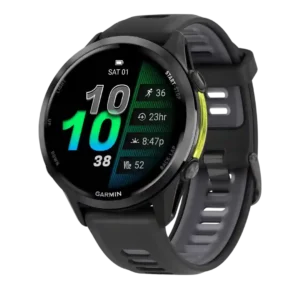
The Garmin ecosystem is reasonably broad, with built-in widgets and ConnectIQ-based extensions adding more functionality around the core watch experience.
ConnectIQ is highlighted as a large marketplace for extra apps and watch faces, with many free options.
Band hardware and strap details come across as sturdy and trail-ready rather than flashy.
The band gets a positive note for micro-adjustment-like stretch and stable wear.
Battery life is one of the biggest strengths in the entire review set, with repeated reports of multi-day to multi-week endurance and especially strong Solar performance.
Battery life is the main hardware compromise: acceptable to good with sensible settings, but clearly worse than some Garmins or rivals when brightness and always-on display are pushed.
Pulse-ox support is present and reviewers describe it as a standard onboard health metric rather than a standout differentiator.
PulseOx support is present for overnight breathing-related data, and one reviewer found its overnight battery impact minimal.
Bluetooth pairing and device connectivity are described positively, with reliable phone pairing and standard accessory support.
Bluetooth support is broad enough for external sensors and accessories, with no major complaints in the cited review.
Screen brightness is strong enough for bright daylight use, according to reviewers who tested it outside.
Brightness is a standout upgrade and among the most frequently praised hardware changes.
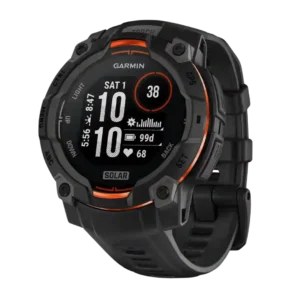
Build quality is repeatedly described as rugged and well made, with durable plastics and reinforced design details.
The overall construction feels premium, with sapphire and titanium helping the watch feel like a true flagship.
The five-button control scheme is a major part of the Instinct identity: reliable in bad conditions, though not every reviewer loved the feel with gloves.
Physical buttons remain a strength, giving reliable control alongside the touchscreen.
Call handling is limited: some reviews mention basic on-watch accept or reject actions, but others stress that you cannot really take calls from the watch.
On-wrist calling works and is convenient, but speaker volume or overall call quality is not universally praised.
Charging convenience is only average because Garmin still uses a proprietary cable, even though infrequent charging softens the annoyance.
Charging is reasonably quick, with reviews citing roughly 90-minute to 2-hour full charges and useful top-ups from short sessions.
Coaching and training guidance are well developed, with reviewers praising Garmin’s suggested workouts and expanded training feature set.
Garmin Coach and triathlon planning are consistently praised for building detailed, adaptive training plans.
Comfort is good for many users in daily wear, but the chunky design can be less pleasant for sleep or smaller wrists.
Reviewers consistently find the watch comfortable enough for all-day wear.
Garmin’s companion software is reviewed favorably for stability and ease of use, especially for syncing and daily summaries.
Garmin Connect is described as comprehensive, but not consistently elegant, with one reviewer criticizing layout while another praises data presentation.
Garmin Pay is a consistent plus in the reviews, giving the Instinct 3 dependable NFC contactless payment support.
Garmin Pay is available and described as easy or useful where banks are supported.
The watch works with both major phone platforms for core notification features, though the exact capabilities differ by platform.
Compatibility across Apple and Android phones is present, but capabilities differ and iOS remains more limited.
Customization is a strong point, with configurable watch faces, buttons, widgets, data screens, and other settings.
Customization is extensive, from sport-profile behavior to data fields and watch-face choices.
The AMOLED display earns strong praise for looking brighter, richer, and easier on the eyes than earlier Instinct screens.
The AMOLED display is repeatedly praised for looking bright, sharp, and premium.
Durability is a standout theme, with reviewers reporting hard knocks and drops without meaningful damage.
Sapphire protection and tougher materials are repeatedly credited with improving scratch resistance and day-to-day durability.
Reviews explicitly note that the Instinct 3 lacks ECG support because Garmin did not bring the newer ECG-capable sensor to this line.
The watch adds manual ECG support and reviewers consistently present it as a meaningful upgrade, though one notes it is still a manual snapshot tool rather than continuous monitoring.
Fit benefits from the secure case-and-strap design, with one reviewer specifically praising the reduced wrist gap.
Despite the 47 mm case, multiple reviewers say the watch sits well and feels manageable on the wrist.
Fitness tracking looked strong in real use, including accurate separation of activity segments like snowboard runs versus lift rides.
In multisport and gym use, one reviewer says the watch tracked indoor training sessions reliably.
GPS is one of the strongest areas in the reviews, with repeated praise for fast locks, clean tracks, and strong real-world accuracy.
GPS performance is one of the clearest strengths, with multiple reviewers calling it impeccable, highly accurate, or spot-on across varied conditions.
Heart-rate performance is generally good for steady efforts and often tracks closely to trusted comparators, but some reviews report weaker responsiveness in harder or more variable efforts.
Across runs and workouts, reviewers repeatedly describe optical heart rate as close to chest straps and generally reliable.
LTE is not available on the Instinct 3, so connected emergency and tracking tools still depend on the phone.
The watch lacks built-in cellular and still depends on a nearby phone for calls or assistant functions.
Materials are utilitarian but purposeful, centering on reinforced polymers and metal bezel elements rather than premium luxury finishes.
Materials are premium for the category, especially the titanium bezel and sapphire protection, even if the body remains polymer.
Menu navigation is learnable and generally intuitive once the five-button layout clicks, but it remains firmly button-driven.
Voice tools and interface choices can reduce menu digging, making common actions quicker.
Offline music storage is missing, and multiple reviewers call that out as a clear limitation.
Offline music storage is a clear strength, with support for downloaded playlists and ample storage.
Daily operation feels familiar and efficient for Garmin users, with reviewers describing the overall experience as clean and intuitive.
Garmin's software experience is generally praised as polished and strong, with reviewers describing it as among the best in sports watches.
Outdoor visibility is a clear strength, with reviewers saying the screen remains readable even in direct sun.
The screen remains easy to read outdoors, including in bright sunlight.
Initial setup and phone pairing are described as quick and painless in the reviews that discuss them.
Pairing is mostly stable once connected, but one reviewer noted setup friction with the app.
Recovery guidance is present through tools like Training Readiness and recovery suggestions, but reviewers do not always find those recommendations perfectly calibrated.
Recovery tools such as Training Readiness, Acute Impact Load, and Running Tolerance are widely described as genuinely useful for judging load and avoiding overtraining.
Reliability is mixed: several reviewers call the watch dependable, but at least one in-depth test also reported notable crashes during early firmware.
A few reviewers encountered crashes or notable bugs, especially around routing or call-related features.
Safety features are solid, with Incident Detection and LiveTrack-style tools covering the basics for solo activities.
Safety tools like incident detection, emergency alerts, and location sharing are a meaningful plus.
The main Instinct 3 line offers two core sizes, which is enough for some buyers but less expansive than Garmin’s broader range history.
Only one case size is available, which limits choice for smaller wrists.
Sleep timing looked dependable in testing, with one reviewer saying wake and sleep times were recorded correctly.
Sleep timing and general sleep scoring were viewed as good to very good, though one review notes Garmin is less reliable on sleep quality details than Oura.
Phone notifications work reliably for common alerts and messages, though the experience remains simpler than on more full-featured smartwatches.
Notifications are well supported, with alerts, calendar items, and message visibility noted positively.
Smartwatch functions are practical but modest, with useful everyday tools available while the overall smart feature set stays intentionally limited.
Smart features such as calls, voice commands, music, notifications, reports, and payments are broader than typical sports watches, though still short of full smartwatch ecosystems.
Software feel is mixed: some reviewers call it fast and lively, while others notice small delays in button response or uploads.
Lag when saving activities, loading screens, or moving around maps is a recurring complaint.
Stress tracking is part of the health suite, and reviewers describe Garmin’s stress and Body Battery readouts as useful and reliable.
One reviewer specifically praised stress tracking for catching a severe migraine and adjusting training recommendations accordingly.
Reviewers like the bold, rugged styling, especially the G-Shock-adjacent look and brighter color options.
The design is broadly viewed as sleek, sporty, and attractive, though one reviewer still sees it as a large performance-first watch.
Third-party support exists through Connect IQ and related app integrations, but it is not positioned as the watch’s main selling point.
Support for services and ecosystems such as Strava, Apple Health, and ConnectIQ add-ons is a notable plus.
Touch responsiveness is effectively absent because the Instinct 3 does not have a touchscreen at all.
Touch interaction is mostly responsive and easy to use, though some reviewers mention sensitivity quirks.
The refreshed interface is easier to read and interact with than older Instinct generations, especially on the AMOLED model.
The interface is feature-rich and generally easy to use, but some reviewers still find it click-heavy or overwhelming in places.
Value looks decent rather than unbeatable: reviewers like the battery life and Garmin training depth, but the missing maps and music keep it from feeling like a steal.
Value is mixed: several reviewers say the watch earns its premium performance position, while others argue the price and extras make it harder to justify.
Reviews say the watch does not offer voice tools or voice-assistant style features.
Voice tools are generally described as useful and workable, especially for quick commands, though they are not positioned as class-leading smart assistant replacements.
Watch-face support is broad, with many built-in and Connect IQ options highlighted by reviewers.
Watch-face choice is a strength, with many downloadable and customizable options.
Water resistance is strong across reviews, with the 100-meter rating repeatedly highlighted.
The 5ATM/50m rating is sufficient for swimming and general sport use, but it is not positioned as a dive watch.
Wellness insights are a core strength, with Morning Report, Body Battery, recovery context, and related daily summaries repeatedly called out as useful.
Morning and Evening Reports, sleep guidance, training previews, and broader daily insights are repeatedly described as useful and informative.
Reviews explicitly state that Instinct 3 syncs over Bluetooth and does not include Wi-Fi.
Reviewers consistently describe the Instinct 3 as supporting a very broad mix of sports and outdoor activity profiles.
Reviewers describe a massive activity list, with new sport profiles and broad support for running, swimming, cycling, gym work, and more.