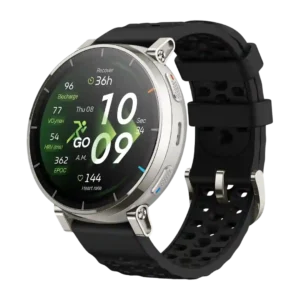
- Compared: rugged outdoor smartwatch value Amazfit T-Rex 3 is described as a cheaper direct competitor with tradeoffs in training reliability and bulk.
Garmin Instinct 3 Review
Bottom Line
Choose the Garmin Instinct 3 for rugged durability, excellent battery life, accurate GPS, and Garmin training tools. Skip it if you need full offline maps, touchscreen control, onboard music, or a richer smartwatch experience.
Best for hikers, runners, outdoor users, and Garmin fans who want rugged construction, long battery life, accurate GPS, physical buttons, and core training/recovery insights without paying Fenix-level prices.
Not for buyers who need full offline maps, touchscreen navigation, onboard music, LTE, Wi-Fi, voice assistant features, ECG, or a richer smartwatch/app experience.
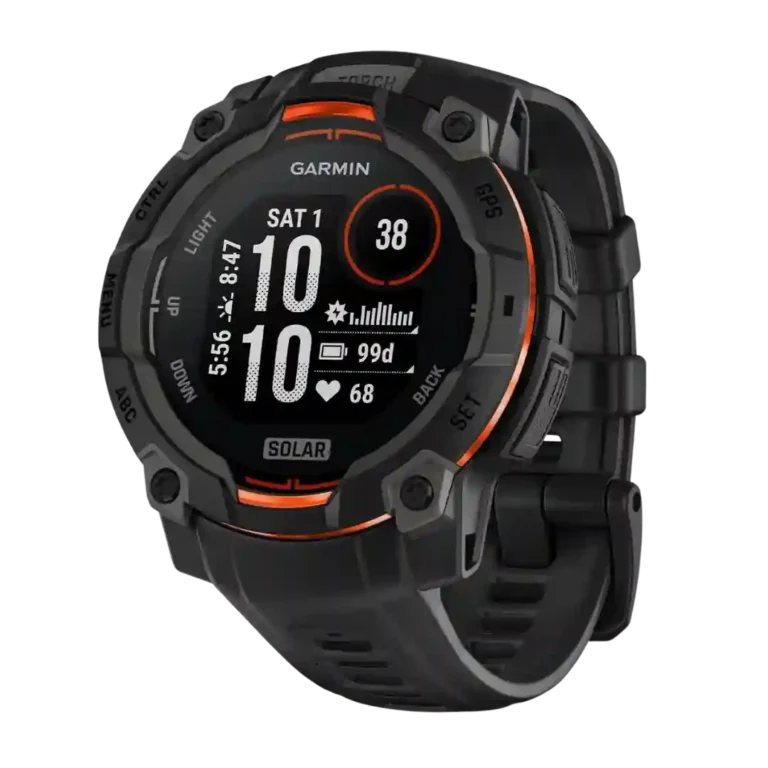
The Garmin Instinct 3 lands as a rugged outdoor smartwatch with unusually strong battery life, reliable GPS, broad workout coverage, useful Garmin training and recovery tools, and a brighter AMOLED option alongside the Solar models. Reviewers repeatedly liked the durable build, button-led control scheme, outdoor readability, and practical flashlight. The tradeoff is that Garmin keeps several premium features out: full offline maps are the biggest miss, and the watch also lacks a touchscreen, onboard music, Wi-Fi, LTE, voice features, and ECG. Heart-rate accuracy is generally serviceable but less convincing during harder intervals. Overall, it fits users who value dependability and endurance over a richer smartwatch or navigation feature set.
Compared in Reviews
Products reviewers directly compared with this model, grouped into quick takeaways.
- Worse: GPS battery life The Instinct 3 is framed as lasting far longer for GPS tracking than Apple Watch Ultra 2.
- Compared: offline maps, battery, and durability Coros Pace Pro is presented as a cheaper mapping alternative but with less durability and battery longevity.
Feature Scorecards
Pros
-
Water resistance was a strength, with multiple reviews citing 100m or 10ATM-style protection for wet activities.
-
Charging speed was described positively, with empty-to-full or short top-up times considered quick.
-
Durability was a clear strength, with military-grade toughness, scratch resistance, reinforced materials, and real-world knocks noted.
-
Battery life was one of the strongest points across nearly every review, especially Solar endurance and multi-day AMOLED use.
-
Pairing reliability was strong in the available evidence, with setup and pairing described as immediate or problem-free.
-
Workout tracking variety was excellent, with reviewers repeatedly citing broad sport modes across outdoor, endurance, gym, and adventure activities.
-
Build quality was consistently described as rugged, sturdy, and well-built, with reinforced or durable construction.
-
Display quality was a major upgrade on AMOLED models, with reviewers praising color, clarity, vibrancy, and easier data reading.
-
Customization was strong through data pages, widgets, settings, and sport-profile adjustments.
-
Fit was viewed positively where reviewers discussed wrist gap, stability, and the tighter feel of the smaller case.
-
Watch face quality was supported by Garmin and Connect IQ customization, including many options and user-made faces.
-
GPS accuracy was one of the best-supported strengths, with many reviews praising multiband/SatIQ performance and clean tracks.
-
Outdoor visibility was praised across AMOLED and Solar/MIP contexts, especially in sunlight and trail conditions.
-
Brightness was praised, especially on AMOLED models, which reviewers found easy to read outdoors or in broad daylight.
-
Fitness tracking accuracy was generally strong, supported by reliable workout behavior and Garmin GPS performance.
-
Reviewers noted useful automatic behavior in sport contexts, especially snowboard lift/run parsing and multisport auto-transition.
-
Band feedback was mostly positive, with durable or comfortable silicone/rubber noted, though the fixed strap style limits flexibility.
-
Coaching support was strong through suggested workouts, race-plan guidance, training plans, and Garmin readiness-style tools.
-
Wellness insights were a strength through Morning Report, Body Battery, HRV, sleep, stress, and readiness-style summaries.
-
Style and design drew positive reactions from reviewers who liked the rugged G-Shock-like, colorful, or outdoor-oriented look.
-
The five-button system was widely valued for outdoor reliability, though a few reviewers found it less friendly than touch in everyday menus.
-
The companion apps were generally useful, with Garmin Connect, Garmin Explore, Wikiloc, and stable pairing/setup helping route, stats, and workout use.
-
Safety features were strong for outdoors use, especially inReach control, Incident Detection, LiveTrack, and TracBack-style tools.
-
Size options were adequate with 45mm and 50mm Instinct 3 models plus Instinct E sizing, but not as broad as earlier lineups.
-
Recovery insights were a major Garmin strength, though one reviewer found suggested recovery time too conservative.
-
Bluetooth syncing and phone pairing were described as automatic or modern, with no major complaints in the supporting reviews.
-
Garmin Pay support was repeatedly confirmed and treated as a useful smartwatch feature.
-
Cross-platform phone support was good, with reviewers using or citing Apple and Android notification experiences.
-
Stress tracking was present in Garmin wellness/recovery metrics and generally treated as part of the reliable daily-health suite.
-
Step tracking was only lightly supported, with one review grouping steps among reliable, accessible wellness metrics.
-
Sleep tracking was generally useful, with correct sleep/wake detection and sleep-coach/Morning Report features, though comfort affected use.
-
The user interface was seen as easier with AMOLED and generally intuitive for Garmin users, though not touch-driven.
-
The Garmin ecosystem was viewed as useful through Connect IQ widgets/apps and Garmin-connected services, though not as broad as a phone-like smartwatch platform.
-
Blood oxygen/Pulse Ox tracking is present and folded into Garmin health metrics, but reviewers did not treat it as a standout advantage.
-
Smartphone notifications were broadly supported, with Android and iOS alerts plus richer Android behavior in some reviews.
-
The operating system experience was usable and fairly easy to learn, based on the review that discussed the on-watch software directly.
-
Menu navigation was mostly intuitive, but button-only control could feel slow compared with touch-based watches.
-
Third-party app support exists through Connect IQ, including apps like Komoot, but reviewers still saw limitations around mapping.
-
Charging is reasonably practical because top-ups are quick or infrequent, but the proprietary cable remains a mild inconvenience.
-
Comfort was mixed: reviewers liked the lighter fit for daytime or activity use but several found it bulky or less ideal for sleep.
-
Materials were rugged rather than premium, with polymer/plastic construction offset by metal accents and reinforced glass.
-
Health tracking accuracy was acceptable but limited by the older sensor platform and some reviewer hesitation around per-beat smoothness.
-
Music controls exist for controlling phone playback, but they are separate from true onboard music support.
-
Heart-rate accuracy was serviceable to good for steady efforts, but several reviewers saw lag, spikes, or weaker interval performance.
-
Value was mixed: reviewers liked the rugged Garmin package, but pricing drew criticism because cheaper or older rivals have maps.
Cons
-
Reliability was mixed: one deep review reported crashes and lost data, while another found it dependable for casual tracking.
-
Smartwatch features were intentionally limited; reviewers liked basics but repeatedly noted missing premium smart functions.
-
Software smoothness was a weakness in the one review that focused on lag, citing small delays in button presses and uploads.
-
Navigation was the most repeated weakness: breadcrumb routes, TracBack, and prompts work, but full offline maps are missing.
-
Call handling is basic: reviewers found notifications and accept/reject or canned-response support, but no true on-watch calling.
-
Touchscreen responsiveness is effectively absent because reviewers repeatedly stated the watch has no touchscreen.
-
Voice assistant quality is poor or unavailable because reviewers noted no voice tools, smart assistant, or mic/speaker calling features.
-
ECG functionality was consistently absent because the watch uses the older Garmin sensor platform rather than the Gen 5 feature set.
-
Onboard music storage was repeatedly listed as missing, limiting phone-free listening.
-
LTE connectivity is absent; at least one review emphasized emergency tools depend on the phone because there is no LTE option.
-
Wi-Fi connectivity is absent, with a deep review explicitly noting no WiFi on the Instinct 3 series.
Compared With Category Average
Compared with other Smart Watch, this product is above average in contactless payments, below average in touchscreen responsiveness, Wi-Fi connectivity, onboard music storage.
| Attribute | This product | Category average | Difference |
|---|---|---|---|
| touchscreen responsiveness | 1.2 | 3.7 | -2.5 |
| Wi-Fi connectivity | 1.0 | 3.2 | -2.2 |
| onboard music storage | 1.0 | 2.9 | -1.8 |
| mapping and navigation | 2.3 | 3.7 | -1.4 |
| voice assistant quality | 1.1 | 2.7 | -1.6 |
| ECG functionality | 1.1 | 2.3 | -1.3 |
| contactless payments | 4.0 | 2.8 | +1.2 |
| software smoothness | 2.7 | 3.9 | -1.2 |
FAQ
Does the Garmin Instinct 3 have offline maps?
No. Reviews repeatedly describe breadcrumb navigation, TracBack, turn prompts, and route following, but they consistently flag the lack of full offline maps as the biggest limitation.
How good is the Garmin Instinct 3 battery life?
Battery life is one of the strongest areas. Reviewers praised weeks-long use, strong GPS runtime, and especially impressive Solar endurance when sunlight is available.
Is the AMOLED display worth it?
Reviewers liked the AMOLED screen for color, clarity, and readability, especially when viewing stats and widgets. The tradeoff is shorter battery life than the Solar/MIP models.
Does the Garmin Instinct 3 have a touchscreen?
No. The watch uses Garmin’s five-button controls, which reviewers often liked for outdoor, wet, cold, or glove use, though some missed touch for everyday navigation.
How accurate is the GPS?
GPS accuracy was widely praised. Multiple reviewers found SatIQ, multiband, or standard GPS tracks reliable, with only occasional issues in especially tricky conditions.
Is heart rate accuracy good enough for training?
It is generally good for steady efforts and everyday training, but several reviewers saw more lag or variability during intervals or sudden intensity changes. Chest straps remain better for strict heart-rate-zone work.
Can it replace a full smartwatch?
Not for everyone. Reviews confirm notifications, Garmin Pay, safety tools, and some app support, but also note no onboard music, LTE, Wi-Fi, voice assistant, true calls, or full app ecosystem.
Consider This Instead
If you want better touchscreen responsiveness
Choose Fitbit Sense 2. It scores 4.9 vs 1.2 for touchscreen responsiveness, with a 3.5 overall score.
If you want better onboard music storage
Choose Huawei Watch Fit 4. It scores 4.7 vs 1.0 for onboard music storage, with a 4.1 overall score.
If you want better mapping and navigation
Choose Garmin Epix Pro (Gen 2). It scores 4.8 vs 2.3 for mapping and navigation, with a 4.1 overall score.
If you want better call handling
Choose Apple Watch Series 10. It scores 4.6 vs 2.2 for call handling, with a 4.2 overall score.
Overall Top Smart Watch Alternatives
Good if you want the most rugged Apple Watch, brighter outdoor screen, better battery, LTE, and top apps. Skip it if you need Garmin-like mapping, recovery analytics, smaller sizing, or...
Pros: display quality, heart rate accuracy
Cons: cross-platform compatibility, recovery insights
Choose the Galaxy Watch 6 for a polished Android smartwatch with a bright screen, strong apps, and broad health tracking. Skip it if battery life, iPhone support, or full non-Samsung...
Pros: outdoor visibility, workout tracking variety
Cons: cross-platform compatibility, battery life
Good if you need a rugged Garmin with deep outdoor, tactical, GPS, training, and battery features. Skip it if you want a cheaper lifestyle watch or do not need the...
Pros: materials quality, durability
Cons: LTE connectivity, value for money
Good if you want premium golf maps, virtual caddie tools, health metrics, music, notifications, and long battery life in one watch. Skip it if you only need basic yardages or...
Pros: pairing reliability, brightness
Cons: software smoothness, user interface