Move IQ auto-detection is present, but one reviewer found it less reliable than starting workouts manually.
Garmin offers a meaningful Connect IQ ecosystem, but reviewers still describe the broader app experience as behind Apple and Samsung.
Garmin's broader software ecosystem is a positive, with Connect and Connect IQ giving the watch more depth than a barebones entry-level tracker.
The included silicone band was described as comfortable, easy to clean, and functional for everyday wear.
The included band gets positive remarks for its slim silicone construction and everyday wearability.
Battery life is a standout across reviews, with multi-day real-world endurance and especially strong results on larger or solar variants.
Battery life is good for an AMOLED running watch and often lands near Garmin's claims, but it is not class-leading once heavy GPS use or always-on display enters the picture.
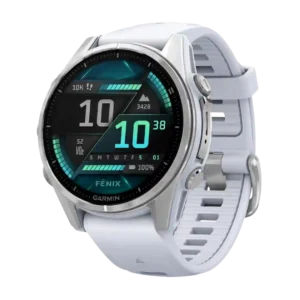
Pulse-ox support is included as part of the Fenix 8’s broad sensor suite, though reviewers did not test its accuracy deeply.
Pulse-ox support is present and useful for extra health data, but it is treated more as a nice add-on than a core reason to buy the watch.
Bluetooth setup and device support were described positively, with straightforward accessory pairing and phone-linked features.
Bluetooth support is solid for headphones and sensor sharing, with reviewers reporting stable connections in normal use.
Reviewers found the screen bright enough for clear viewing, especially on the AMOLED model.
Screen brightness is strong enough to make the display look lively and readable instead of dim or washed out.
The watch was repeatedly described as sturdy and well assembled, with a premium, rugged feel.
Build quality is strong for the price, with reviewers calling Garmin's overall construction dependable.
The button-plus-touch setup was praised for flexibility and ease, giving users reliable control during workouts.
The five-button layout is a real advantage for sweaty workouts and gloves, giving the watch dependable control beyond touch alone.
Calls work, but audio quality is a compromise: reviewers noted quiet speaker output and less-than-ideal voice clarity.
Call features are limited because the watch lacks a microphone and speaker for taking calls directly from the wrist.
Charging remains dependable, but the proprietary pin cable was seen as less convenient than magnetic chargers.
Charging is less convenient than USB-C-on-watch designs because Garmin still relies on its proprietary cable.
Charging speed is solid, with one reviewer reporting roughly a one-hour full charge.
Charging speed is a plus, with reviewers commonly seeing a full charge in about an hour.
Garmin’s coaching layer is useful, with structured strength plans and workout guidance expanding the training toolkit.
Coaching is a major strength, with Garmin Coach, adaptive plans, and suggested workouts giving newer runners useful structure without much friction.
Comfort is good for many users, but the larger case and weight can feel bulky, especially on smaller wrists.
Comfort is a standout, with many reviewers saying the watch feels light, unobtrusive, and easy to wear all day and overnight.
Garmin Connect was one of the strongest positives, praised as stellar, comprehensive, and best-in-class.
Garmin Connect is generally useful and improving, though some reviewers still find it a bit dense compared with simpler platforms.
Contactless payment support is available and adds to the watch’s everyday convenience.
Garmin Pay is a convenient inclusion and works well when supported by the user's bank, adding real day-to-day usefulness during runs and errands.
Core phone integration works across platforms, but iPhone users face more limitations than Android users.
The watch works across phone platforms, though the notification experience can vary somewhat between iPhone and Android.
Customization is a major strength, from deep settings control to broad watch-face and interface personalization.
Customization is a strong point, with editable widgets, data screens, watch faces, and settings that let users tune the experience to their preferences.
The AMOLED display earned especially strong praise for its vivid, premium presentation.
The AMOLED display is a headline feature, repeatedly praised for its sharpness, color, and premium feel at this price.
Long-term wear feedback was strong, with sapphire holding up well and the watch tolerating daily knocks.
Durability looks strong for normal training use, with reviewers calling the watch durable and noting it held up well over time.
ECG hardware is present, but availability remains region-limited rather than universally accessible.
ECG is a clear omission; multiple reviewers note that shoppers who need ECG or EKG features should look at pricier Garmin models.
Fit benefits from multiple case sizes, though the biggest models can still feel cumbersome on smaller wrists.
Fit is generally good across typical wrists, though the single-case-size approach will not suit everyone equally.
General fitness and workout tracking were reviewed very positively, with strong sensor-driven exercise data.
Core fitness tracking is described as accurate and dependable for day-to-day activity and general training use.
GPS performance is one of the watch’s clearest strengths, with repeated praise for fast, highly accurate tracking.
GPS accuracy is one of the watch's standout strengths, with repeated praise for dependable routes and mileage even without dual-band GPS.
Broader health tracking is well regarded overall, though reviewers focused more on usefulness than exhaustive lab-style validation.
Reviewers describe the watch's sleep and workout insights as highly accurate and useful for everyday training decisions.
Heart-rate accuracy is generally strong, but fast intervals and some sport-specific edge cases still trip it up.
Heart-rate performance is generally strong, with several reviewers finding it reliable and in some cases close to chest-strap or higher-end watch readings.
LTE remains the biggest missing hardware feature, and reviewers repeatedly flagged its absence.
Premium materials such as titanium, steel, and sapphire reinforce the high-end feel, even if they can still show wear.
Materials are more functional than luxurious, leaning on polymer and plastic to keep weight low, though the glass still feels durable.
Garmin’s menus are more organized than before, but reviewers still found navigation uneven and occasionally cumbersome.
Menu navigation is flexible because the watch can be fully operated with buttons, touch, or a mix of both.
Music controls are available during activities, though one reviewer disliked being stuck with the extra music page.
Music handling is functional but mixed: controls are handy once set up, yet several reviewers find Garmin's music experience clunky or not worth the premium.
Offline music support is strong, with storage for provider downloads and local files across major services.
Offline music support is helpful on the Music model and includes major services, but the extra cost and setup friction keep it from being an easy win.
Garmin’s OS is capable and efficient, but it still feels more limited than watchOS or Wear OS.
The watch OS feels familiar and practical, making common tasks like scrolling through menus and smart features straightforward.
Outdoor readability is strong overall, with reviewers highlighting clear visibility and map legibility in real use.
Outdoor visibility is excellent, with reviewers consistently able to read the screen in sunlight and other bright conditions.
Initial syncing and service pairing were smooth in testing, with no major complaints around setup reliability.
Pairing reliability is strong for Bluetooth headphones in day-to-day use.
Recovery-oriented features such as HRV trends and morning summaries add meaningful training context.
Recovery Time, Training Effect, and similar post-workout guidance are useful, but the watch still lacks deeper training-readiness and load tools from higher-end models.
Firmware maturity appears improved, with one long-term reviewer reporting a much more stable experience after updates.
Overall reliability is strong, with reviewers repeatedly calling the watch dependable in daily use and training.
Safety is a strong point thanks to breadcrumb navigation, storm alerts, and backcountry-oriented guidance tools.
Safety features like emergency contacts, incident alerts, and phone-finding tools add meaningful utility beyond pure fitness tracking.
The Fenix 8 line offers helpful size variety, but some reviewers disliked the loss of certain smaller variant combinations.
Only one size is offered, which simplifies the lineup but reduces fit choice for shoppers who prefer smaller or larger cases.
Sleep timing is usually accurate, especially for fall-asleep and wake times, though stage detail remains less convincing.
Sleep tracking is usually judged accurate enough for nightly timing and general recovery, though one reviewer found the sleep score too generous on a rough night.
Notifications work well and are easy to access, with useful phone-linked alerts and media support.
Phone notifications are easy to read and generally reliable, though they are basic smartwatch alerts rather than a full communications experience.
Smartwatch tools are broader than before, with microphones, speakers, music, and other daily-use additions helping close the gap.
Smartwatch extras like notifications, payments, music on the Music model, and safety tools are useful, but the feature set is still secondary to fitness and training.
Software responsiveness is mixed: some interactions feel polished, but lag still appears in certain menus or displays.
Software smoothness is good, with swipes and widget navigation feeling responsive rather than sluggish.
Step counts are reported to line up closely with comparison devices, suggesting dependable all-day step tracking.
Stress tracking is included in the wellness stack, though reviewers mostly mentioned it as a feature rather than validating it in depth.
Stress and recovery-style wellness metrics are available and helpful for day-to-day awareness, even if they are not the platform's most advanced readiness tools.
The design was seen as rugged and premium, though still undeniably large and utilitarian.
The design is sporty, slim, and easy to wear daily, though it favors practical training aesthetics over luxury materials.
Third-party support exists through Connect IQ, but reviewers still see Garmin as limited compared with fuller smartwatch platforms.
Connect IQ widgets, watch faces, and sync options add useful third-party flexibility, though the ecosystem is still more fitness-focused than app-heavy smartwatch rivals.
Touch interaction is mostly strong, especially on AMOLED, and new touch-unlock behavior improves usability in workouts.
Touch response is consistently praised as smooth and reliable, and it works well alongside the physical controls.
The redesigned UI is more colorful and modern, but opinions remain mixed because it can still overwhelm or slow down common actions.
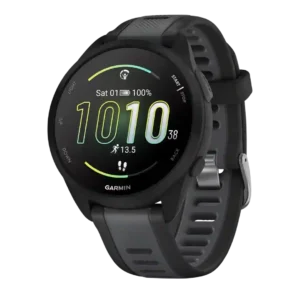
The interface is approachable and easy to learn, which helps the Forerunner 165 feel friendlier than more intimidating Garmin options.
Value is the watch’s weakest area: reviewers consistently praised performance but questioned the very high price.
Value is one of the Forerunner 165's biggest advantages, especially for runners who want Garmin training depth without moving up to much pricier models.
Voice features are useful for simple commands, but the experience is still more practical than truly seamless.
Voice-assistant support is absent, so this is not a strong pick for users who want voice help from a smartwatch.
Watch-face support is broad and customizable, with both built-in options and Connect IQ downloads available.
Watch-face options are plentiful thanks to built-in designs and Connect IQ additions.
Water performance is excellent, with certified dive-ready hardware and strong confidence around swimming and recreational diving use.
Water resistance is solid for rain, sweat, and swimming, making it suitable for everyday fitness use around water.
Wellness insights are a meaningful strength, especially through HRV trends and broader recovery-oriented daily feedback.
Morning Report, Body Battery, HRV, and related insights are widely seen as genuinely useful for understanding recovery, sleep, and daily readiness.
Wi-Fi helps with music downloads and syncing on supported models, but at least one reviewer found the setup and troubleshooting process frustrating.
Workout coverage is exceptionally broad, with reviewers highlighting the sheer range of sport profiles and activity support.
Workout coverage is broad for common sports like running, cycling, swimming, hiking, and gym work, but missing triathlon and some niche activities limits the ceiling.