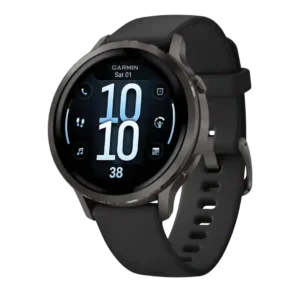
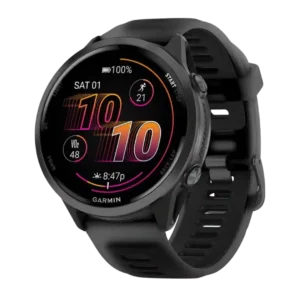
Auto track detection is a real upgrade, with reviewers calling it out as a useful addition for track sessions.
Garmin's app ecosystem remains limited, and extra apps still feel less polished than Apple or Google options.
The app ecosystem is useful but not expansive. Reviewers mention ConnectIQ apps and data fields, while also noting that Garmin’s ecosystem feels more limited than watchOS or Wear OS.
The included silicone band is soft, stretchy, and comfortable enough for long wear.
Band quality is good, with soft silicone straps and positive comments about long-term wear and durability.
Battery life is consistently a strength, with most reviewers getting roughly five to ten days depending on display mode and GPS use.
Battery life is the biggest tradeoff. Some reviewers still found it good in normal use, but many say the brighter screen makes it noticeably weaker than the 265, especially with always-on display.
Pulse Ox/SpO₂ is part of the broader health package and is surfaced alongside sleep and health status metrics.
The watch includes blood-oxygen-related health sensing, with reviewers mentioning a pulse oximeter and overnight blood-oxygen or saturation tracking as part of the health stack.
Bluetooth support is functional for phone-linked features and external sensor pairing, including Bluetooth and ANT+ accessory support.
The AMOLED panel is repeatedly described as much brighter than before and easy to read in bright conditions.
Brightness is a standout strength, with multiple reviews describing the screen as one of Garmin’s brightest and easiest to read outdoors.
The fuller metal construction makes the watch feel sturdier, more premium, and better finished than the Venu 3.
Build quality feels premium for the line, with one review explicitly describing it as a high-quality watch.
The two-button layout works, but several reviewers miss the extra button and find it less ideal during workouts.
Button controls are one of the watch’s practical strengths. Reviewers like the five-button layout and say it works reliably when touch is less convenient.
On-wrist calling works and is handy in a pinch, though speaker performance is only adequate.
Call support is a useful upgrade rather than a must-have killer feature. Reviewers generally found wrist calls workable and clear enough when paired to a phone.
Garmin's proprietary charger remains a notable annoyance for convenience.
Charging convenience is less impressive. Reviewers specifically wanted wireless charging and also called out the proprietary cable setup.
Charging speed is acceptable rather than class-leading, with useful top-ups in short sessions but slower full charges.
Charging speed is fine in practice, with one long-term reviewer saying it can top up from empty to full during a shower.
Garmin Coach, training plans, and race-readiness tools are widely praised and feel more advanced than past Venu generations.
Coaching features are well developed, especially for runners and triathletes. Garmin Coach plans, daily suggestions, and structured guidance were consistently praised.
Comfort is generally good for all-day wear, but the heavier metal build bothers some users during sleep or extended wear.
Comfort is a major plus. Across sizes and use cases, reviewers repeatedly say the watch is easy to wear for workouts, daily use, and even overnight.
Garmin Connect is useful and feature-rich, but some reviewers find newer features tucked away in too many menus.
Garmin Connect is usually viewed positively for depth and data richness, though the new subscription layer is a recurring annoyance in the reviews.
Garmin Pay is convenient when supported, but bank compatibility and extra password friction limit the experience.
NFC payments are available, giving the watch a useful everyday smartwatch feature beyond training tools.
The watch works across iPhone and Android, though Android users get more messaging and smart features.
Cross-platform support looks good overall, with smooth iPhone use noted in one review and phone-assistant access highlighted in another.
Customizable reports, focus modes, and shortcut settings give the watch a solid level of day-to-day personalization.
Customization is a strength. Reviews mention editable glance folders, assignable shortcuts, and flexible watch-face or data layout changes.
The AMOLED display is sharp, colorful, and premium-looking.
Display quality is excellent. Reviewers repeatedly call the AMOLED screen brighter, sharper, clearer, and more vivid than the previous generation.
The upgraded metal build held up well in regular workouts and swimming with no obvious scratches during testing.
Durability impressions are positive. Reviewers mention scratch resistance, pristine condition after use, and very little visible wear over time.
ECG support is a meaningful differentiator, with reviewers highlighting it as a welcome feature absent from some Garmin siblings.
ECG is a clear miss. Reviewers repeatedly call out that the Forerunner 570 lacks ECG despite using Garmin’s newer sensor hardware.
The two-case approach helps most users find a comfortable size and fit.
Fit is excellent when sized correctly, with reviewers describing the watch as secure, flush on the wrist, and almost second-skin-like.
Workout tracking is broadly accurate, with especially positive comments around strength logging and general training data.
Fitness tracking is broadly praised, with one review calling the core tracking accuracy second to none for the watch’s main sports focus.
GPS is one of the Venu 4's strongest areas, with repeated praise for tight tracks, fast lock, and stable route logging.
GPS accuracy is one of the strongest areas. Across city runs, trails, and side-by-side tests, reviews consistently describe tracking as excellent, flawless, or near flawless.
Reviewers generally trust the health metrics, especially once the watch has enough baseline data to interpret trends.
Health stats are generally described as good, with one data-driven review calling overall stat accuracy solid and another saying heart-rate and sleep-stage tracking are pretty good.
Heart-rate accuracy is strong overall and often close to chest straps, though a few reviewers saw brief dips or lag.
Heart-rate tracking is a major strength. Multiple reviewers say it stays close to chest straps, performs well in intervals, and is one of Garmin’s better recent sensors.
There is no LTE option, which limits standalone use away from the phone.
Steel cases and bezels add a noticeably more premium material feel than the prior generation.
Material choices are a step up from older mid-range Forerunners, especially the aluminum bezel and sturdier-feeling case construction.
Navigation is understandable, but the touch-heavy flow can feel cumbersome during wet or sweaty workouts.
Menu navigation is easy to learn and generally straightforward, helped by the refreshed layout and button-plus-touch design.
Basic music controls are present, including voice-command shortcuts like skipping songs.
Music controls are present and usable, including the ability to check what is playing from services like Spotify.
Offline music storage is useful and well supported, though it costs battery life.
Onboard music storage is useful but not generous. Reviews note 8GB of storage and MP3 support, with some calling the capacity a bit stingy.
The new shared Garmin OS feels more modern and should improve feature parity and long-term support.
The overall software experience is modern and capable. Reviewers describe it as faster, more polished, and close in feel to Garmin’s higher-end models.
Outdoor readability is excellent, with reviewers saying the display stays legible even in direct sun.
Outdoor visibility is excellent, with reviewers saying the display remains easy to read in bright sunlight and other tough conditions.
Pairing reliability is mixed. One reviewer found syncing smooth and seamless, while another reported repeated disconnect-and-reconnect behavior.
Recovery guidance is a standout, with Training Readiness, Body Battery, and related metrics frequently called genuinely useful.
Recovery guidance is strong. Reviews highlight training readiness, recovery time, and daily summaries that help frame when to push and when to back off.
Day-to-day reliability is mixed: some testers saw freezes or odd distance glitches, while others expect the unified platform to improve stability.
General reliability is strong, with reviewers saying the watch can be relied on for training and that key controls remain responsive even after submersion.
The built-in flashlight and visibility options are consistently praised as genuinely useful safety and convenience additions.
Safety coverage includes Garmin’s Incident Detection and LiveTrack features for activity sharing and emergency notifications.
Both 41mm and 45mm sizes are available, giving shoppers a real choice between smaller and larger wearables.
Two case sizes broaden the fit range, and multiple reviewers specifically call out the benefit of having both 42mm and 47mm options.
Sleep tracking is generally good and often lines up with other wearables, but it can overcount time spent resting awake.
Sleep tracking is useful but not flawless. Reviews say it is reasonably accurate and helpful for readiness, though some found it less robust than the best sleep-focused competitors.
Notifications are effective and more flexible on Android than on iPhone.
Notifications work, but the experience is mixed. Some reviewers had smooth delivery, while others found text truncated or alerts too persistent on screen.
Smartwatch features cover the essentials, but they still trail Apple and Google on depth and seamlessness.
Smartwatch features are improved meaningfully with the added speaker, microphone, voice tools, and day-to-day conveniences, even if the watch still prioritizes sport over general smartwatch depth.
The refreshed software is notably snappier and more responsive than older Garmin implementations.
Software smoothness is generally strong, but not perfect. Some reviews call the experience polished, while others report crashes or temporary unresponsiveness in edge cases.
Step counting looks dependable, with one controlled test hitting exactly 2,000 steps.
Step counting looked solid in direct testing, with one reviewer finding the watch was off by only around 40 steps in repeated checks.
Stress data is part of the broader wellness picture and is useful when paired with sleep, HRV, and lifestyle logging.
Stress is part of the recovery picture rather than a headline feature, with one reviewer specifically noting that stress levels feed into the watch’s overall readiness guidance.
Style is a major selling point, with reviewers repeatedly calling the Venu 4 one of Garmin's best-looking watches.
The design is widely liked. Reviewers highlight the brighter colors, more expressive styling, and a look that feels more refined than past Forerunners.
Third-party support exists, but the selection and polish remain modest by mainstream smartwatch standards.
Third-party service support is solid for a sports watch, with repeated mentions of Spotify, Deezer, Amazon Music, and YouTube Music support.
The touchscreen is quick and responsive in normal use.
Touch response is consistently described as responsive and easy to use, especially alongside the physical-button setup.
The updated interface is more polished, easier to navigate, and faster than older Garmin UIs.
The interface is widely praised for feeling slicker, cleaner, more intuitive, and more modern than older Garmin implementations.
The feature set is strong, but the $100 price jump makes value a tougher sell unless you specifically want Garmin's training depth.
Value for money is the main weakness. Most reviews say the watch is too expensive for what it adds over the 265, though a small number of owners still felt very happy with the purchase.
Voice features are available and sometimes responsive, but reviewers frequently call them clunky, buggy, or basic.
Voice features are mostly good for simple commands, timers, and phone-assistant access, though one reviewer reported crashes and awkward behavior with the phone assistant.
Watch-face customization is strong, with reviewers calling the default face clean and noting that layouts and displayed data can be tailored easily.
Water resistance is solid for pool use and showers, with reviewers citing the 5 ATM rating positively.
Water resistance is solid for swimming use. Reviews mention pool use, open-water suitability, and repeated use in lakes or the ocean without issue.
Wellness insights are a key selling point, especially through Health Status, Lifestyle Logging, and daily readiness-style feedback.
Wellness insights are a standout. Body Battery, Sleep Score, energy level, and broader readiness-style insights were repeatedly cited as genuinely useful.
Workout variety is a major strength, with repeated praise for the very broad sport profile list.
Workout coverage is excellent. Reviewers repeatedly mention broad activity support, triathlon and multisport tools, and dozens of sport modes.