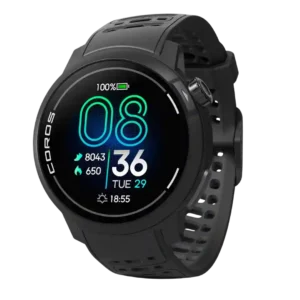
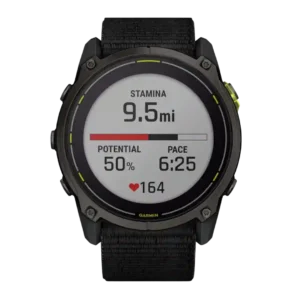
The Pace Pro plugs into a healthy training ecosystem, with reviewers highlighting broad third-party integrations rather than a closed, watch-only experience.
Garmin’s app ecosystem is decent rather than expansive, with app downloads and Connect IQ support present, but not framed as a major reason to buy the watch.
Band impressions are mostly positive for comfort and practicality, though the silicone option is not ideal for everyone and the nylon strap gets stronger praise.
The included nylon band is widely liked for comfort and security, but not universally loved because some reviewers prefer silicone or dislike how the fabric stays damp.
Battery life is one of the Pace Pro’s biggest advantages, though always-on use and certain GPS scenarios can trim real-world results versus the headline specs.
Battery life is the headline feature and consistently lives up to the hype, with standout real-world endurance and major upside from improved solar charging.
SpO2 support is present, but reviewers treated it as a secondary, mostly on-demand wellness feature rather than a major reason to buy the watch.
Blood-oxygen tracking is included as part of the health stack, but reviews mostly mention availability rather than deeply testing its precision.
Bluetooth support is useful for syncing and accessories, and reviewers generally found it competent even when other wireless options were less consistent.
Bluetooth connectivity gets limited direct discussion, but support for ANT+ and Bluetooth Smart sensors suggests strong accessory compatibility for training use.
Brightness is a standout strength, with reviewers repeatedly calling the AMOLED screen easy to see in harsh sunlight and at night.
Brightness is improved and backlight quality is better than before, yet the screen still trails bright AMOLED competitors in darker settings.
Build quality is respectable for a lightweight sports watch, but it does not consistently feel as premium as pricier rivals.
Build quality is reassuring overall, blending a light case with a premium feel that reviewers still trust for hard outdoor use.
The physical controls are generally easy to use, though the crown-first setup is not universally loved.
Button controls are a strong point, with reviewers praising the hybrid control scheme and even preferring the Enduro 3’s click feel to some rivals.
Call handling is limited: reviewers repeatedly note missing mic and speaker hardware, and some mention that call support is mostly limited to rejects or phone-dependent behavior.
The USB-C dongle/keyring charger is convenient for travel, but it is still a proprietary piece you have to keep track of.
Charging convenience is mixed: infrequent charging helps a lot, but the proprietary four-pin cable remains an annoyance.
Charging is reasonably quick in testing, with reviewers generally reporting a full charge in roughly one to two hours.
Charging speed is not a strength; one long-term review notes that topping the watch back to full takes a while.
Training tools are a clear strength, with plans, pacing, recovery, and structured workout support covering most runner-focused coaching needs.
Coaching tools are robust, with structured strength plans, performance condition, recovery guidance, and training-plan support making the watch feel more actionable than passive.
Comfort is usually excellent thanks to the low weight, but the 46mm case and stock silicone strap can be less agreeable on smaller wrists.
Comfort is a major plus for such a large watch, with many reviewers surprised by how wearable and forget-on-wrist the Enduro 3 feels.
The companion app is consistently described as clear, focused, and easy to understand without feeling overwhelming.
The companion app is viewed positively for surfacing trends, plans, and training data, though the reviews focus more on utility than delight.
Contactless payments are simply missing, which remains one of the clearest smartwatch gaps versus Garmin and Apple.
Contactless payments are a consistent plus, with NFC and Garmin Pay repeatedly noted as convenient everyday features that remain intact despite Enduro’s stripped-back smart focus.
Cross-platform support is good but uneven: the watch works with Android and iPhone, yet message replies are more capable on Android than on iOS.
There is meaningful customization for data screens and setup, but reviewers still found the watch less flexible than some rivals.
Customization is a strength, with hotkeys, pinned activities, editable layouts, and data-field flexibility giving power users lots of control.
Display quality is excellent overall, combining sharp visuals, rich color, and a polished AMOLED presentation.
Display quality is improved versus prior solar MIP Garmins, with better clarity and readability, but reviewers still stop short of calling it an AMOLED rival.
Durability looks adequate for everyday training, but the plastic/mineral-glass build is not viewed as especially rugged for tougher adventures.
Durability scores well thanks to rugged construction, scratch resistance, and repeated confidence that the watch is built for years of hard use.
ECG is available, but it is limited in scope and not positioned as a certified medical feature or AFib tool.
ECG support is a meaningful add, but several reviews note it is region-limited, making the feature useful yet not equally available to every buyer.
Fit can be very good, especially on average wrists, but the single 46mm size and strap choice do not suit everyone equally well.
Fit is secure and confidence-inspiring, helped by low weight and a strap design that keeps the watch planted during activity.
General sports tracking is strong across running and multisport use, with reviewers broadly trusting the watch during workouts.
When judged as a training watch, the Enduro 3 delivers an excellent sports-tracking experience and can even substitute for a bike computer in some use cases.
GPS accuracy is a major strength overall, though a few reviewers still noted small offsets or less-polished behavior than top-end competitors in harder scenarios.
GPS performance is one of the watch’s standout strengths, with repeated praise for accurate distance, strong multiband performance, and dependable routing in harder environments.
Core health data such as sleep timing and HRV trends comes across as believable, even if reviewers did not treat every wellness metric as lab-grade.
Reviews describe the Enduro 3 as a strong general wellness watch, with improved sensors and dependable everyday health tracking rather than breakthrough new health precision.
Heart rate tracking is good for many steady efforts, but repeated reviews found it less dependable for hard intervals, cycling, or steep climbs.
Heart-rate tracking is widely rated good to very good, often close to chest straps in steady efforts, but several reviewers note misses or lag during high-intensity or gym work.
LTE is absent, and at least one reviewer explicitly frames that as a missing convenience for buyers who want stronger untethered communication.
Materials clearly prioritize low weight over premium toughness, with polymer and mineral glass trading ruggedness for comfort and price.
Materials balance premium and practical choices: sapphire and titanium are praised, while the plastic back is mostly accepted as a comfort and weight-saving tradeoff.
Menu navigation is fast and intuitive, and the watch’s simplified layout was repeatedly praised.
Menu navigation is improved, with settings and activity functions reorganized to be easier to find and use in the field.
Music controls are a weak point, especially for phone-streamed audio, where reviewers repeatedly noted missing or limited control options.
Music controls are present but not a highlight; reviewers note accessible music widgets and phone control, though one review calls control on the phone clunky.
Onboard storage is generous, but the music experience is still limited by drag-and-drop local files and no streaming support.
Onboard music storage is a real advantage, with offline music support and generous local storage repeatedly cited alongside maps and payments.
The overall operating experience feels focused and sports-first, favoring clarity and efficiency over feature bloat.
The overall OS experience is strong but not frictionless, with reviewers liking the new organization while also noting some learning curve or lifestyle rough edges.
Outdoor visibility is excellent, with the AMOLED screen staying readable in bright daylight and poor light alike.
Outdoor visibility is excellent in bright conditions, one of the MIP display’s biggest advantages, though a few reviewers still needed the backlight in dim terrain.
External sensors generally pair reliably, and reviewers who tested accessories reported easy connections.
Recovery and training-readiness insights are useful, though some reviewers still wanted more polish in how those insights are presented or calculated.
Recovery tools are a clear strength, with readiness, recovery time, and training-state guidance repeatedly highlighted as helpful for pacing hard and easy days.
Day-to-day reliability is mostly solid, but reviews still surfaced a few bugs, quirks, or rough edges that keep it from feeling flawless.
Reliability is a strong suit, with reviewers trusting the Enduro 3 for long adventures, low-maintenance use, and day-to-day dependability.
Navigation safety helpers like off-route alerts and back-to-start support add real value for trail and hiking use.
Safety-minded touches like the flashlight, off-course alerts, sunset info, and satellite-communication pairing support add practical reassurance outdoors.
Size choice is limited because the watch comes in a single 46mm case, which several reviewers said will not suit every wrist.
Size choice is a clear weakness because the Enduro 3 comes only in a large 51mm case that several reviews call a dealbreaker for some wrists.
Sleep tracking is generally trusted for timing and nightly consistency, even if reviewers were not focused on validating every stage metric.
Sleep tracking is positively described, with reviewers calling it solid and useful when paired with Garmin’s overnight recovery and readiness features.
Notifications are readable and useful, but they remain basic and miss richer handling like full emoji support.
Notifications are handled well overall, with a revamped notification center and support for calls, texts, and app alerts, though functionality still depends on phone platform.
Smartwatch features cover the basics, but the Pace Pro still trails stronger rivals when it comes to modern everyday conveniences.
Smartwatch features cover the essentials well enough—music, payments, notifications, flashlight, and watch customization—but the experience is clearly secondary to sport and battery priorities.
Software smoothness is a clear highlight, with the faster processor making menus and maps feel quick and responsive.
Software smoothness is acceptable rather than flawless, with praise for the redesign but repeated mentions of lag, loading delays, or a need for more polish.
Stress tracking exists and can be informative, but at least one reviewer found workout-related stress handling less convincing.
Stress tracking is treated as part of Garmin’s broader wellness suite and is mainly valued for feeding readiness and daily body-status insights.
The design is functional and sporty, but several reviewers felt it looks simpler and less premium than direct rivals.
Style is somewhat divisive: many like the cleaner solar ring and understated rugged look, but several reviews still note the big case or polarized aesthetics.
Third-party app support is a plus, especially for services like Strava, TrainingPeaks, Komoot, and similar training platforms.
Third-party app support exists but gets mixed enthusiasm, with some reviewers appreciating downloads while others say the wider smartwatch app experience is still limited.
Touch responsiveness is excellent, with multiple reviewers describing the screen as fast, accurate, and easy to use mid-workout.
Touch response is a plus, especially for maps and quick interactions, and Garmin’s touch-unlock approach earns specific praise.
The user interface is approachable and well organized, even if it is not the fanciest or most fully featured in the category.
The updated interface is generally well received for feeling more modern and organized, though not everyone thinks Garmin has fully finished the polish yet.
Value is one of the Pace Pro’s biggest appeals, especially for buyers who want AMOLED, maps, and long battery life without stepping into flagship prices.
Value is judged unusually well for a high-end Garmin because Enduro 3 undercuts pricier siblings while keeping most of the training and navigation substance.
Voice assistant support is a weakness because the Enduro 3 lacks the Fenix 8’s speaker and microphone setup that powers voice-driven features.
Watch faces look good and benefit from the AMOLED screen, though some reviewers still wanted deeper data-field personalization.
Watch-face support is mixed: there are new watch-face tools and customization options, but some reviewers still find Garmin’s faces less appealing than rivals’.
Water resistance is fine for rain, pool use, and open water swimming, but it is not built for more demanding water sports or diving.
Water resistance is solid for swimming and surface sports, but reviewers consistently remind buyers that this is not the dive-ready Garmin option.
Wellness insights are useful for understanding exertion, recovery, and general trends, even if they are not especially medical or exhaustive.
Wellness insights are deep and useful, with Body Battery, HRV, sleep coaching, illness-readiness signals, and training status frequently called out as valuable daily context.
Wi-Fi is available, but at least one reviewer ran into inconsistent behavior, making it less confidence-inspiring than the rest of the watch.
Workout variety is strong, with plenty of sport modes and enough range for most running, triathlon, hiking, gym, and swim use.
Workout coverage is extensive, spanning major endurance sports, gym profiles, and multisport use, with reviewers repeatedly emphasizing just how broad the activity list is.