- Better: smartwatch skills and apps Runner's World says the Enduro 3 cannot match the Apple Watch Ultra 2 for daily smartwatch capability.
- Worse: battery life Android Authority says the Enduro 3's battery life makes the Apple Watch Ultra look weak.
Garmin Enduro 3 Review
Bottom Line
Choose the Garmin Enduro 3 if you want class-leading battery life, reliable GPS, maps, and training depth for endurance adventures. Skip it if you need a smaller watch, AMOLED polish, calling, voice tools, LTE, or dive features.
Best for ultrarunners, thru-hikers, endurance cyclists, backcountry users, and Garmin fans who want huge battery life, dependable GPS, maps, recovery metrics, and a lighter large-case build.
Not for shoppers who need a small watch, AMOLED display, LTE, true wrist calls, voice-assistant tools, dive features, or a full Apple/Samsung-style app experience.
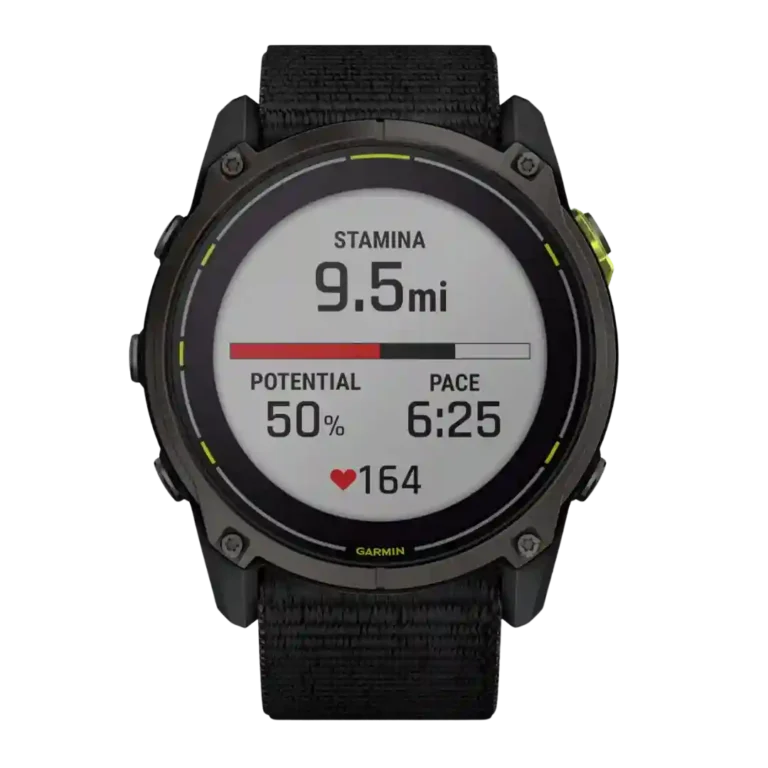
The Garmin Enduro 3 comes through as a purpose-built endurance watch rather than a broad lifestyle smartwatch. Across the reviews, its battery life, GPS accuracy, mapping tools, training metrics, flashlight, and surprisingly light 51mm build are the repeated reasons it stands out. The tradeoff is clear: Garmin stripped out or skipped several Fenix 8-style extras, including speaker, microphone, dive capability, LTE, and AMOLED gloss. That makes the watch less appealing for people who want phone-like daily features, but it also keeps the focus on long races, hikes, expeditions, and training blocks where charging less, navigating reliably, and seeing recovery data matter more than smartwatch polish.
Compared in Reviews
Products reviewers directly compared with this model, grouped into quick takeaways.
- More expensive: sports features and battery Hodinky says the Garmin Fenix 8 is expensive compared with the Enduro 3 for similar sports features.
- Alternative: mainstream user alternative OutdoorGearLab presents the Forerunner 965 as the better top pick for most users.
Feature Scorecards
Pros
-
Reliability is strong in long-term use, with one reviewer describing the watch as dependable for demanding races and adventures.
-
Workout variety is excellent, with reviewers describing broad sports profiles and deep sport-specific modes for runners, cyclists, swimmers, hikers, triathletes, gym users, and more.
-
Battery life is the clearest consensus strength, with reviewers repeatedly reporting weeks of use, ultra-long GPS tracking, and meaningful solar gains.
-
Value for money is strong despite the high price because reviewers repeatedly emphasize the reduced launch price and cheaper position versus comparable Fenix models.
-
GPS accuracy is one of the strongest areas, with repeated praise for satellite lock, multiband performance, technical-terrain reliability, and real-world route precision.
-
Customization is a strength, with hotkeys, data fields, widgets, sport screens, and Garmin-style controls offering deep personalization.
-
Durability is strong in long-term and lab-style reviews, with sapphire, titanium, rugged construction, and minimal visible wear after months of use.
-
Recovery insights are a major strength, with training readiness, recovery time, Body Battery, and readiness guidance helping users decide when to push or rest.
-
Fit is secure and comfortable despite the 51mm case, helped by low weight and strap stability.
-
Materials quality is strong where it matters, with sapphire glass and titanium repeatedly cited, though some plastic parts are a tradeoff for lower weight.
-
Mapping and navigation are major strengths, with TopoActive maps, turn-by-turn guidance, ClimbPro, off-course alerts, rerouting, and route-following praised across reviews.
-
Coaching features are strong, especially daily suggestions, training plans, strength workouts, animated exercises, and readiness-based workout guidance.
-
Fitness tracking accuracy is strong across real workouts, with reviewers praising activity logs and controlled heart-rate tests while noting some optical limits.
-
Safety features are valuable for outdoor use, especially the flashlight, red LED, and off-course alerts that can prevent navigation mistakes.
-
Contactless payments are a clear positive, with Garmin Pay and NFC repeatedly mentioned as available and useful.
-
Touchscreen responsiveness is good, especially for maps and the new touch-unlock behavior, while physical buttons remain available for reliability.
-
Button controls are a major strength, combining Garmin's five-button system with touch input and customizable hotkeys.
-
Reviewers found Garmin's health signals useful and sometimes impressively sensitive, especially when wellness scores reflected underlying fatigue or illness signs.
-
Onboard music storage is well supported, with offline music, 32GB for maps/music, and streaming services such as Spotify, Amazon Music, Deezer, and YouTube Music mentioned.
-
Smartphone notifications are useful and improved, with grouping, clearer notification access, and basic notification display across paired phones.
-
Build quality is generally strong for the price, but reviewers split on the move to more plastic and the loss of some metal construction.
-
Wellness insights are extensive, combining sleep, HRV, stress, Body Battery, blood oxygen, recovery levels, and daily health trends into useful training context.
-
Comfort is surprisingly good for a large endurance watch thanks to low weight and nylon straps, though sleeping with it or wearing it on small wrists can be less comfortable.
-
Display quality is strong for an MIP watch, with improved clarity and readability, but reviewers consistently frame AMOLED as brighter and more colorful.
-
Brightness is improved versus prior solar designs and usable in dim conditions with backlight, though it is not AMOLED-level vivid.
-
Water resistance is solid for swimming and surface water use at 10ATM or 100 m, but reviewers stress that it is not a dive watch.
-
Blood oxygen tracking is present as part of the broader Garmin sensor and wellness package rather than a standout reason to buy.
-
Bluetooth connectivity is supported for sensors, with the watch pairing to ANT+ and Bluetooth Smart accessories.
-
The companion app helps surface trends and training context, though reviewers focus more on Garmin's watch-side metrics than on the app itself.
-
The operating system experience improves over older Garmins with the Fenix 8-style interface, though not all reviewers think the redesign is fully polished.
-
Sleep tracking was described as solid, with sleep stages, HRV, Sleep Coach, and morning wellness context supporting recovery decisions.
-
Stress tracking appears within Garmin's broader daily health suite, alongside sleep, blood oxygen, Body Battery, and recovery metrics.
-
Heart rate accuracy was generally strong with the Gen 5 sensor, though several reviewers still saw optical-sensor wobble during sharp intervals, climbs, or strength work.
-
Band quality is mostly positive for comfort and adjustability, but sweat retention and the lack of an included silicone option are recurring caveats.
-
ECG support is repeatedly noted through the Gen 5 sensor, but availability is region-dependent and not treated as the watch's main draw.
-
Menu navigation is improved and more coherent for some reviewers, but added screens and button presses can still make parts of the interface feel busy.
-
The user interface is generally more modern and phone-like, with quicker access to key settings, though some reviewers remain on the fence.
-
The app ecosystem is adequate but not Apple-like, with Connect IQ apps and watch faces available but not treated as a major strength.
-
Outdoor visibility is mostly strong in bright light, but mixed in forests or dim map situations where the backlight may be necessary.
-
Cross-platform compatibility is good for basic Android and iPhone use, though reviewer evidence implies fuller reply features are stronger on Android.
-
Style and design are polarizing: reviewers like the rugged, slimmer-bezel direction, but some call the look subjective or too large.
Cons
-
Charging convenience is mixed: huge battery life reduces charging frequency, but Garmin's physical proprietary cable remains a nuisance for some.
-
Software smoothness is mixed: some reviewers found the watch fast and reactive, while others saw sluggish UI behavior or slow loading of post-run stats.
-
Music controls are available but mixed: reviewers note a dedicated music lane and phone controls, while also calling some implementation clunky or not dismissible.
-
Watch face quality is mixed: Connect IQ and third-party options exist, but one reviewer criticized the built-in faces while another liked the large library.
-
Calorie tracking appears as a standard activity metric, but reviewers do not give it much deeper evaluation beyond its presence in activity profiles.
-
Wi-Fi connectivity is only lightly evidenced through watch settings access, with no detailed performance praise or complaint.
-
Smartwatch features cover essentials such as notifications, music, Garmin Pay, and Messenger, but reviewers agree it falls short of Apple, Samsung, or Fenix 8 lifestyle extras.
-
Charging speed is a minor weakness in the long-term evidence, where one reviewer says it takes a while to reach full charge.
-
Third-party app support is a weakness versus mainstream smartwatches, with reviewers noting few compelling third-party apps.
-
Size options are a clear weakness because the Enduro 3 comes only in a large 51mm case.
-
Call handling is limited because the Enduro 3 lacks speaker and microphone hardware; reviewers note rejection or phone handoff rather than true wrist calling.
-
Voice-assistant quality is weak because reviewers repeatedly note the absence of microphone, speaker, and digital-assistant interaction.
-
LTE connectivity is effectively absent; reviewers note no cellular connectivity and one argues the Enduro line is the kind of model that deserves LTE.
Compared With Category Average
Compared with other Smart Watch, this product is above average in ECG functionality, contactless payments, onboard music storage, below average in charging speed, call handling, size options.
| Attribute | This product | Category average | Difference |
|---|---|---|---|
| ECG functionality | 3.8 | 2.3 | +1.6 |
| contactless payments | 4.3 | 2.8 | +1.5 |
| charging speed | 2.5 | 4.1 | -1.6 |
| call handling | 1.7 | 3.1 | -1.4 |
| onboard music storage | 4.3 | 2.8 | +1.4 |
| reliability | 5.0 | 3.7 | +1.3 |
| size options | 2.0 | 3.2 | -1.2 |
| voice assistant quality | 1.5 | 2.7 | -1.2 |
FAQ
How good is the Garmin Enduro 3 battery life?
Reviewers consistently treated battery life as the standout strength, with reports ranging from about two weeks of heavy long-term use to close to a month in general use and very long GPS tracking estimates.
Is the Garmin Enduro 3 accurate for GPS?
Yes. Reviewers repeatedly found GPS performance strong across multiband, SatIQ, city, mountain, trail, race, and long-route testing, with only minor caveats in GPS-only or difficult environments.
Is the Garmin Enduro 3 comfortable despite the 51mm size?
Mostly yes. Reviewers found it surprisingly light and comfortable for a large watch, especially with the nylon band, but several noted that the single 51mm size can be too bulky for smaller wrists or sleep.
What smartwatch features does the Enduro 3 lack?
It lacks LTE, a speaker, a microphone, full wrist calling, voice-assistant interaction, and the richer app experience of Apple or Samsung watches. It still has notifications, Garmin Pay, music, watch faces, and Garmin Messenger-style basics.
How are the maps and navigation?
They are a major strength. Reviews praised TopoActive maps, turn-by-turn guidance, ClimbPro, off-course alerts, rerouting, course following, and trail usefulness, though one reviewer still found map interaction clunky compared with phones.
Is the Enduro 3 better value than the Fenix 8 Solar?
For endurance-focused users, reviewers often framed it as better value because it keeps many core Garmin sports, health, navigation, and software features while costing less and lasting longer. The Fenix 8 remains better if you need smaller sizes, AMOLED options, dive capability, or voice hardware.
Consider This Instead
If you want better LTE connectivity
Choose Samsung Galaxy Watch Ultra (2025). It scores 4.5 vs 1.0 for LTE connectivity, with a 4.1 overall score.
If you want better call handling
Choose Apple Watch Ultra 3. It scores 4.6 vs 1.7 for call handling, with a 4.2 overall score.
If you want better size options
Choose Garmin Approach S70. It scores 4.7 vs 2.0 for size options, with a 4.3 overall score.
If you want better charging speed
Choose Suunto Race 2. It scores 5.0 vs 2.5 for charging speed, with a 3.4 overall score.
Overall Top Smart Watch Alternatives
Good if you want the most rugged Apple Watch, brighter outdoor screen, better battery, LTE, and top apps. Skip it if you need Garmin-like mapping, recovery analytics, smaller sizing, or...
Pros: display quality, heart rate accuracy
Cons: cross-platform compatibility, recovery insights
Choose the Galaxy Watch 6 for a polished Android smartwatch with a bright screen, strong apps, and broad health tracking. Skip it if battery life, iPhone support, or full non-Samsung...
Pros: outdoor visibility, workout tracking variety
Cons: cross-platform compatibility, battery life
Good if you need a rugged Garmin with deep outdoor, tactical, GPS, training, and battery features. Skip it if you want a cheaper lifestyle watch or do not need the...
Pros: materials quality, durability
Cons: LTE connectivity, value for money
Good if you want premium golf maps, virtual caddie tools, health metrics, music, notifications, and long battery life in one watch. Skip it if you only need basic yardages or...
Pros: pairing reliability, brightness
Cons: software smoothness, user interface