- Better: smart features and training analysis The Forerunner 265 has better smart features and training analysis, but the Pace Pro has maps and longer battery life.
- Worse: battery life The Pace Pro is framed as lasting longer than the Forerunner 265 in dual-frequency GPS and smartwatch use.
- Better: brand reliability at the same price The reviewer felt the same-priced Forerunner 265 made the Pace Pro's price less impressive because Garmin is more established.
Coros Pace Pro Review
Bottom Line
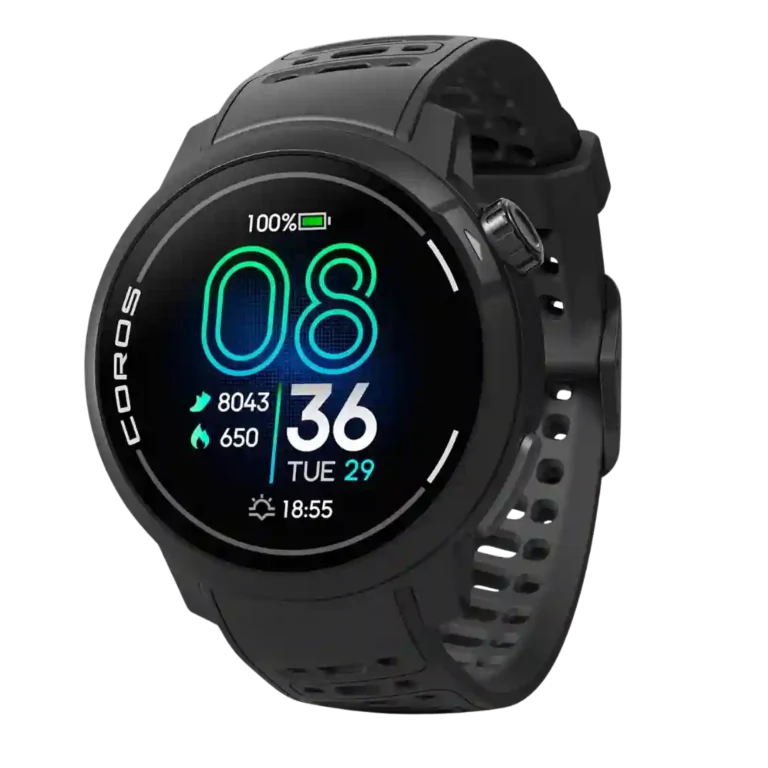
Choose the Coros Pace Pro for a light AMOLED training watch with strong maps, GPS and battery. Skip it if you want premium materials, robust smartwatch features, payments or the most consistent wrist heart-rate data.
Best for runners, hikers and endurance athletes who want a lightweight AMOLED sports watch with strong GPS, offline maps, long battery life and a focused training experience.
Not for users who prioritize a full smartwatch experience, premium rugged materials, smaller case options, contactless payments, streaming music or highly precise wrist heart-rate data in every workout.
Reviewers consistently framed the Coros Pace Pro as a training-first sports watch that gets the fundamentals right: a vivid AMOLED screen, strong GPS, useful offline maps, fast software and standout battery life for the price. The main tradeoff is that Coros keeps the experience narrow. That focus helps runners and hikers who want clear workout data, route guidance and long endurance, but it leaves obvious smartwatch gaps such as contactless payments, streaming music, richer notifications and a flashlight. Heart-rate accuracy is good enough for many steady workouts, yet it becomes less dependable during intervals, cycling, climbs or strength training. Materials are another compromise, with lightweight plastic and mineral glass helping comfort but limiting rugged appeal.
Compared in Reviews
Products reviewers directly compared with this model, grouped into quick takeaways.
- Better: smartwatch and sports-watch mix The Apple Watch Series 10 is recommended over Pace Pro for shoppers wanting a stronger sports-and-smartwatch blend.
- Better: navigation versatility The Pace Pro's navigation is useful but not as advanced as the Garmin Fenix 8.
Feature Scorecards
Summary
49 reviewed features- Very positive 4.5-5.0 29% 14 features
- Positive 3.5-4.4 37% 18 features
- Neutral 2.5-3.4 22% 11 features
- Negative 1.5-2.4 8% 4 features
- Very negative below 1.5 4% 2 features
Pros
-
Outdoor visibility was excellent; reviewers repeatedly said the AMOLED remained readable in direct sun, rain, darkness, and varied weather.
-
Display quality was one of the strongest points, with reviewers repeatedly calling the AMOLED screen bright, sharp, clear, vibrant, and easy to read.
-
Brightness was consistently excellent, with reviewers praising the 1,500-nit AMOLED for night use, sunlight, and general readability.
-
Menu navigation was praised as quick, simple, and intuitive, especially through the crown and minimal interface.
-
Pairing reliability was strong in reviews that connected external sensors, with easy or no-problem Bluetooth pairing.
-
Bluetooth performance was praised when reviewers used it for sensor connections or map transfers, with easy pairing and practical backup syncing.
-
Software smoothness was a clear strength, with reviewers praising fast menus, snappy map rendering, and little to no lag.
-
Battery life was one of the clearest strengths, with reviewers repeatedly reporting multi-day AMOLED use and strong GPS endurance, though one review saw shorter always-on life under heavy GPS use.
-
Third-party syncing is a strength where reviewers discussed it; Strava and similar integrations moved data quickly and supported the training workflow.
-
Fit was positive where the strap sat securely, but the broader evidence also suggests some wrist-size limitations.
-
The operating system experience was considered focused and polished by reviewers who wanted a training-first watch rather than a full smartwatch.
-
Reliability was positive where reviewers recommended the watch's core functionality and long-term training use.
-
Third-party app support was positive where mentioned, with a rich set of apps and quick data sharing.
-
Mapping and navigation were major strengths thanks to bright offline topo maps, easy route following, and quick map rendering, though reviewers noted missing routable maps, labels, and some workflow polish.
-
Comfort was a major strength due to the light body, though the larger case and silicone strap were less comfortable for some smaller wrists or sleep use.
-
The companion app was widely praised as clear, useful, configurable, and easy to understand, with only occasional criticism of presentation clarity.
-
Value for money was widely praised, especially for AMOLED, maps, GPS accuracy, and battery at a mid-range price, despite compromises in smartwatch features and materials.
-
GPS accuracy was consistently strong, with reviewers calling it reliable, accurate, top-notch, or close to Garmin, though not flawless in every situation.
-
Fitness tracking accuracy was strong for runs, GPS-based workouts, and general use, though strength training and some harder sensor scenarios were less reliable.
-
Charging speed was viewed positively overall, with some reviewers reporting full charges in about one to two hours.
-
Wellness insights were useful and easy to understand, especially through the app, but remained secondary to training and sensor limitations.
-
The user interface was generally intuitive and easy, though some reviewers wanted more polish and glanceable insight presentation.
-
Workout tracking variety was broad enough for most runners and multisport users, though not as extensive as some brands or higher-end Coros models.
-
Sleep tracking evidence was mostly positive for sleep/wake timing or perceived sleep scores, though one reviewer found it did not always match Whoop.
-
Touchscreen responsiveness was usually excellent, but some reviewers noted finicky scrolling, water-triggered touches, or touchscreen design that felt secondary.
-
Button controls were generally easy and improved, especially with gloves or workouts, but the crown/button layout caused some accidental pauses and a few reviewers preferred more conventional buttons.
-
Bands drew mixed feedback: some reviewers liked the dry, comfortable silicone or optional nylon bands, while others found the silicone strap fiddly or poor for smaller wrists.
-
Charging convenience was split: reviewers liked the tiny USB-C adapter for travel, but others criticized the changed port, lack of a cable, and risk of losing the adapter.
-
Coaching and training tools were useful for runners, but several reviewers criticized training-load presentation and flexibility compared with Garmin.
-
Recovery insights were useful but uneven, with positive recovery tools offset by criticism of training-load formulas and presentation.
-
Watch faces were mixed: reviewers liked some defaults and available faces, but criticized limited interactivity.
-
Style and design were mixed: some liked the look, but others found it basic or cheaper-looking compared with rivals.
Cons
-
Heart-rate accuracy was the most mixed core sensor result: good for steady runs and general use, but less dependable during intervals, outdoor cycling, intense climbs, or strength work.
-
Build quality was mixed: reviewers liked the light, practical construction but repeatedly noted the plastic case and less premium feel.
-
Blood oxygen support was treated as limited because reviewers noted it as more of an on-demand or altitude-oriented feature rather than a deeply used health metric.
-
Durability was a concern for rugged use because reviewers noted the mineral glass, plastic build, and weaker suitability for harsh adventures.
-
Customization was limited; reviewers liked configurable workout fields but wanted more watch-face and data-field flexibility.
-
Smartphone notifications worked for basics but were criticized for missing emoji support, wasted screen space, and limited interaction.
-
Smartwatch features were the main compromise: reviewers accepted the focused sports-watch design but noted limited apps, payments, calls, reports, and streaming smarts.
-
Materials quality was a recurring compromise: the lightweight polymer build helped comfort but mineral glass and plastic felt less premium and less rugged than rivals.
-
Size options were a weakness because the single larger case was too big or less appealing for smaller wrists.
-
Stress tracking was criticized in the one opinionated review because workouts appeared as stress regardless of whether the activity felt enjoyable.
-
Water resistance was adequate for pool/open-water swimming but scored lower for hikers because reviewers said it was not suitable for diving or high-impact water sports.
-
Onboard music storage was useful in theory but limited by drag-and-drop MP3 files and no streaming service support.
-
ECG was treated as limited because reviewers emphasized that it is not medically certified and should not be used as a medical device.
-
Wi-Fi connectivity was a weak point in the review that tested it, with repeated sync attempts needed and ongoing imperfections.
-
Music controls were weak because reviewers said the watch could not control phone playback and lacked the seamless music experience expected from rivals.
-
Contactless payments were a clear weakness because reviewers repeatedly noted the lack of Garmin Pay, Apple Pay, or NFC payments.
-
Flashlight usefulness scored poorly because reviewers repeatedly wanted a simple screen flashlight and noted that it was missing.
Compared With Category Average
Compared with other Smartwatches, this product is above average in third-party app support, below average in flashlight usefulness, music controls, contactless payments.
Summary
8 compared features- Above average 0.4+ pts higher 13% 1 feature
- Same as average within 0.3 pts 0% 0 features
- Below average 0.4+ pts lower 88% 7 features
| Attribute | This product | Category average | Difference |
|---|---|---|---|
| flashlight usefulness | 1.0 | 3.9 | -2.9 |
| music controls | 1.5 | 3.5 | -2.0 |
| contactless payments | 1.0 | 2.7 | -1.7 |
| water resistance | 2.5 | 4.2 | -1.7 |
| materials quality | 2.5 | 4.0 | -1.5 |
| customization options | 2.7 | 4.1 | -1.4 |
| durability | 2.8 | 4.2 | -1.4 |
| third-party app support | 4.5 | 3.1 | +1.4 |
FAQ
Is the Coros Pace Pro good for runners?
Yes. Reviewers repeatedly praised its GPS accuracy, light feel, battery life, training tools and route navigation, making it especially strong for running and endurance training.
How good is the AMOLED display?
The display is one of the clearest strengths. Reviewers described it as bright, sharp, vibrant and easy to read in sunlight, rain, darkness and during workouts.
Does the Coros Pace Pro have maps?
Yes. It has offline topo-style maps and route navigation, and reviewers liked the bright map view and fast rendering. The main limitations are that the maps are not fully routable and some workflows or labels need more polish.
Is heart-rate tracking accurate?
It is generally good for steady running and everyday workouts, but reviewers found more mixed results during hard intervals, outdoor cycling, steep climbs and strength training. Several suggested using an external sensor for the most precise data.
How is battery life?
Battery life was widely praised. Reviewers reported multi-day AMOLED use, strong GPS endurance and much less charging anxiety than typical smartwatches.
What smartwatch features are missing?
Reviewers repeatedly noted missing or limited extras such as contactless payments, streaming music, phone music controls, richer notifications, voice calling, apps and a screen flashlight.
Is it durable enough for rugged outdoor use?
It is fine for everyday runs, hikes, pool swims and general outdoor use, but reviewers were cautious about harsh adventures because of the plastic case, mineral glass and 5ATM water resistance.
Sample Expert Reviews We Analyzed
These are a few of the reviews included in our analysis.
Video Reviews
- Review score
- 3.7/5
Article Reviews
Consider This Instead
If you want better contactless payments
Choose Garmin Enduro 3. It scores 5.0 vs 1.0 for contactless payments, with a 3.9 overall score.
If you want better flashlight usefulness
Choose Suunto Race 2. It scores 5.0 vs 1.0 for flashlight usefulness, with a 3.7 overall score.
If you want better music controls
Choose Samsung Galaxy Watch 6. It scores 5.0 vs 1.5 for music controls, with a 4.1 overall score.
If you want better ECG functionality
Choose Apple Watch Series 11. It scores 4.8 vs 2.2 for ECG functionality, with a 4.3 overall score.
Overall Top Smartwatches Alternatives
Best for rugged outdoor training, long battery life, accurate GPS, maps, calls, and a genuinely useful flashlight. Skip it if the high price, tactical extras, proprietary charging cable, or mixed...
Pros: wellness insights, build quality
Cons: LTE connectivity, band quality
Good if you want the best balanced Apple Watch for an older upgrade, stronger battery, comfort, and health tools. Skip it if you own Series 10, need week-long battery, or...
Pros: ECG functionality, app ecosystem
Cons: cross-platform compatibility, recovery insights
Choose it if you want a rugged Garmin hybrid with real hands, a sharp AMOLED display, strong tracking, and a genuinely useful flashlight. Skip it if price, full maps, onboard...
Pros: heart rate accuracy, GPS accuracy
Cons: onboard music storage, mapping and navigation
Best for bright AMOLED visuals, strong battery life, accurate GPS, maps, and standout value. Skip it if you need rich apps, reliable payments, LTE, ECG, or the cleanest companion app.
Pros: step counting accuracy, menu navigation
Cons: voice assistant quality, contactless payments