Auto-detection is explicitly criticized in testing, with reviewers saying workouts usually need to be started manually to access the watch’s richer tracking features.
The app ecosystem is solid rather than class-leading: reviewers cite Connect IQ support and a healthy app catalog, but not the broader polish or reach of Apple or Wear OS ecosystems.
ConnectIQ is highlighted as a large marketplace for extra apps and watch faces, with many free options.
Band quality is generally good, with flexible silicone straps and solid sweat performance, though silicone can stay damp and irritate skin if not dried after workouts.
The band gets a positive note for micro-adjustment-like stretch and stable wear.
Battery life is a major strength. Reviewers report multi-day to multi-week endurance depending on usage, with always-on display and GPS workouts reducing runtime but still leaving it ahead of many rivals.
Battery life is the main hardware compromise: acceptable to good with sensible settings, but clearly worse than some Garmins or rivals when brightness and always-on display are pushed.
The watch supports blood oxygen tracking and related wellness sensors, but reviewers discuss it more as part of the feature set than as a standout accuracy differentiator.
PulseOx support is present for overnight breathing-related data, and one reviewer found its overnight battery impact minimal.
Bluetooth connectivity is dependable for phone pairing and headphone playback, with no major complaints in the selected reviews.
Bluetooth support is broad enough for external sensors and accessories, with no major complaints in the cited review.
Brightness is repeatedly praised. Reviewers call the AMOLED screen bright, vivid, and easy to read in varied lighting.
Brightness is a standout upgrade and among the most frequently praised hardware changes.
Build quality feels premium overall, helped by the metal or titanium bezel and polished finish, even if outright ruggedness is not the headline strength.
The overall construction feels premium, with sapphire and titanium helping the watch feel like a true flagship.
Button controls are a clear positive. Multiple reviews praise the tactile hardware buttons and say they remain easy to use during workouts and with gloves.
Physical buttons remain a strength, giving reliable control alongside the touchscreen.
Call handling is inconsistent across reviews. One source says calls can be answered via a paired phone, while others explicitly note missing call functionality compared with Garmin’s more smartwatch-focused models.
On-wrist calling works and is convenient, but speaker volume or overall call quality is not universally praised.
Calorie tracking is only modestly useful. Calories are visible in daily metrics, but one review says users wanting stronger calorie and intake support should look elsewhere.
Charging convenience is a weak point because Garmin still uses a proprietary connector, and reviewers call the port connection delicate while also noting the lack of wireless charging.
Charging speed is good, with reviewers citing roughly an hour to reach high percentages and quick top-ups that provide meaningful battery in minutes.
Coaching features are strong, with suggested workouts, race prediction, and readiness-style guidance giving the watch a helpful training-assistant feel.
Garmin Coach and triathlon planning are consistently praised for building detailed, adaptive training plans.
Comfort is a strength for most users thanks to the light, slim build and wearable design, though the large case can still be noticeable for some sleepers or smaller wrists.
Reviewers consistently find the watch comfortable enough for all-day wear.
Companion app quality is mixed. Garmin Connect is praised for depth and data access, but several reviewers also call it confusing or poorly organized in places.
Garmin Connect is described as comprehensive, but not consistently elegant, with one reviewer criticizing layout while another praises data presentation.
Contactless payments are available through Garmin Pay, but real-world usefulness depends heavily on bank support, which several reviewers say is still uneven.
Garmin Pay is available and described as easy or useful where banks are supported.
Cross-platform compatibility is strong, with consistent support for both Android and iPhone across reviews.
Compatibility across Apple and Android phones is present, but capabilities differ and iOS remains more limited.
Customization options are extensive, including watch faces, widgets, data pages, and other configurable on-watch and in-app elements.
Customization is extensive, from sport-profile behavior to data fields and watch-face choices.
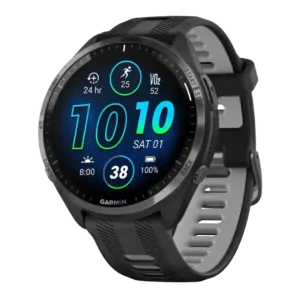
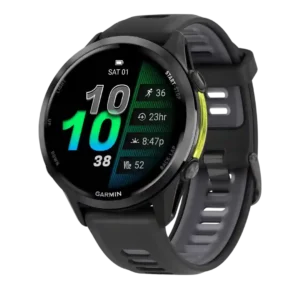
Display quality is one of the headline wins. The AMOLED panel is widely described as sharp, vibrant, and transformative compared with older MIP models.
The AMOLED display is repeatedly praised for looking bright, sharp, and premium.
Durability is mixed. Some reviewers appreciate the materials and scratch resistance expectations, but several also report real scratches and visible wear sooner than expected.
Sapphire protection and tougher materials are repeatedly credited with improving scratch resistance and day-to-day durability.
ECG functionality is absent. Multiple reviews explicitly state that the Forerunner 965 does not include ECG hardware or support.
The watch adds manual ECG support and reviewers consistently present it as a meaningful upgrade, though one notes it is still a manual snapshot tool rather than continuous monitoring.
Fit is acceptable for many wrists but not ideal for everyone. Several reviews warn that the 47mm case can feel large on smaller wrists.
Despite the 47 mm case, multiple reviewers say the watch sits well and feels manageable on the wrist.
Fitness tracking accuracy is a standout strength, with reviewers praising the consistency of workout metrics and the overall trustworthiness of exercise data.
In multisport and gym use, one reviewer says the watch tracked indoor training sessions reliably.
GPS accuracy is one of the watch’s clearest strengths, repeatedly described as spot-on, industry-leading, or nearly dead accurate in testing.
GPS performance is one of the clearest strengths, with multiple reviewers calling it impeccable, highly accurate, or spot-on across varied conditions.
Health tracking accuracy is good overall but not flawless. Reviewers praise the depth and usefulness of health data, while some flag sleep-related inconsistency that affects broader health confidence.
Heart rate accuracy is strong for a wrist-based sensor, with several reviewers calling it excellent or near chest-strap performance, though interval lag can still appear.
Across runs and workouts, reviewers repeatedly describe optical heart rate as close to chest straps and generally reliable.
LTE connectivity is absent. Reviews explicitly note that the watch lacks LTE or mobile internet support.
The watch lacks built-in cellular and still depends on a nearby phone for calls or assistant functions.
Materials quality is solid, with repeated mentions of titanium, Gorilla Glass, and generally premium-feeling hardware choices.
Materials are premium for the category, especially the titanium bezel and sapphire protection, even if the body remains polymer.
Menu navigation is generally good once learned, with reviewers highlighting customizable widgets and easy menu flow, though Garmin’s depth can still feel dense at first.
Voice tools and interface choices can reduce menu digging, making common actions quicker.
Music controls are well covered for a sports watch, with reviewers noting onboard player controls and convenient workout use.
Onboard music storage is a strength thanks to offline music support and ample storage for playlists, maps, and media.
Offline music storage is a clear strength, with support for downloaded playlists and ample storage.
The operating system experience is capable but not always elegant. Reviewers appreciate the depth and button-first control options, yet some still describe Garmin’s interface conventions as archaic or complex.
Garmin's software experience is generally praised as polished and strong, with reviewers describing it as among the best in sports watches.
Outdoor visibility is a clear positive. Reviewers say the AMOLED screen remains readable outdoors and in direct sun, even if some still prefer MIP’s look.
The screen remains easy to read outdoors, including in bright sunlight.
Pairing reliability is strong, with quick phone pairing and dependable syncing or headphone use in the selected reviews.
Pairing is mostly stable once connected, but one reviewer noted setup friction with the app.
Recovery insights are a major strength, especially through Training Readiness, recovery time, and related load metrics that help guide training decisions.
Recovery tools such as Training Readiness, Acute Impact Load, and Running Tolerance are widely described as genuinely useful for judging load and avoiding overtraining.
Reliability is broadly strong. Reviewers describe stable tracking, dependable uploads, and few serious failures in day-to-day use.
A few reviewers encountered crashes or notable bugs, especially around routing or call-related features.
Safety features are meaningful, with reviewers highlighting LiveTrack and fall detection as useful extras for training and outdoor use.
Safety tools like incident detection, emergency alerts, and location sharing are a meaningful plus.
Size options are limited because the Forerunner 965 is effectively a one-size model, which can be restrictive for smaller-wrist users.
Only one case size is available, which limits choice for smaller wrists.
Sleep tracking accuracy is one of the most mixed areas. Some reviewers call it excellent or improved versus older Garmins, while others say the results can feel off or inconsistent.
Sleep timing and general sleep scoring were viewed as good to very good, though one review notes Garmin is less reliable on sleep quality details than Oura.
Smartphone notifications work well enough for viewing alerts, but several reviews point out limitations around interaction and reply behavior, especially on iPhone.
Notifications are well supported, with alerts, calendar items, and message visibility noted positively.
Smartwatch features are good for a training watch, including notifications, music, and payments, but they still trail more full-fledged smartwatches in polish and breadth.
Smart features such as calls, voice commands, music, notifications, reports, and payments are broader than typical sports watches, though still short of full smartwatch ecosystems.
Software smoothness is a strong point, with reviewers describing the interface as fluid and largely free of lag or stutter.
Lag when saving activities, loading screens, or moving around maps is a recurring complaint.
Step counting accuracy is strong in the selected evidence, including one low-error test result and praise for the visible real-time counter.
Stress tracking is well integrated into Garmin’s broader readiness and wellness stack, with reviewers frequently citing it as one of the useful day-to-day metrics.
One reviewer specifically praised stress tracking for catching a severe migraine and adjusting training recommendations accordingly.
Style and design are widely praised, with the AMOLED display, slimmer body, and premium bezel helping the 965 look more modern and upscale than earlier Forerunners.
The design is broadly viewed as sleek, sporty, and attractive, though one reviewer still sees it as a large performance-first watch.
Third-party app support is good, with Connect IQ apps plus integrations like Strava and TrainingPeaks adding flexibility for training and data workflows.
Support for services and ecosystems such as Strava, Apple Health, and ConnectIQ add-ons is a notable plus.
Touchscreen responsiveness is generally praised, with reviewers saying touch makes navigation easy and smooth when they choose to use it.
Touch interaction is mostly responsive and easy to use, though some reviewers mention sensitivity quirks.
The user interface is improved and easier on the eyes than earlier Forerunners, with smoother visuals and a more modern presentation.
The interface is feature-rich and generally easy to use, but some reviewers still find it click-heavy or overwhelming in places.
Value for money is mixed. Several reviewers think the feature set can justify the price, but others say many buyers would be better served by cheaper Garmin alternatives.
Value is mixed: several reviewers say the watch earns its premium performance position, while others argue the price and extras make it harder to justify.
Voice assistant functionality is absent. Reviews explicitly note there is no voice assistant, microphone-based response system, or similar wrist voice feature.
Voice tools are generally described as useful and workable, especially for quick commands, though they are not positioned as class-leading smart assistant replacements.
Watch face quality is good overall, especially visually on the AMOLED display, but some reviewers also note fewer face options than previous Garmin experiences.
Watch-face choice is a strength, with many downloadable and customizable options.
Water resistance is strong, with repeated confirmation of 5ATM or 50-meter suitability for swimming and everyday water exposure.
The 5ATM/50m rating is sufficient for swimming and general sport use, but it is not positioned as a dive watch.
Wellness insights are a major selling point, with Body Battery, sleep scores, readiness-style guidance, and rest cues making daily health data more actionable.
Morning and Evening Reports, sleep guidance, training previews, and broader daily insights are repeatedly described as useful and informative.
Wi-Fi connectivity is useful for tasks like map or music downloads, though it is not framed as especially fast or notable compared with other core features.
Workout tracking variety is excellent, with broad multisport coverage, triathlon support, and many workout modes ranging from yoga to golf and hiking.
Reviewers describe a massive activity list, with new sport profiles and broad support for running, swimming, cycling, gym work, and more.